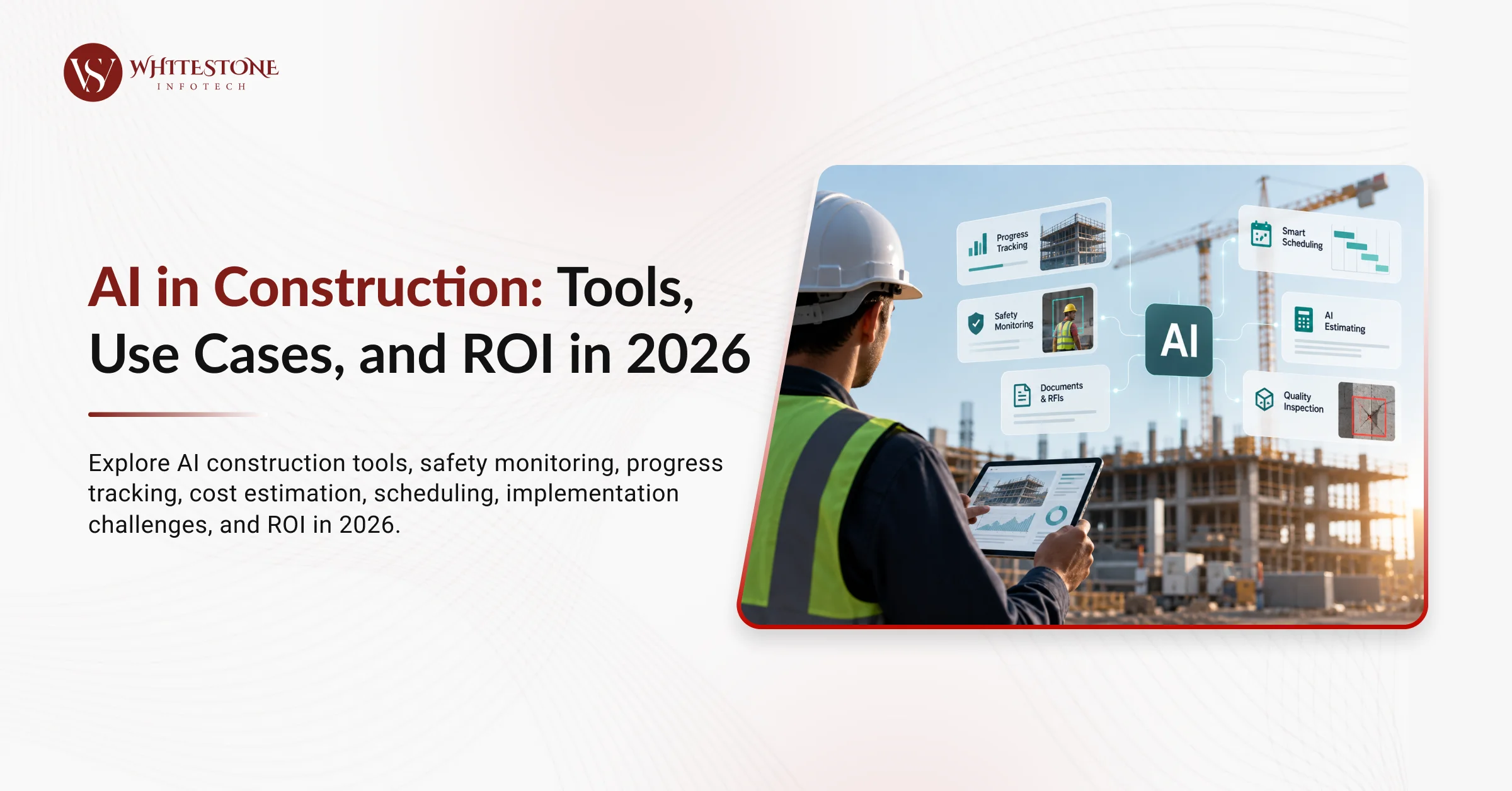

A US commercial construction firm director we spoke to in 2026 was evaluating AI deployment across their 24-project construction portfolio. AI vendors were pitching specific AI progress tracking (Buildots at specific per-project pricing with specific computer vision progress analysis), specific AI safety and PPE detection (specific vendor at specific per-project pricing), specific generative AI for documents and RFIs (OpenAI GPT plus construction-specialist generative AI at specific usage pricing), specific AI scheduling (specific vendor), specific AI estimating (specific vendor). Combined pitched investment was $420k year one across the 24-project portfolio.
The honest ai in construction operations analysis for the director's 24-project portfolio told a specific story. AI progress tracking (Buildots, OpenSpace, DroneDeploy): 2026 evidence suggests measurable progress tracking automation particularly for specific project phases with specific site photo frequency; established vendors (Buildots, OpenSpace, DroneDeploy) deliver production-grade progress automation; universal AI progress tracking across all 24 projects may deliver lower per-project ROI than scoped AI progress tracking on specific larger projects. AI safety and PPE detection: specific safety compliance monitoring delivers measurable improvement but specific HITL critical because safety decisions have specific consequences. Generative AI for documents and RFIs: measurable document productivity with human review for brand voice and specific accuracy; universal generative AI without human review damages specific stakeholder relationships. AI scheduling: specific optimisation delivers measurable value with specific construction platform integration (Procore in this case); scheduling AI without Procore integration delivers limited value.
Revised scope decision: scoped construction AI deployment matched to specific use cases with HITL and Procore integration. AI progress tracking (Buildots on 8 larger projects at specific per-project pricing, scoped for specific project phases with specific site photo frequency delivering measurable progress automation). AI safety and PPE detection (specific vendor on all 24 projects with HITL review workflow for specific safety alerts). Generative AI for documents and RFIs (OpenAI GPT models for RFI response drafts and document drafting with specific human review workflow). AI scheduling (specific AI scheduling with Procore integration for specific optimisation across 24 projects). AI estimating: deferred (specific estimating team preferred specific manual approach for 2026, revisit 2027). Total: typically $185k year one plus specific ongoing including specific vendor subscriptions plus specific implementation plus specific HITL design.
Twelve months after scoped construction AI deployment, outcomes were measurable. AI progress tracking at 8 larger projects: specific progress tracking automation delivered 50-70 percent reduction in specific manual progress tracking time; specific project schedule accuracy improved through specific earlier identification of specific delays. AI safety and PPE detection across all 24 projects: specific safety compliance incidents reduced 35 percent through specific earlier detection of specific PPE non-compliance and specific unsafe conditions; HITL review workflow prevented specific false positive alert fatigue. Generative AI for documents and RFIs: specific RFI response time reduced from 48 hours to 12 hours average with specific human review maintaining response quality; specific document productivity delivered specific team time savings. AI scheduling with Procore integration: specific scheduling optimisation delivered specific project duration reduction on specific scheduled-constrained projects. Portfolio scaled from 24 to 32 projects (33 percent growth) using same operational team plus one additional operational staff.
The director's reflection: "AI in construction operations in 2026 delivers practical wins for specific scoped use cases with HITL and construction platform integration. Universal AI transformation chasing 2023-2024 vendor promises does not. The lesson I would give any construction firm director: scope AI deployment to specific use cases where measurable ROI justifies specific vendor investment (AI progress tracking Buildots/OpenSpace/DroneDeploy on larger projects, AI safety and PPE detection with HITL across projects, generative AI for documents and RFIs with human review, AI scheduling with construction platform integration). HITL critical for safety-critical and financially-material scenarios. Construction platform integration (Procore, Autodesk Construction Cloud, Trimble, specific other) critical for operational value."
That is the ai in construction operations 2026 conversation across US commercial construction, UK construction, international construction firms. AI deployment consolidated around specific use cases delivering practical wins with HITL and construction platform integration.
Transparency note: WhiteStone has not shipped construction AI as primary offering. Our proof points are adjacent: TrackVid Auto Claim HITL deployment per our enterprise AI piece referenced below (confidence threshold 0.92, human handoff below threshold, 2.4x throughput improvement with human quality maintained, HITL design principles directly transfer to construction AI). Broader AI deployment experience across 50-plus product portfolio. Construction firms scoping AI deployment can benefit from our adjacent AI deployment experience plus scoped-use-case framework matching construction AI to HITL and construction platform integration.
This article is a candid guide for US and UK construction firm directors, project managers, superintendents, safety managers, and construction technology leaders scoping ai in construction operations in 2026. Construction AI use cases with practical wins. 2026 vendor landscape. HITL design patterns. Construction platform integration patterns. Honest cost and timeline bands.
Construction AI Use Cases With 2026 Practical Wins
AI progress tracking. Specific site photo analysis for progress automation. Specific drone imagery analysis. Specific 360 photo analysis. 2026 vendors: Buildots (AI progress tracking with computer vision), OpenSpace (AI 360 photos with specific site documentation), DroneDeploy (construction drone imagery with specific progress analysis), specific other. 2026 practical win: 50-70 percent reduction in specific manual progress tracking time.
AI safety and PPE detection. Specific computer vision for safety compliance monitoring (PPE detection, specific unsafe condition detection, specific other). 2026 vendors: specific AI safety vendors with specific computer vision for construction. 2026 practical win: typical 25-45 percent reduction in safety incidents through earlier detection with HITL review.
Generative AI for documents and RFIs. Specific document drafting (RFI responses, submittals, specific other construction documents). Specific document review. 2026 approach: OpenAI GPT models (GPT-4, GPT-5), Anthropic Claude, specific construction-specialist generative AI with specific construction document training. Human review critical for brand voice and accuracy. 2026 practical win: typical 60-80 percent reduction in document drafting time with human review maintaining quality.
AI scheduling. Specific schedule optimisation and specific schedule risk analysis. 2026 vendors: specific AI scheduling platforms plus general scheduling tools (Primavera P6, Microsoft Project, specific other) with AI capability. 2026 practical win: specific schedule optimisation delivering specific project duration reduction on specific scheduled-constrained projects.
AI estimating. Specific quantity takeoff automation and specific cost estimation. 2026 vendors: specific AI estimating platforms. 2026 practical win: specific takeoff automation delivering specific estimating team productivity.
AI quality control. Specific defect detection and specific inspection automation. 2026 vendors: specific AI quality control platforms.
AI design review. Specific BIM (Building Information Modeling) analysis and specific clash detection. 2026 vendors: Autodesk Construction Cloud with AI, specific other BIM AI capabilities.
AI equipment monitoring. Specific IIoT-based equipment tracking per our IIoT piece. Specific equipment performance analysis.
Use cases where construction AI typically does NOT deliver measurable wins in 2026.
Specific complex judgment scenarios (specific stakeholder negotiation, specific contract judgment, specific other complex scenarios).
Specific trust-sensitive stakeholder communication (specific owner relationship management, specific client communication).
Specific nuanced estimating requiring specific experience (specific unique projects, specific complex scopes).
Universal AI transformation chasing full automation without HITL.
2026 Construction AI Vendor Landscape
Construction Platforms With AI
Procore: Dominant US construction management platform with AI capabilities added. Specific AI capability across Procore ecosystem.
Autodesk Construction Cloud: Autodesk's construction platform with AI capabilities including specific BIM AI, specific other.
Trimble: Construction platform with AI capabilities including specific scheduling AI.
Specific other construction platforms adding AI: various.
AI Progress Tracking
Buildots: Established AI progress tracking with specific computer vision. 2026 growing adoption.
OpenSpace: AI 360 photos with specific site documentation. 2026 established adoption.
DroneDeploy: Construction drone imagery with specific progress analysis.
Specific other AI progress tracking: various emerging specialists.
AI Safety and PPE Detection
Specific AI safety vendors: various including specific computer vision for construction safety.
General computer vision for construction: including custom computer vision deployments.
Generative AI for Construction
OpenAI GPT models (GPT-4, GPT-5): Generative AI for construction documents and RFIs.
Anthropic Claude: Generative AI for construction documents and RFIs.
Specific construction-specialist generative AI: specific generative AI trained on construction documents.
AI Estimating
Specific AI estimating platforms: various including specific quantity takeoff automation specialists.
AI Scheduling
Specific AI scheduling platforms: various.
General scheduling with AI: Primavera P6 with AI capability, Microsoft Project with AI, specific other.
Vendor selection factors 2026.
Specific use case match (progress tracking, safety, documents, scheduling, estimating).
Construction firm scope and project portfolio size.
Existing construction platform integration (Procore, Autodesk Construction Cloud, Trimble, specific other).
Specific HITL design capability.
Specific site infrastructure (specific camera deployment for progress tracking, specific other).
Specific pricing model (per-project, per-month subscription, specific other).
Per McKinsey 2026 construction AI research and Gartner 2026 construction technology analysis, 2026 construction AI landscape has consolidated around specific use cases where measurable practical wins justify investment, with 2026 vendor landscape across construction platforms with AI (Procore, Autodesk Construction Cloud, Trimble), AI progress tracking (Buildots, OpenSpace, DroneDeploy), AI safety and PPE detection, generative AI (OpenAI, Anthropic, construction specialists), AI estimating, AI scheduling delivering specific use case capability plus HITL design requirements.
Human-in-the-Loop (HITL) Design for Construction AI
Why HITL is critical for construction AI. Construction decisions have specific safety consequences (specific worker safety, specific site safety) and specific financial consequences (specific project cost, specific schedule, specific liability). AI output without human review in safety-critical or financially-material scenarios creates specific risk.
HITL design patterns.
Confidence threshold tuning per use case. Specific threshold for progress tracking (typically lower automated acceptance with human verification), specific threshold for safety alerts (typically high confidence with specific escalation workflow), specific threshold for document generation (typically high confidence with human review).
Human review for safety-critical scenarios. All AI safety alerts reviewed by human safety manager; AI as detection aid, human as decision maker.
Human review for financially-material scenarios. AI-generated estimates, specific AI-generated schedules, specific other financially-material AI output reviewed by human before specific commitments.
Human expert judgment for specific nuanced scenarios. Specific unique projects, specific complex scopes, specific stakeholder judgment scenarios require human expertise.
HITL pattern from TrackVid Auto Claim deployment. TrackVid Auto Claim per our human-in-the-loop enterprise AI piece: confidence threshold 0.92, human handoff below threshold, 2.4x throughput improvement with human quality maintained. HITL design principles directly transfer to construction AI: confidence threshold tuning per use case, human review for safety-critical and financially-material scenarios, specific escalation workflow.
Construction Platform Integration Context
Why construction platform integration is critical. Standalone construction AI without construction platform integration delivers limited value because specific project context (schedule, documents, stakeholders, financials) requires construction platform integration.
2026 construction platform landscape. Procore (dominant US construction management), Autodesk Construction Cloud (Autodesk's construction platform), Trimble construction, specific other construction platforms.
Construction platform AI integration capability. Established construction platforms typically have specific AI integration capability including specific AI capability within platform and specific partner AI integration patterns.
Pattern. Construction firm AI deployment typically starts with specific use case AI integrated with existing construction platform; broader AI programme follows from specific platform integration patterns.
Honest 2026 Construction AI Cost Bands
Use case / scope | Typical cost | Notes |
AI progress tracking (Buildots, OpenSpace, DroneDeploy) per project | 500-5000 per month per project | depends on project size and scope |
AI safety and PPE detection per project | 300-3000 per month per project | depends on site complexity |
Generative AI for documents (OpenAI GPT, Anthropic Claude) | pay-per-usage LLM pricing | typically 500-5000 per month per firm depending on usage |
AI scheduling | 500-5000 per month per firm | depends on scheduling scope |
AI estimating | 500-5000 per month per firm | depends on estimating scope |
Enterprise construction AI programme | 50k-500k year one | combined use cases plus implementation plus HITL design |
Combined year one construction AI cost for mid-sized construction firm (24-project portfolio case). Typically 75k-300k year one combining specific use case AI tools plus construction platform integration plus HITL design plus implementation. 24-project portfolio case: scoped construction AI deployment at $185k year one delivered 33 percent portfolio growth with specific per-project operational improvements.
ROI timeline realism. Scoped use case AI deployment with HITL and construction platform integration: typically 6-18 months to measurable ROI. Enterprise construction AI programme: typically 12-24 months.
Common Failure Modes
Universal AI transformation without scoping. Construction firm pursues universal AI transformation. Pattern of over-ambition; agent adoption friction; vendor-promised outcomes not delivered. Fix: scoped use case focus with practical wins framework.
AI without HITL for safety-critical scenarios. AI safety alerts handled without human review. Specific safety consequences from false positives (alert fatigue) and false negatives (missed hazards). Fix: HITL for all AI safety alerts.
Standalone AI without construction platform integration. Construction AI deployed without integration with existing construction platform (Procore, Autodesk Construction Cloud, Trimble). Specific project context missing. Fix: construction platform integration from inception.
Universal AI progress tracking across all projects. AI progress tracking deployed universally across projects regardless of project size. Specific per-project ROI varies substantially. Fix: scoped AI progress tracking on specific larger projects where specific per-project ROI justifies specific per-project cost.
Generative AI documents without human review. AI-generated construction documents published without human review. Specific brand voice drift and specific accuracy issues. Fix: human review step mandatory.
AI estimating treated as replacement for estimator expertise. AI estimating output accepted without estimator review. Specific estimating errors on specific nuanced projects. Fix: AI estimating as estimator productivity tool; estimator expertise for specific nuanced scenarios.
Underestimating site infrastructure requirements. AI progress tracking deployment underestimates specific site camera or specific drone imagery infrastructure requirements. Specific deployment delays. Fix: site infrastructure scoped and resourced from inception.
Vendor promise exceeds 2026 reality. Vendor promises specific transformation metrics; 2026 realistic range typically lower. Fix: realistic ROI expectation; pilot validates specific metrics.
Underestimating ongoing operational cost. Construction AI requires ongoing operational investment (platform licensing, specific tuning, HITL human review capacity). Fix: realistic ongoing cost planning.
Vendor concentration risk. Dependence on single AI vendor without contingency. Fix: vendor due diligence; data export; contingency planning.
What We Have Learned From Adjacent AI Deployment Experience
WhiteStone has not shipped construction AI as primary offering. We have adjacent AI deployment experience through TrackVid Auto Claim HITL deployment per our enterprise AI piece referenced above, broader AI deployment across 50-plus product portfolio including specific IIoT engagements per our IIoT piece. Three lessons transfer to construction firms scoping AI deployment.
TrackVid Auto Claim HITL deployment demonstrates confidence threshold tuning transferable to construction AI. TrackVid Auto Claim: confidence threshold 0.92, human handoff below threshold, 2.4x throughput improvement with human quality maintained. HITL design principles directly transfer to construction AI particularly for safety-critical and financially-material scenarios.
IIoT deployment patterns from our IIoT piece transfer to construction AI equipment monitoring. IIoT equipment monitoring patterns per our IIoT piece transfer directly to construction AI equipment monitoring: specific IIoT sensor deployment, specific data collection, specific analytics, specific HITL alerting. Pattern: construction AI equipment monitoring builds on established IIoT patterns.
Honest 2026 reality: AI works for specific scoped construction use cases with HITL and construction platform integration; universal transformation chasing 2023-2024 vendor promises typically does not deliver. Pattern: scoped use case focus with established vendors (Buildots, OpenSpace, DroneDeploy, Procore AI, Autodesk Construction Cloud AI, Trimble, generative AI with OpenAI/Anthropic) plus HITL plus construction platform integration delivers measurable construction operations ROI.
See our portfolio of shipped work for adjacent AI deployment case studies. For a scoped ai in construction operations readiness assessment, book a construction AI advisory call with WhiteStone.
Frequently Asked Questions
What is AI in construction operations and what has delivered practical wins in 2026?
AI in construction operations 2026 covers specific use cases: AI progress tracking (Buildots, OpenSpace, DroneDeploy), AI safety and PPE detection, generative AI for documents and RFIs (OpenAI GPT, Anthropic Claude), AI scheduling, AI estimating, AI quality control, AI design review, AI equipment monitoring. 2026 practical wins: 50-70 percent reduction in progress tracking time, 25-45 percent reduction in safety incidents through earlier detection with HITL, 60-80 percent reduction in document drafting time with human review maintaining quality, specific schedule optimisation. What remains hard: complex judgment scenarios, trust-sensitive stakeholder communication, nuanced estimating requiring experience.
Which construction AI vendors should construction firms evaluate in 2026?
Construction platforms with AI: Procore (dominant US construction management with AI), Autodesk Construction Cloud (BIM AI), Trimble construction AI. AI progress tracking: Buildots (computer vision), OpenSpace (360 photos), DroneDeploy (drone imagery). AI safety and PPE detection: specific AI safety vendors with computer vision for construction. Generative AI: OpenAI GPT models, Anthropic Claude, specific construction-specialist generative AI. AI estimating and scheduling: specific AI platforms plus general tools with AI. Choice depends on use case, firm scope, construction platform integration, HITL design, pricing.
How does AI progress tracking (Buildots, OpenSpace, DroneDeploy) work in 2026?
AI progress tracking 2026: specific site photo analysis for progress automation. Buildots uses computer vision analysing specific interior site photos; OpenSpace uses 360 photos with specific site documentation; DroneDeploy uses construction drone imagery with progress analysis. Pattern: regular site photo or drone imagery collection, AI analysis identifying progress against schedule, specific exception reporting for schedule deviations. 2026 practical win: 50-70 percent reduction in manual progress tracking time; specific earlier identification of delays.
What is the state of AI safety and PPE detection in construction 2026?
AI safety and PPE detection 2026: specific computer vision for safety compliance monitoring including PPE detection (hardhat, high-visibility vest, safety glasses, specific other PPE), specific unsafe condition detection, specific other safety monitoring. Vendors include specific AI safety specialists with computer vision for construction. 2026 practical win: typical 25-45 percent reduction in safety incidents through earlier detection. HITL critical: AI as detection aid; human safety manager as decision maker; specific escalation workflow.
How does generative AI change construction document and RFI workflow?
Generative AI (OpenAI GPT models, Anthropic Claude, specific construction-specialist generative AI) delivers document drafting including RFI responses, submittals, specific other construction documents. Pattern: AI generates initial draft; human reviews for brand voice and accuracy; specific document goes through standard review workflow. 2026 practical win: typical 60-80 percent reduction in document drafting time with human review maintaining quality. Human review critical: universal generative AI without human review damages stakeholder relationships.
Should construction firms deploy AI scheduling in 2026?
AI scheduling suitable for construction firms with specific schedule complexity where specific schedule optimisation delivers measurable value. 2026 vendors: specific AI scheduling platforms plus general scheduling (Primavera P6, Microsoft Project) with AI capability. Construction platform integration (Procore, Autodesk Construction Cloud, Trimble) critical for AI scheduling to incorporate specific project context. HITL critical: AI schedule optimisation as recommendation; human project manager as decision maker.
What AI estimating capabilities exist for construction in 2026?
AI estimating 2026: specific quantity takeoff automation and specific cost estimation. Vendors: specific AI estimating platforms. Pattern: AI delivers initial takeoff from drawings; human estimator reviews and refines. 2026 practical win: specific takeoff automation delivering specific estimating team productivity. HITL critical: AI as estimator productivity tool; estimator expertise for specific nuanced scenarios including specific unique projects and specific complex scopes.
How much does AI deployment cost for construction firms in 2026?
AI progress tracking per project: 500-5000 per month. AI safety and PPE detection per project: 300-3000 per month. Generative AI pay-per-usage typically 500-5000 per month per firm. AI scheduling: 500-5000 per month per firm. AI estimating: 500-5000 per month per firm. Enterprise construction AI programme: 50k-500k year one. 24-project portfolio case: scoped construction AI deployment at $185k year one delivered 33 percent portfolio growth.
Why choose WhiteStone Infotech for construction AI advisory?
Transparency note: WhiteStone has not shipped construction AI as primary offering. Our proof points are adjacent: TrackVid Auto Claim HITL deployment per enterprise AI piece (confidence threshold 0.92, 2.4x throughput improvement, HITL design directly transfers to construction AI particularly for safety-critical and financially-material scenarios); broader AI deployment across 50-plus product portfolio including IIoT engagements. US construction firm director case: scoped construction AI deployment (AI progress tracking Buildots on 8 larger projects + AI safety across 24 projects + generative AI for RFIs + AI scheduling with Procore integration) at $185k year one delivered 33 percent portfolio growth vs $420k universal pitch.
Construction firms can benefit from our adjacent AI deployment experience plus scoped-use-case framework. Contact WhiteStone Infotech at whitestoneinfotech.com/contact.
The One Thing to Remember
AI in construction operations in 2026 delivers practical wins for specific scoped use cases: AI progress tracking (Buildots computer vision, OpenSpace 360 photos, DroneDeploy drone imagery delivering 50-70 percent progress tracking time reduction), AI safety and PPE detection with HITL (25-45 percent safety incident reduction through earlier detection), generative AI for documents and RFIs with human review (60-80 percent document drafting time reduction), AI scheduling with construction platform integration (specific schedule optimisation), AI estimating as estimator productivity tool. 2026 vendor landscape: construction platforms with AI (Procore, Autodesk Construction Cloud, Trimble); AI progress tracking (Buildots, OpenSpace, DroneDeploy); AI safety and PPE detection (specific vendors); generative AI (OpenAI GPT, Anthropic Claude, construction specialists); AI estimating and AI scheduling. HITL critical for safety-critical and financially-material scenarios: confidence threshold tuning, human review for safety and financial scenarios, human expert judgment for nuanced scenarios. Construction platform integration critical for operational value. US construction firm director case: scoped AI deployment ($185k year one) delivered 33 percent portfolio growth vs $420k universal pitch. The single decision that determines construction AI ROI: scoped use case focus with HITL and construction platform integration, or universal AI transformation chasing 2023-2024 vendor promises that did not survive to 2026? Scoped use case focus with HITL delivers measurable practical wins.