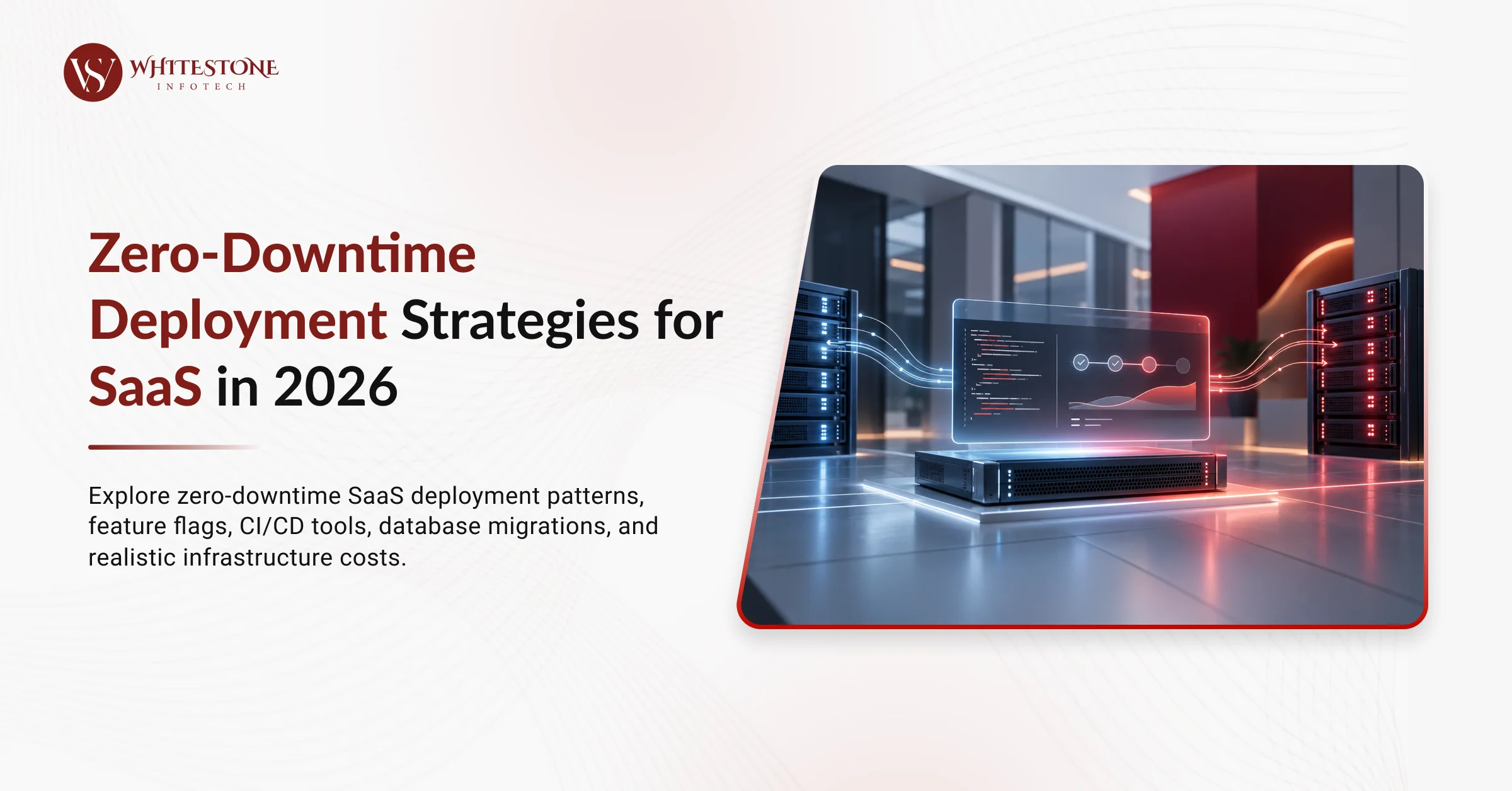
A UK B2B SaaS CTO we worked with scaled their platform from 180 to 420 enterprise customers across 14 months (per our load testing piece referenced below). Deployment frequency increased from monthly release cycles with specific maintenance windows to multiple deployments per week without customer-visible downtime. The deployment infrastructure that supported this transition required specific zero-downtime deployment patterns, specific feature flag platform, specific CI/CD platform, specific container orchestration with specific service mesh, and specific database migration workflow.
The honest zero downtime deployment saas analysis for the CTO's platform transition told a specific story. Previous deployment approach (monthly releases with maintenance windows) was no longer acceptable: enterprise customers with specific SLA commitments required zero customer-visible downtime; deployment frequency required for rapid feature delivery would not fit maintenance window pattern. Zero-downtime deployment required specific deployment patterns (blue-green or canary for application deployment, expand-contract for database migration), specific feature flag platform for decoupling feature release from deployment, specific CI/CD platform for automated deployment, specific container orchestration (Kubernetes) with specific service mesh for traffic management.
Revised scope: zero-downtime deployment infrastructure deployment. Container orchestration (Kubernetes with specific EKS managed service). Service mesh (Linkerd for specific simplicity focus matching their team's preference over Istio complexity). Feature flag platform (LaunchDarkly for specific enterprise feature flagging including specific advanced targeting and specific experimentation). CI/CD platform (GitHub Actions for specific developer workflow fit, with specific Argo CD for Kubernetes-native GitOps continuous deployment). Deployment patterns: canary deployment with specific metrics-based promotion using Linkerd traffic shifting, feature flag decoupling for risky feature releases, blue-green for specific critical paths requiring instant rollback. Database migration: expand-contract pattern with Flyway migration tool.
Twelve months after zero-downtime deployment infrastructure deployment, outcomes were measurable. Deployment frequency increased from monthly to specific multiple-per-week (specific average 15-25 deployments per week across services). Customer-visible downtime from deployments reduced from specific monthly maintenance window hours to zero customer-visible deployment downtime. Deployment-related incidents reduced substantially through specific canary deployment catching specific regressions in canary traffic before full rollout. Feature flag platform enabled specific feature releases decoupled from deployment allowing specific feature rollout to specific customer segments for specific validation before full rollout.
The CTO's reflection: "Zero-downtime deployment for SaaS is 2026 operational discipline requiring specific infrastructure investment (feature flags, Kubernetes with service mesh, CI/CD with GitOps, database migration patterns). Deployment frequency plus customer SLA compliance plus feature rollout risk mitigation justify specific infrastructure investment. The lesson I would give any SaaS CTO: zero-downtime deployment infrastructure is specific capability investment that pays for itself through specific deployment velocity plus specific SLA compliance plus specific feature rollout risk mitigation. Modern platforms (LaunchDarkly or Flagsmith for feature flags, Kubernetes with Linkerd or Istio service mesh, GitHub Actions or GitLab CI with Argo CD for continuous deployment) deliver production-grade capability at reasonable cost."
That is the zero downtime deployment saas 2026 conversation across UK and US SaaS CTOs facing enterprise customer SLA commitments plus rapid deployment velocity requirements. Zero-downtime deployment is 2026 operational discipline requiring specific infrastructure investment matched to specific deployment velocity and specific risk tolerance.
WhiteStone has shipped 50-plus products with specific zero-downtime deployment patterns across UK and US customer contexts. TrackVid continuous deployments with specific zero-downtime patterns for 4000-plus merchants (specific canary deployment, specific feature flagging, specific database migration patterns). CorvixAI production rebuild with specific zero-downtime deployment infrastructure as part of production stack transition. UK B2B SaaS CTO deployments at enterprise scale per the case above and per our load testing piece referenced below. Specific other SaaS deployment engagements across 50-plus product portfolio. The zero-downtime deployment patterns we have shipped transfer directly to any SaaS team scoping deployment infrastructure.
This article is a practitioner guide for SaaS CTOs, engineering leads, SRE leads, and platform engineers scoping zero downtime deployment saas infrastructure in 2026. Deployment patterns. 2026 vendor landscape across feature flags, CI/CD, orchestration, service mesh. Database migration patterns. Honest cost and timeline bands.
Zero-Downtime Deployment Patterns
Blue-green deployment. Specific parallel environment (blue environment running old version, green environment running new version). Deployment: deploy new version to green environment, validate green, switch traffic from blue to green (instant switch via load balancer or DNS). Specific rollback: instant switch back to blue if issue detected. Resource requirements: 2x infrastructure during deployment. Best for: specific critical paths requiring instant rollback capability.
Canary deployment. Specific progressive traffic shift from old to new version. Pattern: deploy new version to small subset of instances (specific canary percentage, typically 5-10 percent), route specific percentage of traffic to canary, monitor specific metrics (error rate, latency, specific business metrics), progressively increase canary percentage if metrics healthy, roll back if metrics unhealthy. Resource requirements: slightly more than 1x infrastructure. Best for: specific risk mitigation through gradual rollout with metrics-based promotion.
Rolling deployment. Specific sequential instance replacement. Pattern: deploy new version to one instance at a time, replace old instance after new instance validated healthy, continue through all instances. Resource requirements: 1x infrastructure (slightly over during transition). Best for: specific resource efficiency with specific gradual rollout.
Feature-flag-based progressive delivery. Specific feature flag enabling specific feature rollout decoupled from deployment. Pattern: deploy code containing new feature behind feature flag (feature off by default); enable feature for specific user segments progressively (percentage-based, specific user attribute-based, specific other targeting). Decouples specific feature release from specific deployment. Best for: specific feature-level rollout control, specific experimentation A/B testing, specific risky feature release risk mitigation.
Shadow deployment. Specific traffic mirroring to new version for specific validation without specific production impact. Pattern: deploy new version alongside old version, mirror specific production traffic to new version, compare specific output or behaviour between versions, validate new version before specific traffic cutover. Best for: specific high-stakes migrations with specific behaviour validation requirement.
Combined patterns. Modern SaaS teams typically combine patterns: canary deployment for application rollout, feature flag decoupling for feature releases, blue-green for critical paths requiring instant rollback, shadow deployment for high-stakes migrations.
2026 Feature Flag Platform Landscape
LaunchDarkly: Dominant enterprise feature flag platform with specific advanced targeting, specific experimentation A/B testing capabilities, specific enterprise feature flagging. Established market position.
Split.io by Harness: Acquired by Harness. Specific experimentation focus with specific statistical rigour.
Unleash: Open source feature flag platform with specific SaaS offering (Unleash Enterprise) and specific self-hosted option.
Flagsmith: Open source feature flag platform with specific SaaS and specific self-hosted.
GrowthBook: Open source feature flag platform with specific experimentation focus.
ConfigCat: Specific configuration management with feature flagging.
Specific other feature flag platforms: various.
Feature flag platform selection factors 2026.
Specific feature flagging requirements (basic toggles vs advanced targeting vs experimentation).
Open source vs commercial preference.
SaaS vs self-hosted preference.
Pricing scaling with usage.
Specific ecosystem integration (specific CI/CD, specific observability).
Specific developer SDK ecosystem.
2026 CI/CD Platform Landscape
GitHub Actions: Native GitHub CI/CD with growing adoption and specific GitHub ecosystem integration.
GitLab CI/CD: Native GitLab CI/CD with specific GitLab ecosystem integration.
CircleCI: Established CI/CD platform with specific SaaS and specific self-hosted.
Jenkins: Open source CI/CD with specific plugin ecosystem.
Argo CD: Kubernetes-native GitOps continuous deployment. CNCF (Cloud Native Computing Foundation) graduated project.
Spinnaker: Multi-cloud continuous deployment originally from Netflix.
Octopus Deploy: CI/CD platform with specific deployment focus.
Specific other CI/CD platforms: various including Buildkite, Drone, specific other.
CI/CD platform selection factors 2026.
Specific developer stack integration (GitHub, GitLab, specific other).
SaaS vs self-hosted preference.
Specific Kubernetes-native GitOps requirement.
Specific multi-cloud requirement.
Pricing scaling with usage.
Specific plugin and extension ecosystem.
Container Orchestration and Service Mesh
Container orchestration. Kubernetes dominant with specific adoption across SaaS. Managed Kubernetes services: AWS EKS, Azure AKS, Google GKE, specific other. Specific Kubernetes alternatives (specific Nomad by HashiCorp, specific Docker Swarm, specific other) have specific niche adoption. 2026 Kubernetes is standard SaaS orchestration platform.
Service mesh. Service mesh adds specific traffic management, specific observability, specific security to Kubernetes. 2026 options:
Istio: Dominant service mesh with specific advanced traffic management and specific extensibility. Complexity typically higher than Linkerd.
Linkerd: Service mesh with specific simplicity focus. CNCF graduated project.
Consul Connect: HashiCorp service mesh with specific HashiCorp ecosystem integration.
AWS App Mesh: AWS native service mesh.
Specific other service mesh: various.
Service mesh for zero-downtime deployment. Service mesh enables specific zero-downtime deployment capabilities including specific traffic routing (specific canary traffic shifting), specific health checking, specific graceful shutdown, specific observability. 2026 Kubernetes with specific service mesh is dominant architecture for zero-downtime deployment at scale.
Per AWS 2026 SaaS deployment guidance and Gartner 2026 continuous delivery analysis, 2026 zero-downtime deployment for SaaS has consolidated around specific deployment patterns (blue-green, canary, rolling, feature-flag-based progressive delivery, shadow deployment), feature flag platforms (LaunchDarkly, Split.io, Unleash, Flagsmith, GrowthBook, ConfigCat), CI/CD platforms (GitHub Actions, GitLab, CircleCI, Jenkins, Argo CD, Spinnaker), Kubernetes with service mesh (Istio, Linkerd, Consul Connect), database migration patterns delivering specific zero-downtime deployment capability.
Database Migration Zero-Downtime
Expand-contract pattern. Standard database migration zero-downtime pattern.
Expand: add new schema compatible with old code (new columns, new tables, specific other additive changes).
Deploy new code supporting both old and new schemas.
Migrate data from old schema to new schema (specific background migration workers).
Contract: remove old schema after specific validation that no code references old schema.
Database migration tools. Flyway (specific established migration tool), Liquibase (specific established), specific other including specific ORM-native migration tools (specific Prisma migrations, specific other). 2026 pattern: specific migration tool integrated with specific CI/CD for specific automated migration workflow.
Database replication patterns. Specific primary-replica replication for specific read scalability. Specific multi-primary replication for specific availability. Specific database-specific zero-downtime capabilities (specific PostgreSQL logical replication, specific MySQL replication, specific other).
Database migration complexity. Database migration zero-downtime is specific complex capability requiring specific planning beyond application deployment patterns. Specific failure modes include specific long-running migration locks, specific data integrity issues during migration, specific application compatibility issues across migration phases.
Honest 2026 Zero-Downtime Deployment Infrastructure Cost Bands
Infrastructure component | Typical cost | Notes |
Kubernetes managed service (EKS, AKS, GKE) | typically scales with cluster size | per-cluster pricing plus compute |
Service mesh (Istio open source, Linkerd open source, Consul Connect) | typically free licensing | infrastructure cost |
LaunchDarkly (commercial feature flag) | typically 5k-100k+ year one | depends on scale |
Split.io (commercial feature flag) | typically scales with scale | depends on scale |
Unleash SaaS | typically 0-5k+ year one | free tier plus SaaS pricing |
Flagsmith SaaS | typically 0-5k+ year one | free tier plus SaaS pricing |
GitHub Actions | typically included in GitHub subscription plus usage pricing | GitHub plan dependent |
GitLab CI/CD | typically included in GitLab subscription plus usage pricing | GitLab plan dependent |
CircleCI | typically 0-20k+ year one | free tier plus pricing |
Argo CD (open source) | typically free licensing | infrastructure cost |
Spinnaker (open source) | typically free licensing | infrastructure cost |
Database migration tools (Flyway, Liquibase) | typically free open source | commercial support available |
Combined year one zero-downtime deployment infrastructure cost for mid-sized SaaS. Typically £20k-£150k year one combining Kubernetes managed service plus service mesh plus feature flag platform plus CI/CD platform plus database migration tools plus engineering time. Enterprise SaaS with substantial requirements £50k-£500k+.
Specific engineering time cost. Zero-downtime deployment infrastructure requires substantial engineering time (specific infrastructure setup, specific deployment pipeline development, specific feature flag integration, specific database migration workflow). Engineering time typically dominates platform licensing cost.
Common Failure Modes
Deployment pattern without database migration consideration. Application deployment pattern (blue-green, canary) deployed without specific database migration pattern. Specific database schema mismatch during deployment. Fix: expand-contract database migration pattern integrated with application deployment.
Feature flag platform without governance. Feature flags proliferate without specific governance (specific flag lifecycle, specific flag cleanup, specific flag ownership). Specific technical debt accumulates. Fix: feature flag governance from inception (specific flag lifecycle, specific cleanup process, specific ownership).
Canary deployment without specific metrics-based promotion. Canary deployment deployed without specific metrics-based promotion criteria. Specific manual promotion decision becomes bottleneck. Fix: specific metrics-based promotion with specific criteria (error rate threshold, latency threshold, specific business metrics).
Service mesh adopted without specific need. Service mesh (Istio) adopted for simple SaaS without specific advanced traffic management need. Specific complexity burden exceeds specific benefit. Fix: service mesh adoption matched to specific needs (Linkerd for simplicity, Istio for advanced requirements).
CI/CD without specific GitOps for Kubernetes. Kubernetes deployments without specific GitOps (Argo CD) workflow. Specific drift between Git state and cluster state. Fix: GitOps workflow with Argo CD or specific other for Kubernetes.
Blue-green deployment without specific database compatibility. Blue-green deployment deployed without specific database schema compatibility across versions. Specific schema mismatch during traffic switch. Fix: expand-contract database migration ensuring specific schema compatibility across old and new versions.
Database migration during peak traffic. Database migration run during peak traffic causing specific lock contention or specific performance degradation. Fix: specific migration scheduling during specific low-traffic periods.
Rollback capability untested. Zero-downtime deployment pattern deployed without specific rollback capability testing. Specific rollback fails when needed. Fix: specific rollback capability tested in specific disaster recovery exercises.
Underestimating service mesh complexity. Istio adoption underestimates specific operational complexity. Specific operational burden exceeds specific team capability. Fix: Linkerd for simpler scenarios or specific gradual Istio adoption with specific operational expertise.
Underestimating engineering time cost. SaaS team expects zero-downtime deployment platform to deliver value without substantial engineering time investment. Fix: realistic engineering time planning for specific infrastructure setup, pipeline development, migration workflow.
What We Have Learned Shipping 50-Plus Products With Zero-Downtime Deployment
WhiteStone has shipped 50-plus products with specific zero-downtime deployment patterns across UK and US customer contexts. Three lessons transfer to any SaaS team scoping zero-downtime deployment infrastructure.
TrackVid continuous deployments for 4000-plus merchants demonstrate zero-downtime patterns at scale. TrackVid continuous deployment infrastructure supports specific zero-downtime patterns (canary deployment, feature flagging, database migration patterns) for 4000-plus merchants with specific zero customer-visible deployment downtime. Pattern: zero-downtime deployment patterns transfer across specific product scales.
CorvixAI production rebuild included zero-downtime deployment infrastructure as part of production stack transition. CorvixAI Lovable to production rebuild (per our enterprise AI piece) included specific zero-downtime deployment infrastructure matching production requirements. Pattern: zero-downtime deployment is specific production stack capability that specific product rebuilds deliver when specific tools (Lovable, specific other) hit specific production constraints.
UK B2B SaaS CTO case demonstrates zero-downtime deployment infrastructure enabling specific deployment velocity plus specific SLA compliance. UK B2B SaaS CTO case (per our load testing piece): zero-downtime deployment infrastructure (Kubernetes with Linkerd + LaunchDarkly + GitHub Actions with Argo CD + Flyway for database migration) delivered specific 15-25 deployments per week with specific zero customer-visible deployment downtime supporting specific 180 to 420 enterprise customer scaling. Pattern: zero-downtime deployment infrastructure enables specific business outcomes including specific deployment velocity, specific SLA compliance, specific feature rollout risk mitigation.
See our portfolio of shipped work for 50-plus products shipped with specific zero-downtime deployment patterns. For a scoped zero downtime deployment saas infrastructure readiness assessment, book a SaaS deployment advisory call with WhiteStone.
Frequently Asked Questions
What is zero-downtime deployment and why does SaaS need it in 2026?
Zero-downtime deployment is deployment approach delivering specific application updates without specific customer-visible downtime. Required for 2026 SaaS because enterprise customers with specific SLA commitments require zero customer-visible deployment downtime; deployment frequency for rapid feature delivery requires zero-downtime patterns incompatible with maintenance window approach. Zero-downtime deployment combines specific deployment patterns (blue-green, canary, rolling, feature-flag-based progressive delivery), specific infrastructure (Kubernetes with service mesh), specific feature flag platform, specific CI/CD platform, specific database migration patterns.
What are the main zero-downtime deployment patterns in 2026 (blue-green, canary, rolling)?
Blue-green: parallel environment with instant traffic switch; 2x infrastructure during deployment; instant rollback. Canary: progressive traffic shift with metrics-based promotion; slightly more than 1x infrastructure; risk mitigation through gradual rollout. Rolling: sequential instance replacement; 1x infrastructure; resource efficiency. Feature-flag-based progressive delivery: feature flag decoupling feature rollout from deployment; feature-level rollout control. Shadow deployment: traffic mirroring to new version for validation without production impact. Modern SaaS teams typically combine patterns.
Which feature flag platforms should SaaS teams evaluate in 2026 (LaunchDarkly, Split.io, Unleash, Flagsmith)?
LaunchDarkly (dominant enterprise with advanced targeting and experimentation), Split.io by Harness (experimentation focus), Unleash (open source with SaaS and self-hosted), Flagsmith (open source with SaaS and self-hosted), GrowthBook (open source experimentation focus), ConfigCat (configuration management with feature flagging). Choice depends on feature flagging requirements (basic toggles vs advanced targeting vs experimentation), open source vs commercial preference, SaaS vs self-hosted, pricing, ecosystem integration, developer SDK ecosystem.
How does zero-downtime database migration work in 2026?
Expand-contract pattern 2026 standard: expand (add new schema compatible with old code, additive changes); deploy new code supporting both old and new schemas; migrate data from old schema to new schema (background migration workers); contract (remove old schema after validation no code references it). Database migration tools (Flyway, Liquibase, specific ORM-native) integrated with CI/CD for automated migration workflow. Database replication patterns (primary-replica, multi-primary) support specific zero-downtime scenarios. Complex capability requiring planning beyond application deployment patterns.
Should SaaS teams use service mesh (Istio, Linkerd, Consul Connect) for zero-downtime deployment?
Service mesh adds specific traffic management, observability, security to Kubernetes supporting zero-downtime deployment capabilities (traffic routing for canary, health checking, graceful shutdown). 2026 options: Istio (dominant with advanced traffic management, complexity higher), Linkerd (simplicity focus, CNCF graduated), Consul Connect (HashiCorp ecosystem), AWS App Mesh (AWS native). Service mesh adoption matched to needs: Linkerd for simplicity, Istio for advanced requirements. Service mesh adopted without specific need adds unnecessary complexity.
What CI/CD platforms support zero-downtime deployment in 2026?
GitHub Actions (native GitHub with growing adoption), GitLab CI/CD (native GitLab), CircleCI (established with SaaS and self-hosted), Jenkins (open source with plugin ecosystem), Argo CD (Kubernetes-native GitOps, CNCF graduated), Spinnaker (multi-cloud CD originally from Netflix), Octopus Deploy (deployment focus). Choice depends on developer stack integration, SaaS vs self-hosted, Kubernetes-native GitOps requirement, multi-cloud requirement, pricing. For Kubernetes zero-downtime deployment, Argo CD with specific GitOps workflow is 2026 standard pattern.
How does progressive delivery differ from traditional deployment in 2026?
Progressive delivery decouples specific feature release from specific application deployment through specific feature flagging. Pattern: deploy code containing new feature behind feature flag (feature off by default); enable feature for specific user segments progressively (percentage-based, user attribute-based). Delivers feature-level rollout control, experimentation A/B testing, risky feature release risk mitigation. Traditional deployment combines code deployment with feature release; progressive delivery separates them for independent control.
How much does zero-downtime deployment infrastructure cost for SaaS in 2026?
Open source infrastructure (Kubernetes, Istio or Linkerd, GitHub Actions or GitLab CI, Flagsmith or Unleash self-hosted, Argo CD): free licensing plus infrastructure cost. Commercial feature flag (LaunchDarkly 5k-100k+ year one, Split.io scaling pricing). Commercial CI/CD (CircleCI 0-20k+ year one, Jenkins enterprise). Combined year one mid-sized SaaS £20k-£150k; enterprise £50k-£500k+. Engineering time typically dominates platform licensing cost. UK B2B SaaS CTO case: zero-downtime deployment infrastructure enabled 15-25 deployments per week with zero customer-visible deployment downtime supporting 180 to 420 enterprise customer scaling.
Why choose WhiteStone Infotech for zero downtime deployment saas advisory?
WhiteStone has shipped 50-plus products with specific zero-downtime deployment patterns across UK and US customer contexts. TrackVid continuous deployments for 4000-plus merchants with zero customer-visible deployment downtime. CorvixAI production rebuild including zero-downtime deployment infrastructure. UK B2B SaaS CTO case: zero-downtime deployment infrastructure (Kubernetes with Linkerd + LaunchDarkly + GitHub Actions with Argo CD + Flyway) delivered 15-25 deployments per week with zero customer-visible deployment downtime supporting 180 to 420 enterprise customer scaling. SaaS teams can benefit from our direct deployment infrastructure experience plus scoped-infrastructure framework. Contact WhiteStone Infotech at whitestoneinfotech.com/contact.
The One Thing to Remember
Zero-downtime deployment for SaaS in 2026 is operational discipline for mature SaaS products with enterprise SLA commitments plus rapid deployment velocity requirements. Deployment patterns: blue-green (parallel environment with instant traffic switch, 2x infrastructure, instant rollback), canary (progressive traffic shift with metrics-based promotion, risk mitigation), rolling (sequential instance replacement, resource efficiency), feature-flag-based progressive delivery (feature flag decoupling from deployment, feature-level rollout control), shadow deployment (traffic mirroring for validation). 2026 feature flag platforms: LaunchDarkly dominant enterprise, Split.io by Harness, Unleash open source, Flagsmith open source, GrowthBook open source, ConfigCat. 2026 CI/CD platforms: GitHub Actions, GitLab CI, CircleCI, Jenkins, Argo CD Kubernetes-native GitOps, Spinnaker multi-cloud. Container orchestration: Kubernetes dominant with managed services (EKS, AKS, GKE). Service mesh: Istio advanced, Linkerd simplicity focus, Consul Connect HashiCorp ecosystem. Database migration zero-downtime: expand-contract pattern with migration tools (Flyway, Liquibase). UK B2B SaaS CTO case: zero-downtime deployment infrastructure (Kubernetes with Linkerd + LaunchDarkly + GitHub Actions with Argo CD + Flyway) delivered 15-25 deployments per week with zero customer-visible deployment downtime supporting 180 to 420 enterprise customer scaling (per load testing piece). The single decision that determines SaaS deployment ROI: zero-downtime deployment infrastructure matched to deployment velocity and SLA commitments, or maintenance window approach incompatible with 2026 enterprise customer requirements? Zero-downtime deployment infrastructure delivers measurable deployment velocity plus SLA compliance plus feature rollout risk mitigation.