
A UK insurance group CDO we worked with in 2025 was designing claims triage AI. Initial AI model classified claims by severity (low, medium, high, critical) based on claims text, documents, and policy data with roughly 88 percent accuracy on live production claims data. The initial engineering proposal was deploy AI fully automated with periodic quality monitoring. The CDO rejected this: regulatory requirements for insurance claims decisions required human oversight for high-value and complex claims, and 88 percent accuracy meant 12 percent of claims would be misclassified without any human catch.
The honest HITL design we developed used confidence-based routing with exception rules. Claims with AI confidence above 0.92 and claim value below £5,000 and no exception signals (specific policy types, specific claim circumstances) auto-decided (roughly 55 percent of claims). Claims with AI confidence between 0.75 and 0.92 or claim value between £5,000 and £25,000 routed to standard claims adjuster review with AI prediction visible (roughly 30 percent of claims). Claims with AI confidence below 0.75 or claim value above £25,000 or exception signals routed to senior claims adjuster review (roughly 15 percent of claims). All claims regardless of routing had post-decision random sampling (3 percent sampled for quality monitoring).
Nine months after production go-live, outcomes were measurable. Claims auto-decided at AI confidence above 0.92 had accuracy of 97 percent (adjuster random sampling confirmation). Claims routed to standard adjuster review resulted in adjuster agreement with AI 83 percent of the time (adjuster added value by catching the 17 percent misclassification). Claims routed to senior adjuster review resulted in senior adjuster agreement 76 percent of the time (senior judgement added significant value on complex claims). Overall claims triage throughput increased 2.4x compared to fully manual adjuster processing while regulatory compliance was maintained. Claims adjuster capacity was scaled from reviewing every claim to reviewing roughly 45 percent of claims (confidence-based routing plus random sampling), freeing capacity for complex adjudication rather than routine triage.
The CDO's reflection: "Fully automated would have failed regulatory review and would have generated 12 percent error rate on claims that genuinely needed human judgement. Fully manual would not have scaled. Confidence-based routing with claim-value exceptions delivered 2.4x throughput at better accuracy than either extreme. The lesson for any enterprise AI programme in regulated or high-stakes contexts: do not treat HITL as binary (fully automated or fully manual); design confidence-based routing with exception rules against the specific use case."
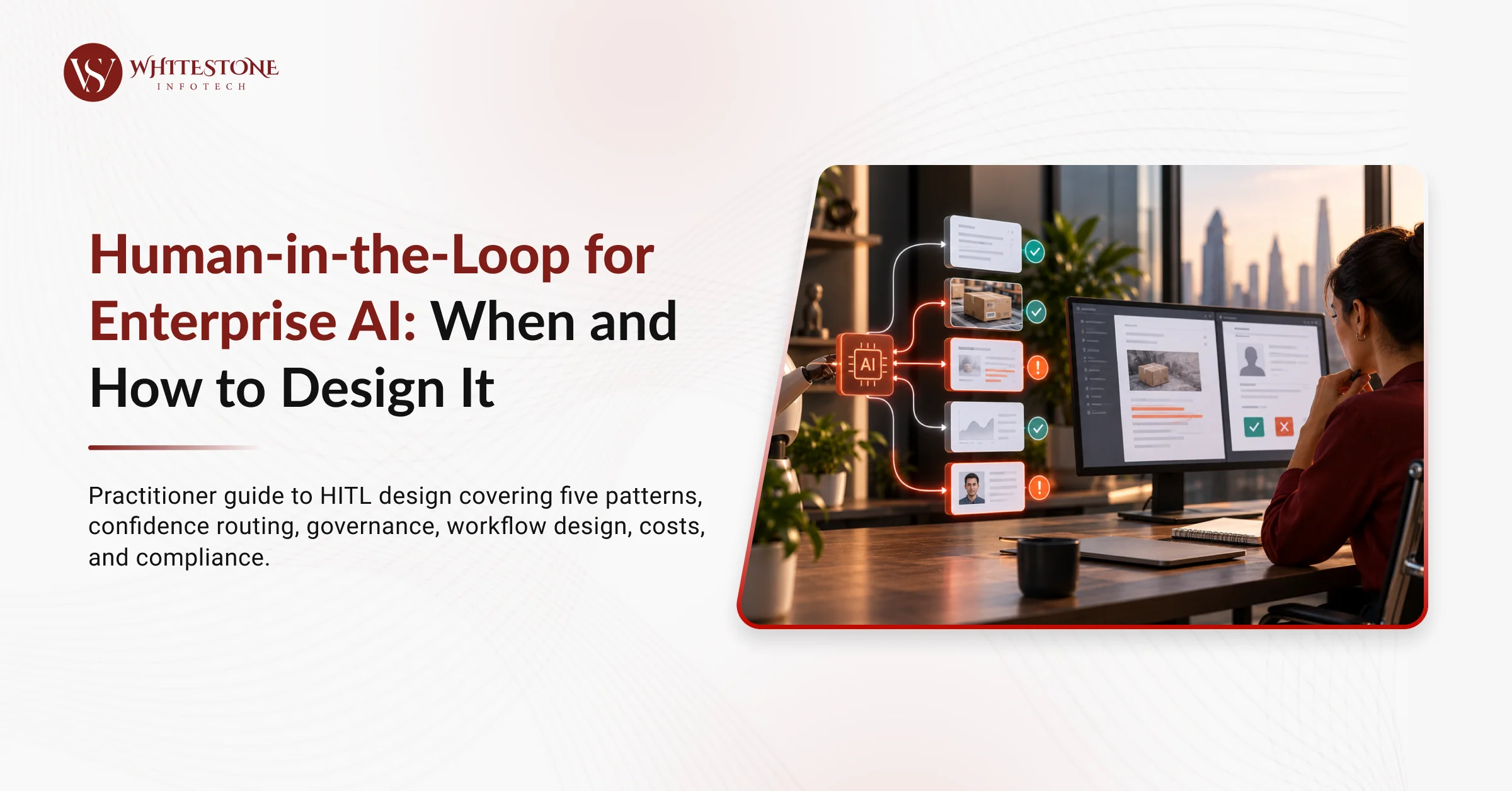
That is the human in the loop enterprise ai 2026 conversation across UK and US enterprises. HITL is not binary; it is design pattern spectrum from pre-decision review (every decision reviewed) through confidence-based routing (uncertain decisions reviewed) through random sampling (quality monitoring) to no HITL (fully automated). Right pattern per use case depends on regulatory requirements, cost of error, AI confidence calibration, reviewer capacity, speed requirements. Enterprise AI programmes in regulated or high-stakes contexts frequently use confidence-based routing with exception rules as the most useful pattern for scaling reviewer capacity.
This article is a practitioner guide for CDOs, chief AI officers, AI product managers, and engineering leaders scoping HITL design for enterprise AI in 2026. The five HITL design patterns. When HITL matters. Confidence-based routing in detail. Workflow design considerations. Governance and compliance. Honest cost impact. Common failure modes. What we have learned shipping AI with HITL design across TrackVid, IELTSArena, and enterprise engagements.
The Five HITL Design Patterns
Pattern 1: Pre-decision review. Human reviews AI prediction before decision executes. AI acts as recommendation engine; human makes the actual decision. Highest oversight pattern. Operational cost: 40-80 percent increase over automated. Fits: regulated decisions where human must make the formal decision (lending credit decisions, medical diagnoses in some jurisdictions, legal determinations), highest-stakes decisions where cost of error is substantial.
Pattern 2: Post-decision review. AI decides, action executes, human reviews afterwards. Faster than pre-decision review; adds oversight without blocking throughput. Operational cost: 20-50 percent increase over automated depending on review intensity. Fits: situations where speed matters but systematic oversight needed (content moderation, moderate-stakes decisions), compliance review for sampled decisions.
Pattern 3: Confidence-based routing. AI confidence above threshold auto-decides; below threshold routes to human. Most useful pattern for scaling reviewer capacity while maintaining oversight on uncertain decisions. Operational cost depends on threshold and confidence distribution; typically 15-30 percent increase over automated. Fits: situations with calibrated AI confidence and scale (dispute triage, claims triage, document classification, scoring, moderation).
Pattern 4: Random sampling. Human reviewers sample subset of AI decisions for quality monitoring. Does not block any decisions; provides ongoing quality signal. Operational cost: 5-15 percent increase over automated depending on sample rate (typically 1-5 percent sampling). Fits: ongoing AI quality monitoring, drift detection, bias monitoring across demographics, regulatory evidence of quality oversight. Should be used alongside other patterns for most enterprise AI.
Pattern 5: Exception-based routing. Specific signals or edge cases route to human regardless of AI confidence. Catches novel scenarios, specific regulatory conditions, bias risk categories. Operational cost: depends on exception rate; typically 5-15 percent increase. Fits: situations where specific scenarios need human attention regardless of AI confidence (specific customer categories, specific transaction types, specific demographic contexts for bias oversight).
Combination in practice. Most enterprise AI with HITL combines patterns. Confidence-based routing as primary scaling pattern, exception-based routing for specific scenarios, random sampling for ongoing quality monitoring. Pre-decision or post-decision review for specific regulatory contexts.
When HITL Matters
Regulated contexts. EU AI Act high-risk classifications require human oversight. UK and US financial services (FCA, PRA, CFPB) require human involvement in significant customer decisions. Healthcare (CQC, FDA, EMA) requires clinical oversight. Insurance claims (FCA, state insurance regulators) require adjuster involvement for significant claims. HITL often not optional in regulated contexts; it is compliance requirement.
High-stakes outcomes. Large financial transactions. Medical diagnoses. Legal determinations. Hiring decisions. Insurance claims decisions. Credit decisions. Content moderation of sensitive categories. Cost of AI error justifies human review cost in these cases.
Uncertain predictions. AI confidence below calibrated threshold indicates the model is uncertain. Routing uncertain predictions to humans adds judgement where AI judgement is weakest.
EU AI Act specifically. Per EU AI Act 2026 high-risk AI requirements, high-risk AI applications (including credit scoring, employment decisions, essential services, law enforcement, migration decisions, education assessments, and certain healthcare) require human oversight as compliance requirement. HITL design is compliance implementation.
Bias risk. Human review catches systematic bias patterns that AI alone misses. Particularly important for AI affecting protected categories (hiring, lending, healthcare).
Novel scenarios. AI was trained on specific distribution. Novel scenarios (new product types, edge-case customer situations, unprecedented conditions) warrant human review.
When HITL is NOT needed. Low-stakes repetitive decisions with reliable AI confidence (standard transaction classification, routine data entry categorisation, standard email routing). Decisions where cost of error is low and speed matters. Internal operational decisions with no external impact. HITL cost is not justified in these contexts.
Per NIST AI Risk Management Framework 2026 guidance, human oversight design is one of the core AI risk management functions; HITL is the operational implementation of human oversight requirements across regulated and high-stakes AI applications.
Confidence-Based Routing in Detail
Confidence-based routing is the most useful HITL pattern for scaling enterprise AI.
How it works. AI makes prediction with confidence score. Confidence above threshold auto-decides; below threshold routes to human reviewer. Threshold is calibrated against operational data.
Calibration process. Run AI on representative sample of production data. Compare AI predictions against human-expert-labelled ground truth. Plot AI confidence against accuracy. Choose threshold that balances automation (higher threshold routes more to human, less automation) against error risk (lower threshold auto-decides more, more AI errors slip through).
Typical thresholds. AI confidence 0.9-0.95 typical for high-stakes decisions. AI confidence 0.75-0.85 typical for medium-stakes. AI confidence 0.6-0.75 for lower-stakes. Threshold varies substantially by AI model and use case.
Threshold adjustment over time. As AI accuracy improves through retraining, threshold can be adjusted. Monitoring AI accuracy at different confidence bands supports threshold tuning.
Reviewer load prediction. Confidence distribution predicts reviewer load. If 70 percent of predictions above threshold and 30 percent below, reviewer handles 30 percent of decisions. Reviewer capacity planning follows from this distribution.
Combining with exception rules. Confidence-based routing combined with exception rules handles both uncertain AI predictions and specific scenario categories. Rules examples: route to human regardless of confidence if transaction above £X, if customer type is specific category, if specific risk signals present.
Observability. Monitor confidence distribution over time (drift indicator). Monitor accuracy at different confidence bands. Monitor reviewer override rate (indicator of threshold calibration quality). Monitor reviewer decision time.
HITL Workflow Design
Workflow design matters as much as pattern selection.
Reviewer UI principles. Present AI prediction clearly. Show AI confidence prominently. Provide relevant context (customer history, transaction details, policy information). Avoid biasing reviewer towards or against AI prediction. Enable reviewer to see supporting evidence and reasoning if AI provides it.
Decision capture. Distinguish between AI confirmation (reviewer agrees with AI), AI override (reviewer disagrees and makes different decision), escalation (reviewer needs expert or senior input). Capture reviewer rationale for overrides (regulatory evidence and AI training feedback).
Audit trail. Record reviewer identity, decision, time, rationale, AI prediction and confidence, context presented. Audit trail enables regulatory engagement and post-decision review.
Override feedback into AI training. Reviewer overrides are high-value training data (human expert disagreed with AI). Feed overrides back into AI training to improve future predictions and confidence calibration.
Reviewer quality monitoring. Inter-reviewer agreement (would different reviewers reach same decision on same case). Override rate per reviewer. Decision time per reviewer. Reviewer quality metrics should be monitored to maintain quality.
Reviewer training. Reviewers need training on AI capability and limitations, decision rubric, when to escalate. Reviewer skill materially affects HITL quality.
Reviewer capacity management. Confidence-based routing predicts reviewer load. Capacity management responds to confidence distribution changes (AI drift increasing uncertain predictions, business volume changes).
Governance and Compliance Considerations
Reviewer accountability. Clear role definitions. Reviewer decisions are formal decisions (particularly in pre-decision review). Audit trail supports accountability.
Decision override logic. When reviewer overrides AI, does override execute immediately or require second reviewer confirmation? Depends on stakes and governance requirements.
Bias monitoring. HITL does not eliminate bias; it moves bias potentially from AI alone to AI plus reviewer. Monitor outcomes across protected categories (demographic groups, geographic regions) to detect bias in AI, in reviewer decisions, or in combination.
Regulatory engagement. HITL design should be documented for regulatory engagement. EU AI Act high-risk classification, FCA supervisory engagement, healthcare compliance all benefit from clear HITL documentation.
Role-based access. Reviewer access to AI predictions and context should be role-based with audit logs. Different reviewer roles (standard, senior, specialist) have different access and authority.
Decision reversibility. Can reviewer decision be reversed if later shown to be wrong? Compliance implications depend on business context.
Honest Cost Impact
HITL adds operational cost compared to fully automated AI.
Pattern 1 pre-decision review. 40-80 percent operational cost increase. Every decision requires reviewer. Highest cost pattern.
Pattern 2 post-decision review. 20-50 percent operational cost increase depending on review intensity.
Pattern 3 confidence-based routing (most common pattern). 15-30 percent operational cost increase typically. Depends on threshold and confidence distribution. At 90 percent threshold with 10-30 percent routed to human, roughly 15-25 percent cost increase.
Pattern 4 random sampling. 5-15 percent operational cost increase depending on sample rate.
Pattern 5 exception-based routing. 5-15 percent operational cost increase depending on exception rate.
Combination costs add. Most enterprise AI uses multiple patterns. Confidence-based routing plus random sampling plus exception rules typically adds 20-40 percent operational cost.
Cost should be weighed against value of HITL. Error cost avoided (reviewer catches 10-20 percent of AI errors). Compliance cost avoided (regulatory engagement without HITL may be substantially more expensive). Bias cost avoided (bias claims and remediation substantially more expensive than HITL cost).
Rule that holds in regulated or high-stakes contexts. HITL operational cost is typically much lower than cost of errors avoided plus cost of compliance failures avoided.
Common Failure Modes
Treating HITL as binary (fully automated or fully manual). Enterprise AI programme adopts either fully automated (regulatory and error risk) or fully manual (does not scale, defeats AI purpose). Fix: five HITL design patterns spectrum, choose and combine per use case.
AI confidence not calibrated for threshold routing. Confidence-based routing requires calibrated AI confidence. If AI outputs are not actual probability but ranking scores, threshold routing does not work predictably. Fix: calibrate AI confidence against operational data before deploying threshold routing.
Not combining patterns. Enterprise AI uses single HITL pattern (just confidence-based or just random sampling) without combining with exception rules or quality monitoring. Gaps emerge. Fix: combine confidence-based routing with exception rules with random sampling as standard default.
Reviewer workflow biases reviewer towards AI. Reviewer UI prominently shows AI prediction before showing context. Reviewers defer to AI (automation bias). Override rate drops not because AI is better but because reviewers defer. Fix: UI design that presents context before AI prediction, or presents AI as one input among many.
Not capturing override reasoning. Reviewer overrides AI without capturing reasoning. Override feedback cannot flow back to AI training. Compliance audit trail incomplete. Fix: reasoning capture required for overrides.
Threshold set once and never adjusted. Confidence-based routing threshold set at deployment and never tuned despite AI retraining and operational data accumulation. Fix: threshold tuning as ongoing operational activity.
Ignoring reviewer quality. Reviewer workflow deployed without reviewer quality monitoring. Reviewer drift (reviewers become less careful over time, inter-reviewer disagreement increases) not detected. Fix: reviewer quality metrics monitored.
Not thinking through override execution. Reviewer override logic unclear. Does override execute immediately? Need second reviewer? What happens if reviewer and AI disagree repeatedly? Fix: override execution clearly designed per use case.
Fully automated AI in regulated or high-stakes contexts. Enterprise AI deployed fully automated in context requiring human oversight. Regulatory engagement reveals compliance gap. Fix: HITL design should be scoped against regulatory and compliance requirements from day one, not retrofit.
What We Have Learned Shipping AI with HITL Design
WhiteStone has shipped 50-plus AI-integrated products including explicit HITL design decisions. TrackVid AI dispute detection and Auto Claim for 4000-plus Indian ecommerce merchants. IELTSArena AI scoring processing tens of thousands of student assessments monthly. UK insurance CDO claims triage case above. Three lessons transfer to any enterprise AI programme scoping HITL design.
TrackVid Auto Claim uses confidence-based routing with value exceptions. TrackVid Auto Claim processes ecommerce dispute auto-resolution. AI confidence above threshold (calibrated against operational data) auto-resolves disputes. AI confidence below threshold routes to merchant for review with AI prediction visible. Dispute value above threshold routes to merchant review regardless of AI confidence. Pattern delivers roughly 65 percent dispute auto-resolution with 7 percent merchant override rate (merchants mostly confirm AI). Random sampling of 2 percent of auto-resolved disputes for ongoing quality monitoring. Operational cost impact: Auto Claim adds roughly 20 percent operational cost compared to fully automated (hypothetical) but saves roughly 40 percent operational cost compared to fully manual dispute handling.
IELTSArena AI scoring uses confidence-based routing with human expert review of borderline scores. IELTSArena AI scoring produces IELTS speaking and writing scores. AI confidence above threshold auto-scores. Scores near grade boundaries (e.g., 6.5 vs 7.0 which materially affects student outcomes) route to human IELTS expert reviewer regardless of AI confidence. Random sampling of 1 percent of auto-scored assessments across demographics for bias monitoring. Pattern delivers roughly 85 percent auto-scoring at accuracy comparable to human experts, with human expert review catching the 15 percent where boundary accuracy matters most.
UK insurance CDO claims triage case: confidence-based routing plus claim-value exceptions plus random sampling delivered 2.4x throughput at better accuracy. UK insurance CDO mentioned above. Confidence threshold 0.92 for auto-decision. Claim value threshold £5,000 for standard adjuster review. Claim value £25,000 or AI confidence below 0.75 for senior adjuster review. 3 percent random sampling. Resulted in 55 percent auto-decided (97 percent accuracy), 30 percent standard adjuster review (adjuster agreed with AI 83 percent of time), 15 percent senior adjuster review (senior agreed with AI 76 percent). Overall 2.4x throughput at better accuracy than either fully automated or fully manual.
See our portfolio of shipped work for HITL design case studies. For a scoped HITL assessment for enterprise AI, book an enterprise AI advisory call with WhiteStone.
Frequently Asked Questions
What is human-in-the-loop (HITL) for enterprise AI in 2026?
Human in the loop enterprise ai is design pattern where human reviewers participate in AI decisions through five patterns: pre-decision review (human reviews before AI acts), post-decision review (AI acts then human reviews), confidence-based routing (uncertain predictions route to human), random sampling (quality monitoring sample), exception-based routing (specific scenarios route to human regardless of confidence). Most enterprise AI with HITL combines multiple patterns depending on regulatory requirements, cost of error, AI confidence calibration, reviewer capacity, speed requirements.
When should enterprise AI include human-in-the-loop review?
HITL matters for: regulated contexts (EU AI Act high-risk, FCA/CFPB consumer decisions, healthcare, insurance claims); high-stakes outcomes where cost of AI error is substantial; uncertain predictions below AI confidence threshold; compliance requirements for human oversight; bias risk requiring human review; novel scenarios AI not trained for. HITL is NOT needed for low-stakes repetitive decisions with reliable AI confidence and no regulatory requirement for human oversight.
What are the HITL design patterns for enterprise AI?
Five patterns. Pre-decision review (every decision human-reviewed before execution, 40-80 percent operational cost increase, highest oversight). Post-decision review (AI acts, human reviews, 20-50 percent cost increase). Confidence-based routing (AI confidence above threshold auto-decides, below routes to human, 15-30 percent cost increase, most useful for scaling). Random sampling (quality monitoring sample, 5-15 percent cost). Exception-based routing (specific signals route to human regardless of confidence, 5-15 percent cost). Most enterprise AI combines patterns.
How does confidence-based routing work in HITL AI systems?
AI makes prediction with confidence score. Confidence above threshold (typically 0.85-0.95 depending on use case) auto-decides. Confidence below threshold routes to human. Threshold calibrated against operational data. Higher threshold reduces reviewer load but reduces automation; lower threshold increases automation but increases error risk. Combined with exception rules (specific scenarios route to human regardless of confidence) and random sampling (quality monitoring). Most useful HITL pattern for scaling enterprise AI.
How much does HITL add to AI operational cost in 2026?
HITL adds 15-40 percent operational cost compared to fully automated AI depending on patterns combined. Confidence-based routing at 90 percent threshold typically 15-25 percent cost increase. Pre-decision review 40-80 percent increase. Post-decision review 20-50 percent. Random sampling 5-15 percent. Exception-based routing 5-15 percent. Combination typically 20-40 percent total. In regulated or high-stakes contexts, HITL cost typically much lower than cost of AI errors avoided plus cost of compliance failures avoided.
How does HITL affect AI governance and compliance?
HITL is operational implementation of human oversight requirements. EU AI Act high-risk classifications require human oversight (HITL design is compliance implementation). FCA, CFPB, healthcare, insurance regulators often require human involvement in significant decisions. HITL design should be documented for regulatory engagement: pattern selection, confidence threshold calibration, reviewer workflow, audit trail, override logic. Reviewer accountability and audit trail support compliance.
Which AI applications should NOT use human-in-the-loop?
Low-stakes repetitive decisions where AI confidence is reliable and no regulatory requirement for human oversight. Internal operational decisions with no external impact. Standard transaction classification, routine data entry categorisation, standard email routing, internal document tagging. HITL cost not justified where AI errors are low-cost and reliably caught by downstream processes. Default assumption should be: HITL for anything regulated, high-stakes, or uncertain; no HITL for low-stakes repetitive decisions.
Why choose WhiteStone Infotech for human in the loop enterprise ai design?
We have shipped 50-plus AI-integrated products including explicit HITL design decisions. TrackVid Auto Claim uses confidence-based routing with value exceptions, delivering 65 percent dispute auto-resolution with 7 percent merchant override rate. IELTSArena AI scoring uses confidence-based routing with human IELTS expert review of borderline scores, delivering 85 percent auto-scoring at accuracy comparable to human experts. We delivered a UK insurance CDO's claims triage HITL design (confidence threshold 0.92, claim-value exceptions, 3 percent random sampling) that delivered 2.4x throughput at better accuracy than either fully automated or fully manual. Contact WhiteStone Infotech at whitestoneinfotech.com/contact.
The One Thing to Remember
Human in the loop enterprise ai in 2026 is design pattern spectrum, not binary choice. Five patterns: pre-decision review (every decision human-reviewed, highest cost and oversight), post-decision review (AI acts then human reviews), confidence-based routing (AI confidence above threshold auto-decides, below routes to human, most useful for scaling), random sampling (quality monitoring sample), exception-based routing (specific scenarios route to human regardless of confidence). Most enterprise AI combines patterns. HITL matters in regulated contexts (EU AI Act high-risk, FCA, healthcare, insurance), high-stakes outcomes, uncertain predictions, bias risk, novel scenarios. HITL operational cost 15-40 percent typically; much lower than cost of errors or compliance failures avoided. UK insurance CDO claims triage case: confidence-based routing (threshold 0.92) plus claim-value exceptions plus 3 percent random sampling delivered 2.4x throughput at better accuracy than fully automated or fully manual. The single decision that determines HITL ROI in enterprise AI: design pattern combination against use case specifics (regulatory requirements, stakes, confidence calibration, reviewer capacity), or binary fully-automated or fully-manual default? Pattern combination with honest calibration consistently delivers better outcomes.