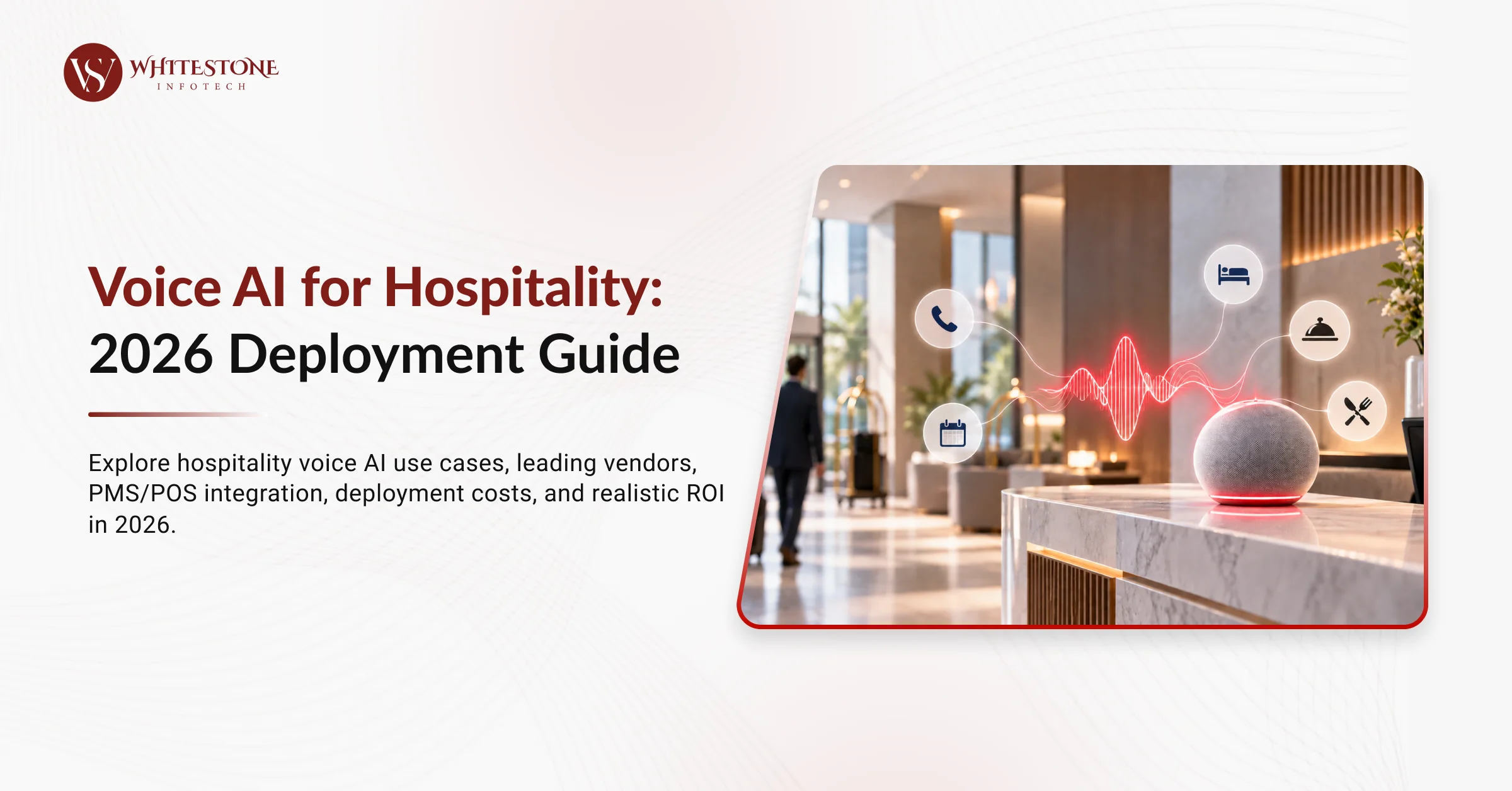
A UK hospitality group CEO we spoke to in early 2026 was being pitched hospitality voice AI by three vendors. The pitches included: phone-based voice AI for inbound reservation handling across all 8 hotel properties (deflecting 60-80 percent of inbound calls per vendor promise); in-room voice assistants in all 420 guest rooms across the properties (specific room service, concierge, maintenance request handling); AI-powered guest experience with specific personalisation. Combined budget request was £680k across 18 months. The CEO wanted an honest view: does any of this actually deliver measurable ROI in 2026 or is this chasing 2023-2024 voice AI hype?
The honest voice ai for hospitality analysis against the pitched use cases told a specific story. Phone-based voice AI for inbound reservation handling: 2026 evidence suggests 30-60 percent inbound call deflection for simple reservation and inquiry scenarios is realistic; 60-80 percent per vendor promise typically assumes ideal conditions not met in practice. ROI possible but requires HITL for complex scenarios. In-room voice assistants in all 420 rooms: specific use cases (room service, maintenance, specific concierge) deliver measurable automation; universal in-room voice assistant deployment frequently delivers lower guest adoption than vendor promise. Specific pilot before universal deployment more prudent. AI-powered guest experience personalisation: specific personalisation delivers measurable value when integrated with guest history from PMS; generic AI personalisation without PMS integration delivers limited value.
Revised scope: scoped voice AI pilot focused on highest-ROI use cases rather than ambitious all-in-one deployment. Phone-based voice AI deployment at 2 properties for inbound reservation and inquiry handling using PolyAI (hospitality-specialist with PMS integration) with HITL handoff to human agents below confidence threshold. In-room voice assistant pilot at 1 property (80 rooms) using Volara by Nomadix for room service, maintenance, specific concierge with POS and PMS integration. Specific guest personalisation using PMS guest history data for repeat guest recognition and preferences. Total scope: £185k year one (£110k phone-based voice AI across 2 properties plus £65k in-room pilot at 1 property plus £10k integration and HITL workflow) plus £75k ongoing annual. Vs £680k universal pitch.
Twelve months after scoped pilot deployment, outcomes were measurable. Phone-based voice AI at 2 pilot properties: 42 percent inbound call deflection for simple reservations and inquiries (within 30-60 percent realistic range), human agent capacity freed for high-value interactions, guest satisfaction maintained with specific HITL handoff smoothness. In-room voice assistant at 1 pilot property: 38 percent of room service orders through voice (specific guest adoption varied by demographic), maintenance request response time improved 55 percent, specific concierge inquiry handling automated with HITL for complex requests. Guest satisfaction scores stable through pilot. Total ROI 14 months for phone-based voice AI; 18 months for in-room voice assistant. Universal multi-property expansion decision deferred based on scoped pilot success and specific lessons learned about guest demographic adoption variations.
The CEO's reflection: "The 2023-2024 voice AI narrative promised universal hospitality transformation. 2026 reality: voice AI works for specific hospitality use cases where measurable ROI justifies specific vendor investment (phone-based for simple reservations and inquiries with HITL, in-room for specific service and maintenance scenarios with specific guest adoption). Universal all-in-one hospitality voice AI deployment frequently delivers lower adoption than vendor promise. The lesson I would give any hospitality CEO being pitched voice AI: scope pilot to highest-ROI use cases at pilot properties where ROI is measurable in 12-18 months; multi-property universal expansion only after scoped pilot success demonstrates specific adoption patterns; established hospitality-specialist voice AI vendors (PolyAI, Volara by Nomadix, Angie Hospitality, Jurny) deliver production-grade capability for specific use cases with HITL."
That is the voice ai for hospitality 2026 conversation across UK, European, and US hospitality operators. 2023-2024 voice AI universal transformation narrative did not survive. 2026 reality: voice AI works for specific hospitality use cases (phone-based reservation and inquiry handling, in-room room service and maintenance, specific concierge, specific restaurant ordering) with specific hospitality-specialist and general voice AI vendors delivering production-grade capability when deployed with HITL for complex scenarios and PMS/POS integration.
Transparency note: WhiteStone has not shipped hospitality voice AI as our primary offering. We have adjacent voice-AI and human-in-the-loop deployment experience through TrackVid Auto Claim HITL deployment delivering measurable automation per our enterprise AI piece referenced below, SAGE AI employee for Shopify merchants demonstrating conversational AI patterns for ecommerce (adjacent to hospitality voice patterns), and broader AI deployment experience across our 50-plus product portfolio. Hospitality operators scoping voice AI deployment should weigh this candid framing against our evidenced adjacent AI deployment experience plus specific hospitality-adjacent voice AI understanding.
This article is a candid guide for hospitality CEOs, chief digital officers, hotel operations directors, restaurant operators, and hospitality technology leaders scoping voice ai for hospitality deployment in 2026. Deployment types. Hospitality use cases with measurable ROI. 2026 vendor landscape. PMS and POS integration. HITL requirements. Realistic cost and timeline bands. Common failure modes. What has stuck vs what remains hard in 2026.
Hospitality Voice AI Deployment Types
Phone-based voice AI. Inbound phone call handling for hotel front desk inquiries, restaurant reservations, specific guest inquiries. Outbound voice for specific confirmations and follow-up. Integration with telephony (specific SIP providers) and PMS for reservation and guest data. 2026 adoption pattern: hospitality-specialist voice AI (PolyAI, specific other hospitality specialists) and general voice AI platforms (Vapi, Retell AI, Bland AI, Dialpad AI, Vonage AI) dominant for phone deployment. Specific hospitality use cases include reservation handling, availability inquiries, rate inquiries, specific other inbound inquiries.
In-room voice assistants. Voice assistants deployed in hotel guest rooms for room service orders, maintenance requests, concierge inquiries, hotel information, specific other guest requests. Integration with PMS for guest context, POS for room service orders, specific other hospitality systems for maintenance and concierge workflow. 2026 adoption pattern: hospitality-specialist in-room vendors (Volara by Nomadix, Angie Hospitality, Jurny, specific other) dominant for in-room deployment. Pattern: specific pilot before universal deployment given specific guest adoption variations.
Kiosk and lobby voice. Voice-enabled kiosks in hotel lobbies for self-service check-in, information, specific other kiosk functions. Specific vendor landscape includes general kiosk vendors with voice capability plus specific hospitality kiosk specialists.
Mobile and messaging voice. Voice integration in hotel mobile apps and specific messaging workflows. Lower adoption vs phone and in-room; specific use cases emerging.
Restaurant voice. Phone ordering voice AI, drive-thru voice AI (specific restaurant chains deploying), specific other restaurant voice use cases. Specific restaurant voice vendors (Checkmate, PopID voice capability, Toast voice capability, specific other restaurant specialists).
Per McKinsey 2026 hospitality AI research and Gartner 2026 conversational AI hospitality analysis, voice AI for hospitality in 2026 has consolidated around specific use cases where measurable ROI justifies investment, with hospitality-specialist voice AI vendors (PolyAI, Volara by Nomadix, Angie Hospitality, Jurny) and general voice AI platforms (Vapi, Retell AI, Bland AI, Dialpad AI) dominating 2026 hospitality voice AI market, and HITL handoff being critical for guest experience protection.
Hospitality Use Cases With Measurable ROI in 2026
Use case 1: Phone-based reservation handling. Voice AI handles inbound reservation calls with PMS integration. Measurable ROI: inbound call deflection (typically 30-60 percent for simple reservation scenarios), human agent capacity freed for high-value interactions, 24/7 reservation handling without staffing cost. Highest-ROI phone-based voice AI use case in 2026.
Use case 2: Phone-based inquiry handling. Voice AI handles inbound inquiries about rates, availability, amenities, directions, specific hotel information. Measurable ROI: inbound inquiry deflection (typically 40-70 percent for simple information scenarios), guest service availability 24/7.
Use case 3: In-room service orders. Voice AI in guest rooms handles room service orders with POS integration. Measurable ROI: specific order automation (typical 20-50 percent of room service orders through voice depending on guest demographic adoption), kitchen efficiency through structured order capture, specific upsell opportunity through voice menu recommendations.
Use case 4: In-room maintenance requests. Voice AI handles guest-reported maintenance requests with specific maintenance workflow integration. Measurable ROI: maintenance response time improvement (typical 30-60 percent response time reduction), specific maintenance workflow automation.
Use case 5: In-room concierge requests. Voice AI handles specific concierge requests (hotel information, local recommendations, specific other). Measurable ROI: concierge staff capacity freed for high-value personal interactions, 24/7 concierge availability for specific requests.
Use case 6: Restaurant phone ordering. Voice AI handles inbound phone orders for restaurants with POS integration. Measurable ROI: order automation, kitchen efficiency, specific upsell opportunity.
Use case 7: Specific guest preference and personalisation. Voice AI uses guest history from PMS for repeat guest recognition and preferences. Measurable ROI: guest experience improvement, specific loyalty programme engagement.
Use cases where voice AI typically does NOT deliver measurable ROI in 2026.
Complex multi-turn interactions requiring deep context (specific complex guest service scenarios).
Specific empathy-sensitive scenarios (specific guest complaint handling, specific crisis response).
Specific high-value guest interactions requiring human touch (VIP guest handling, specific loyalty programme interactions).
Specific accessibility and language edge cases (specific disability accommodation, specific low-resource language speakers).
Universal in-room voice assistant deployment without specific adoption patterns identified.
2026 Voice AI Vendor Landscape
General voice AI platforms (not hospitality-specific).
Vapi: Developer-focused voice AI platform. Specific voice AI building capability. Growing adoption across industries.
Retell AI: Developer-focused voice AI platform.
Bland AI: Voice AI platform with specific focus on specific use cases.
Dialpad AI: Contact centre AI including voice AI with specific business communication focus.
Vonage AI (Vonage Business): Vonage voice AI with specific business communication focus.
Specific other general voice AI platforms: various.
Hospitality-specialist voice AI.
PolyAI: Voice AI platform with specific hospitality focus. Specific hospitality use cases including reservations, inquiries. Established hospitality adoption.
Volara by Nomadix: In-room voice AI specialist for hospitality. Volara acquired by Nomadix. Dominant for in-room hospitality voice.
Angie Hospitality: In-room hospitality voice assistant.
Jurny: AI platform for hospitality with specific voice capability.
Specific other hospitality voice specialists: various emerging specialists.
Foundation voice capability.
OpenAI Realtime API: OpenAI voice capability for low-latency voice interactions. Foundation capability for custom voice AI builds.
Anthropic voice capability: where applicable for specific voice AI builds.
ElevenLabs: Voice synthesis with specific natural voice quality. Used as voice synthesis component in specific voice AI builds.
Deepgram, Rev AI, Whisper, specific other speech-to-text providers: Speech-to-text capability for specific voice AI builds.
Big cloud voice AI.
Microsoft Azure AI Speech: Microsoft voice AI capability including specific speech services.
Google Cloud Conversational AI including Dialogflow CX: Google voice and conversational AI.
Amazon Lex: AWS voice and conversational AI.
Specific restaurant voice.
Checkmate, PopID voice capability, Toast voice capability, specific other restaurant voice specialists: restaurant-specific voice AI.
Vendor selection factors 2026.
Deployment type (phone, in-room, kiosk, mobile, restaurant).
Hospitality specialisation vs general voice AI.
Existing hospitality system integration (PMS, POS, specific other).
HITL handoff capability.
Specific language and accent coverage for guest demographic.
Pricing model (per-call, per-room, per-month subscription).
Vendor roadmap and ecosystem maturity.
PMS and POS Integration Context
PMS (Property Management System) integration. Hospitality voice AI requires PMS integration for reservation data, guest history, room assignments, specific guest context. 2026 PMS landscape includes Oracle OPERA (established enterprise), Mews (modern cloud-native growing adoption), Cloudbeds (SMB-focused), Little Hotelier (SMB-focused by SiteMinder), SiteMinder (channel manager with PMS adjacency), specific other PMS vendors.
POS (Point of Sale) integration. Hospitality voice AI for room service and restaurant ordering requires POS integration. 2026 hospitality POS landscape includes Toast (restaurant POS), Micros (Oracle Micros), Lightspeed (restaurant POS), specific other POS vendors.
Specific other hospitality system integration. Booking engines (specific hotel booking engines), revenue management (specific revenue management systems), specific other hospitality systems.
Integration complexity. Hospitality voice AI integration with PMS, POS, specific other hospitality systems frequently complex. Integration should be scoped and resourced from inception.
Pattern. Standalone voice AI without PMS and POS integration delivers limited value; integrated voice AI as part of broader hospitality operations architecture delivers measurable ROI.
Human-in-the-Loop (HITL) Handoff is Critical
Why HITL is critical for hospitality voice AI. Guest frustration from poor voice AI handling without human handoff damages hospitality brand materially. Voice AI confidence threshold with human handoff below threshold is 2026 standard. Pattern: voice AI deflects simple scenarios with measurable confidence; complex or empathy-sensitive scenarios hand off to human staff smoothly.
HITL design principles for hospitality voice AI. Confidence threshold tuning per use case (specific threshold for reservations vs inquiries vs complaints). Smooth handoff transition from voice AI to human agent (specific transition language, specific context passing). Human agent capacity planning for expected handoff volume. Specific escalation workflow for high-stakes scenarios (specific VIP guest, specific complaint, specific other).
HITL from TrackVid Auto Claim deployment. TrackVid Auto Claim deployment per our human-in-the-loop enterprise AI piece demonstrates HITL patterns transferable to hospitality voice AI: confidence threshold tuning (0.92 for Auto Claim), human handoff below threshold, 2.4x throughput improvement with human quality maintained. Pattern: HITL design principles from Auto Claim transfer to hospitality voice AI.
Common HITL failure modes. Voice AI without HITL (specific guest frustration scenarios), low confidence threshold without human handoff (specific guest experience failures), poor handoff transition (guest confusion about human agent context), insufficient human agent capacity for handoff volume. Fix: HITL design from inception; confidence threshold tuning; handoff transition design; capacity planning.
Honest 2026 Hospitality Voice AI Cost Bands
Deployment type | Initial cost (per property or specific scope) | Timeline | Ongoing cost (per month or per year) |
Phone-based voice AI (per hotel property or restaurant) | £15k-£80k | 3-6 months | £500-£3000 per month per property |
In-room voice assistant (per hotel property) | £20k-£200k depending on scale | 4-9 months | £300-£2000 per room per year |
Enterprise multi-property voice AI | £100k-£1m+ | 9-24 months | £50k-£500k+ annual |
Restaurant voice AI (per restaurant) | £10k-£50k | 2-5 months | £300-£2000 per month per restaurant |
Cost breakdown year one phone-based voice AI for single hotel property.
Voice AI platform licensing (PolyAI, Vapi, Retell, specific other): typically £5k-£30k year one.
PMS integration: typically £5k-£20k.
HITL workflow design and setup: typically £3k-£15k.
Testing and tuning: typically £2k-£15k.
Internal team time: substantial (hospitality operations, IT).
Ongoing operational cost: platform subscription plus specific services plus HITL human agent capacity.
ROI timeline realism. Phone-based voice AI: typically 6-18 months to measurable ROI. In-room voice assistant: typically 12-24 months. Enterprise multi-property deployment: typically 18-36 months. Longer or absent ROI typical for over-scoped deployments or deployments without HITL and PMS/POS integration.
Common Failure Modes
Universal deployment without pilot. Hospitality operator deploys voice AI universally across all properties and rooms without pilot. Specific adoption variations by demographic not identified; specific ROI pattern not validated. Fix: scoped pilot at pilot properties and rooms; universal expansion only after specific adoption patterns identified.
Voice AI without HITL. Hospitality voice AI deployed without human handoff. Guest frustration from poor voice AI handling damages brand. Fix: HITL design from inception with specific confidence threshold tuning.
Standalone voice AI without PMS and POS integration. Voice AI deployed without hospitality system integration. Delivers limited value. Fix: PMS and POS integration from inception.
Vendor promise exceeds 2026 reality. Vendor promises 60-80 percent call deflection; 2026 realistic range is 30-60 percent for simple scenarios. Fix: realistic ROI expectation; pilot validates specific deflection rate.
Underestimating guest demographic adoption variations. Universal in-room voice assistant deployment assumes universal guest adoption. Guest adoption varies substantially by demographic (specific age, specific tech comfort, specific other). Fix: pilot identifies specific adoption patterns; universal expansion informed by pilot patterns.
Chasing 2023-2024 voice AI hype in 2026. Hospitality operator pursues universal voice AI transformation based on 2023-2024 vendor narrative. Pattern of over-ambition and under-delivery. Fix: 2026 reality check; scoped use case focus with established vendors.
Underestimating integration complexity. Voice AI integration with PMS, POS, specific other hospitality systems frequently complex. Fix: integration scoped and resourced; specific integration capacity.
Underestimating ongoing operational cost. Voice AI requires ongoing operational investment (platform, specific tuning, HITL human agent capacity). Fix: realistic ongoing cost planning; specific operational ownership.
Specific language and accent coverage gaps. Voice AI deployed without specific guest demographic language and accent coverage. Specific guest frustration. Fix: language and accent coverage verified for specific guest demographic.
Accessibility edge cases unaddressed. Specific accessibility scenarios (specific disability accommodation, specific other) not addressed by voice AI. Fix: accessibility verification; HITL for accessibility edge cases.
Vendor concentration risk. Dependence on single hospitality voice AI vendor without contingency. Fix: vendor due diligence; data export capability; specific contingency planning.
What We Have Learned From Adjacent Voice AI and HITL Experience
WhiteStone has not shipped hospitality voice AI as our primary offering. We have adjacent voice-AI and human-in-the-loop deployment experience through TrackVid Auto Claim HITL deployment per our enterprise AI piece referenced above, SAGE AI employee for Shopify merchants demonstrating conversational AI patterns, and broader AI deployment experience. Three lessons transfer to hospitality operators scoping voice AI.
TrackVid Auto Claim HITL deployment demonstrates confidence threshold tuning for voice AI handoff. TrackVid Auto Claim deployment per our human-in-the-loop enterprise AI piece: confidence threshold 0.92, human handoff below threshold, 2.4x throughput improvement with human quality maintained. HITL design principles directly transfer to hospitality voice AI: confidence threshold tuning per use case, smooth handoff transition, human agent capacity planning, specific escalation workflow. Pattern: HITL design is 2026 standard for AI deployment including hospitality voice.
SAGE AI employee demonstrates conversational AI patterns transferable to hospitality voice. SAGE AI employee for Shopify merchants demonstrates conversational AI patterns for ecommerce merchant interactions. Patterns transferable to hospitality voice AI: natural language understanding, context maintenance, specific personalisation using merchant data (equivalent to PMS guest data for hospitality). Pattern: conversational AI patterns from adjacent domains transfer to hospitality voice with specific hospitality context.
Honest 2026 reality: voice AI works for specific hospitality use cases with measurable ROI; universal all-in-one deployment typically does not deliver vendor-promised outcomes. Across AI deployment advisory engagements, 2026 reality is clear: voice AI works for specific scoped use cases (phone-based reservations and inquiries with HITL, in-room room service and maintenance with POS integration, specific restaurant ordering) delivering measurable ROI; universal all-in-one hospitality voice AI deployment frequently delivers lower adoption and ROI than vendor promise. Pattern: scoped use case focus with established vendors (PolyAI, Volara by Nomadix, Angie Hospitality, Jurny, Vapi, Retell AI, Bland AI, Dialpad AI) plus HITL plus PMS/POS integration delivers measurable hospitality ROI.
See our portfolio of shipped work for adjacent AI deployment case studies. For a scoped voice ai for hospitality readiness assessment, book a hospitality voice AI advisory call with WhiteStone.
Frequently Asked Questions
What is voice AI for hospitality and what has actually worked in 2026?
Voice AI for hospitality in 2026 is AI-powered voice interaction for hospitality use cases including phone-based voice AI (inbound reservation handling, inquiry handling), in-room voice assistants (room service, maintenance, concierge), kiosk and lobby voice (self-service check-in), mobile and messaging voice, restaurant voice (phone ordering, drive-thru). What works in 2026: phone-based reservation handling (30-60 percent inbound call deflection for simple scenarios), phone inquiry handling, in-room room service (20-50 percent of orders through voice depending on guest adoption), in-room maintenance requests, specific concierge requests, restaurant phone ordering. What remains hard: complex multi-turn interactions, empathy-sensitive scenarios, high-value guest interactions requiring human touch.
Which voice AI vendors should hospitality operators evaluate in 2026?
General voice AI platforms: Vapi (developer-focused), Retell AI (developer-focused), Bland AI, Dialpad AI (contact centre with voice), Vonage AI, specific others. Hospitality-specialist voice AI: PolyAI (specific hospitality focus), Volara by Nomadix (in-room specialist), Angie Hospitality, Jurny (AI platform with voice), specific others. Foundation voice capability: OpenAI Realtime API, Anthropic voice, ElevenLabs (voice synthesis), Deepgram/Rev AI/Whisper (speech-to-text), specific others. Big cloud voice AI: Microsoft Azure AI Speech, Google Cloud Dialogflow CX, Amazon Lex. Restaurant voice: Checkmate, PopID, Toast voice capability. Vendor choice depends on deployment type, hospitality specialisation, existing hospitality system integration, HITL capability.
What hospitality voice AI use cases deliver measurable ROI in 2026?
Phone-based reservation handling (30-60 percent inbound call deflection for simple scenarios). Phone-based inquiry handling (40-70 percent for simple information scenarios). In-room service orders (20-50 percent of room service orders through voice depending on guest demographic). In-room maintenance requests (30-60 percent response time reduction). In-room concierge requests. Restaurant phone ordering. Specific guest preference and personalisation using PMS guest history. Pattern: voice AI delivers measurable ROI for specific scoped use cases with HITL and PMS/POS integration; universal all-in-one deployment typically does not deliver vendor-promised outcomes.
How does voice AI integrate with hotel PMS and restaurant POS in 2026?
Hospitality voice AI requires PMS integration for reservation data, guest history, room assignments (Oracle OPERA, Mews, Cloudbeds, Little Hotelier, specific other PMS). POS integration for room service and restaurant orders (Toast, Micros, Lightspeed, specific other POS). Integration frequently complex; scoped and resourced from inception. Standalone voice AI without PMS and POS integration delivers limited value; integrated voice AI as part of broader hospitality operations architecture delivers measurable ROI.
What is the difference between phone-based and in-room voice AI for hospitality?
Phone-based voice AI handles inbound and outbound phone calls (reservations, inquiries, specific other). Integration with telephony and PMS. Vendor landscape includes hospitality-specialist (PolyAI) and general voice AI (Vapi, Retell AI, Bland AI, Dialpad AI). In-room voice assistants deployed in guest rooms for room service, maintenance, concierge requests. Integration with PMS, POS, specific other hospitality systems. Vendor landscape dominated by hospitality-specialist in-room vendors (Volara by Nomadix, Angie Hospitality, Jurny). Deployment considerations differ (phone requires telephony integration; in-room requires physical device deployment and specific guest demographic adoption consideration).
How much does voice AI deployment cost for hospitality in 2026?
Phone-based voice AI per hotel property or restaurant: £15k-£80k initial plus £500-£3000 per month per property. In-room voice assistant per hotel property: £20k-£200k initial depending on scale plus £300-£2000 per room per year. Enterprise multi-property hospitality voice AI: £100k-£1m+ initial plus £50k-£500k+ annual. Restaurant voice AI per restaurant: £10k-£50k initial plus £300-£2000 per month per restaurant. ROI timeline typically 6-18 months for well-scoped deployments; longer or absent for over-scoped deployments or deployments without HITL and PMS/POS integration.
What voice AI limitations should hospitality operators plan for in 2026?
Voice AI 2026 limitations: complex multi-turn interactions requiring deep context (specific complex guest service scenarios); specific empathy-sensitive scenarios (guest complaint handling, crisis response); specific high-value guest interactions requiring human touch (VIP guest handling, specific loyalty programme interactions); specific accessibility and language edge cases (specific disability accommodation, low-resource language speakers). HITL (human-in-the-loop) handoff is critical: voice AI confidence threshold with human handoff below threshold is 2026 standard. Pattern: voice AI deflects simple scenarios; complex or empathy-sensitive scenarios hand off to human staff smoothly.
Why choose WhiteStone Infotech for voice ai for hospitality advisory?
Transparency note: WhiteStone has not shipped hospitality voice AI as our primary offering. Our proof points are adjacent: TrackVid Auto Claim HITL deployment per our human-in-the-loop enterprise AI piece (confidence threshold 0.92, human handoff below threshold, 2.4x throughput improvement with human quality maintained, HITL design principles directly transfer to hospitality voice AI); SAGE AI employee for Shopify merchants demonstrating conversational AI patterns for ecommerce merchant interactions (transferable to hospitality voice with hospitality context); broader AI deployment experience across 50-plus product portfolio. UK hospitality group CEO case: scoped voice AI pilot (phone-based voice AI at 2 properties using PolyAI plus in-room voice assistant pilot at 1 property using Volara by Nomadix) at £185k year one plus £75k annual vs £680k universal pitch; 12 months: 42 percent phone deflection at pilot properties, 38 percent room service orders through voice, 55 percent maintenance response time improvement, 14-18 month ROI.
Hospitality operators can benefit from our adjacent AI deployment experience plus honest scoped-pilot framework. Contact WhiteStone Infotech at whitestoneinfotech.com/contact.
The One Thing to Remember
Voice ai for hospitality in 2026 has consolidated around specific use cases with measurable ROI (phone-based reservation and inquiry handling with 30-60 percent inbound call deflection, in-room room service and maintenance orders with POS integration, specific concierge requests, specific restaurant phone ordering). 2026 vendor landscape consolidated around hospitality-specialist voice AI (PolyAI, Volara by Nomadix, Angie Hospitality, Jurny), general voice AI platforms (Vapi, Retell AI, Bland AI, Dialpad AI, Vonage AI), foundation voice capability (OpenAI Realtime API, ElevenLabs, specific speech-to-text providers), and big cloud voice AI (Microsoft Azure AI Speech, Google Cloud Dialogflow CX, Amazon Lex). PMS integration (Oracle OPERA, Mews, Cloudbeds, Little Hotelier) and POS integration (Toast, Micros, Lightspeed) critical for integrated voice AI value. Human-in-the-loop (HITL) handoff is 2026 standard: confidence threshold tuning per use case plus smooth handoff transition plus human agent capacity planning plus specific escalation workflow. UK hospitality group CEO case: scoped voice AI pilot (phone-based at 2 properties using PolyAI plus in-room pilot at 1 property using Volara by Nomadix) at £185k year one delivered 42 percent phone deflection and 38 percent room service orders through voice and 55 percent maintenance response time improvement with 14-18 month ROI vs £680k universal pitch that would not have delivered vendor-promised outcomes. The single decision that determines hospitality voice AI ROI: scoped pilot on highest-ROI use cases with established vendors plus HITL plus PMS/POS integration, or universal all-in-one deployment chasing 2023-2024 vendor promises that did not survive to 2026? Scoped use case focus with established vendors plus HITL delivers measurable hospitality ROI.