
A UK Group CFO we worked with in 2025 was approving the AI copilot programme covering finance operations across the group. The programme served finance analysts, controllers, and executives with document processing, financial analysis AI assistance, and reporting generation. Initial deployment three months earlier was costing roughly £68,000 monthly at scale. Business leadership was supportive but the CFO flagged cost trajectory as a concern given 40 percent business volume growth expected over the next 12 months. Fully proportional cost scaling would reach £95,000 monthly within 12 months, which exceeded the programme budget by a material amount.
The honest ai cost optimisation enterprise analysis we ran against the £68,000 monthly cost identified eight optimisation opportunities. Layer 1 model selection: finance analysts' routine document categorisation tasks were running on GPT-4-class model when Claude Haiku or Gemini Flash would deliver equivalent accuracy at 20x lower cost. Layer 2 prompt engineering: system prompts across use cases averaged 2,400 tokens of boilerplate (role description, formatting instructions, examples) that prompt caching could reduce effective cost on by 70-80 percent. Layer 3 context optimisation: RAG retrieval was returning 15 chunks per query when 4-6 chunks would suffice; re-ranking before LLM processing was absent. Layer 4 response caching: 30 percent of financial analysis queries were semantically similar to recent queries; semantic cache would catch these. Layer 5 batch processing: overnight financial document processing was running on real-time API when Batch API would deliver 50 percent cost reduction with no quality change. Layer 6 model routing: no routing logic by task complexity; everything went to GPT-4-class model. Layer 7 edge inference: not applicable for this cloud workload. Layer 8 governance: no departmental chargeback or budget alerts; cost was aggregated at programme level with no accountability.
Implementation over 8 weeks across layers: model routing by task complexity (routine tasks to Claude Haiku; complex analysis to Claude Sonnet or GPT-4-class). Prompt caching for all system prompts. RAG chunk reduction from 15 to 5 with re-ranking. Semantic cache for repeat and similar queries (Redis-based implementation). Batch API for overnight workloads. Departmental cost tracking with monthly chargeback and budget alerts. Total optimisation implementation effort roughly £85,000 one-off.
Twelve months after optimisation implementation, outcomes were measurable. Monthly cost held at £42k through the 40 percent business volume growth, versus the £95k that proportional scaling would have reached. Effective cost per transaction reduced roughly 30 percent through the optimisation layers. User experience improved rather than degraded (semantic cache delivered faster responses for repeat queries, model routing delivered appropriate quality per task, prompt caching improved latency). Payback on £85k optimisation implementation effort within 3 months.
The CFO's reflection: "AI costs were trending to exceed budget within 12 months without optimisation. Eight-layer optimisation held cost flat while business volume grew 40 percent. The lesson I would give any enterprise CFO funding AI: cost optimisation is not optional overhead on AI programmes; it is architectural requirement that pays back within months and compounds over years. Un-optimised AI programmes consistently overspend by 2-3x versus optimised programmes delivering equivalent capability."
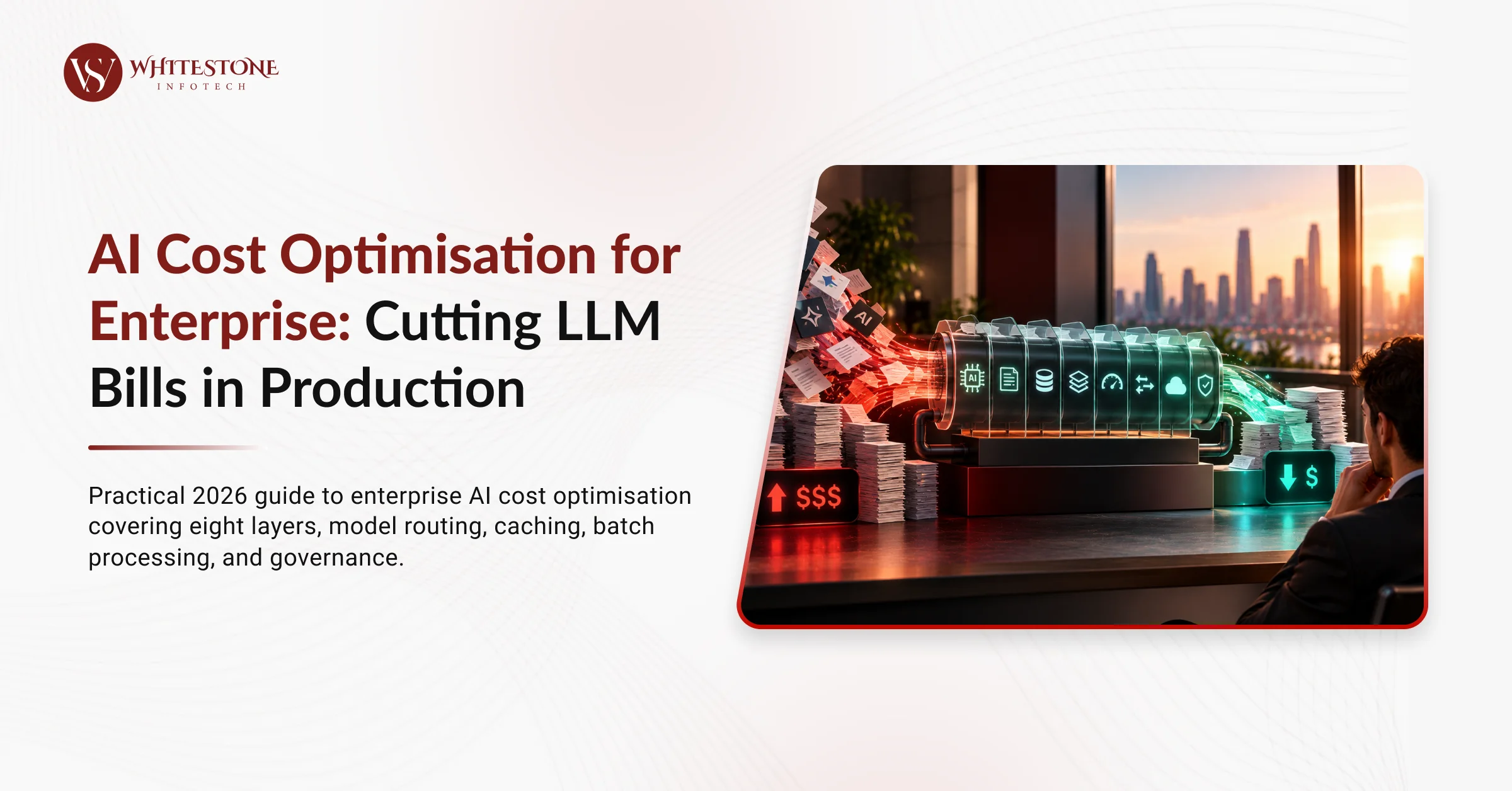
That is the ai cost optimisation enterprise 2026 conversation across UK and US enterprises. Enterprise AI programmes without disciplined cost optimisation consistently overspend by 2-3x versus optimised programmes. Eight-layer optimisation (model selection, prompt engineering, context optimisation, response caching, batch processing, model routing, edge inference, governance) delivers 50-80 percent cost reduction compounded. Model selection and batch processing are highest-ROI layers for most enterprises. Semantic caching catches 20-40 percent of queries that would otherwise re-process. Governance with chargeback and budget alerts prevents runaway cost.
This article is a candid guide for CFOs, CDOs, chief AI officers, and engineering leaders scoping ai cost optimisation enterprise in 2026. The eight optimisation layers in detail. Model selection and routing patterns. Prompt engineering for cost. Semantic caching mechanics. Batch processing opportunities. Edge inference where applicable. Governance patterns. Common failure modes. What we have learned shipping 50-plus AI products with explicit cost optimisation.
The Eight-Layer AI Cost Optimisation Framework
Layer 1: Model selection. Right-size model per use case. Default enterprise pattern of using GPT-4-class or Claude Sonnet-class for everything consistently over-pays. Claude Haiku, Claude Haiku Mini, GPT-4o mini, Gemini Flash, Mistral small models are 10-50x cheaper and sufficient for routine tasks. Reserve frontier models (Claude Sonnet, GPT-4-class, Gemini Pro) for complex reasoning, specialist domain work, long-context processing.
Layer 2: Prompt engineering. Shorter prompts cost less (per-token pricing). Prompt caching (OpenAI prompt caching, Anthropic prompt caching) for system prompts reduces effective cost 50-80 percent on cached portions. Chain-of-thought only when needed; simple tasks do not require elaborate reasoning scaffolding.
Layer 3: Context optimisation. RAG retrieval efficiency. Chunk size optimisation (smaller chunks for extraction, larger for synthesis). Re-ranking before LLM processing (small cross-encoder re-ranker before expensive LLM call). Query rewriting to improve retrieval. Context compression where applicable.
Layer 4: Response caching. Exact match cache (same query returns cached response) for FAQ-style queries. Semantic cache (semantically similar queries return cached response) for broader coverage. Redis Semantic Cache, specialist cache layers, LangChain cache implementations. Semantic cache typically catches 20-40 percent of enterprise AI queries.
Layer 5: Batch processing. OpenAI Batch API and Anthropic Batch API deliver 50 percent cost reduction compared to real-time API. For non-real-time workloads (nightly document processing, bulk categorisation, batch analysis, overnight inference). Materially underused despite immediate 50 percent cost reduction with no quality or capability change.
Layer 6: Model routing. Route queries by task complexity: cheaper model for simple tasks, premium model when needed. Routing can be rule-based (task type determines model) or learned (classifier predicts optimal model). LangGraph, LlamaIndex, specialist routing frameworks support model routing. Hybrid routing (small model attempts first, escalates to large model on low confidence) delivers substantial savings.
Layer 7: Edge inference. Local or edge inference where latency permits per our edge computing for AI apps 2026 piece. On-device inference eliminates per-query API cost. Hybrid patterns (edge for frequent simple tasks, cloud for complex) deliver substantial cost reduction for high-volume applications.
Layer 8: Governance. Cost tracking per use case, team, or department. Departmental chargeback creates accountability. Budget alerts prevent runaway spending. Model usage monitoring. Cost per transaction tracking. Without governance, cost optimisation gains erode as teams add use cases without discipline.
Per OpenAI 2026 pricing and API optimisation guidance and Anthropic 2026 Claude API cost documentation, systematic application of these eight layers consistently delivers 50-80 percent cost reduction in enterprise AI production workloads; model selection and batch processing are the highest-ROI individual layers for most enterprises.
Model Selection and Routing in Detail
Model selection is the highest-ROI individual lever.
2026 model price landscape (illustrative, exact pricing changes).
Claude Haiku Mini: cheapest Claude tier, suitable for simple classification, extraction, routing decisions.
Claude Haiku: cheap, suitable for routine summarisation, classification, extraction, simple generation.
Claude Sonnet: mid-tier, suitable for complex reasoning, coding, specialist domain work.
Claude Opus: premium, suitable for highest-complexity reasoning (used selectively).
GPT-4o mini: cheap OpenAI tier, suitable for routine tasks.
GPT-4o: mid-tier OpenAI, suitable for complex reasoning.
GPT-4.5 and successor models: premium OpenAI (used selectively).
Gemini Flash: cheap Google tier.
Gemini Pro: mid-tier Google.
Gemini Ultra: premium Google.
Mistral small, medium, large tiers.
Open-source models (Llama 3.x, Qwen, DeepSeek) via Together AI, Replicate, or self-hosted.
Model routing patterns.
Task-based routing: specific task types route to specific models (classification to Haiku, complex reasoning to Sonnet).
Confidence-based routing: small model attempts first, escalates to large model on low confidence.
User-tier routing: free-tier users to cheap models, paid users to premium models.
Latency-based routing: latency-sensitive tasks to fastest model, latency-tolerant to cheapest.
Model routing implementation. LangGraph routing. LlamaIndex query routing. Specialist routing frameworks (RouteLLM, specialist LLM gateways). Simple rule-based routing in application code for straightforward patterns.
Model selection cost reduction expectations. Right-sized model routing can reduce model inference costs 40-80 percent while maintaining or improving quality. The specific reduction depends on current baseline (using GPT-4-class for everything delivers largest reduction) and task mix.
Prompt Engineering for Cost Reduction
Prompt engineering reduces costs through multiple mechanisms.
Prompt caching (OpenAI prompt caching, Anthropic prompt caching). System prompts and few-shot examples cached across requests. Cached portions billed at substantially reduced rate (typically 50-80 percent discount). High-impact for enterprise applications with elaborate system prompts.
Prompt length reduction. Shorter prompts cost less (per-token pricing). Removing boilerplate, consolidating instructions, moving examples to fine-tuning or RAG where applicable.
Few-shot example optimisation. Few-shot examples consume tokens on every request. Moving to fine-tuned model or RAG-retrieved examples reduces per-request token cost.
Chain-of-thought discipline. Elaborate chain-of-thought scaffolding costs tokens. Simple tasks do not require chain-of-thought; applying it uniformly wastes cost. Chain-of-thought when needed, direct answer when sufficient.
Response length controls. max_tokens parameter prevents unnecessarily long responses. Structured output formats (JSON schema) reduce response length while improving usability.
Prompt engineering cost reduction expectations. 20-50 percent token cost reduction through disciplined prompt engineering across enterprise applications.
Semantic Caching Mechanics
Semantic caching catches queries that are semantically similar to previous queries.
Exact match caching. Standard caching. Same query returns cached response. Low implementation complexity. Catches 10-20 percent of enterprise queries typically.
Semantic caching. Query embedding compared against embeddings of previous queries. Similar queries (above cosine similarity threshold) return cached response. Higher implementation complexity. Catches 20-40 percent of enterprise queries typically for conversational and support use cases.
Semantic cache implementations. Redis Semantic Cache (official feature). LangChain SemanticCache. Specialist cache layers. Custom implementation using vector database (Pinecone, Weaviate) and application logic.
Semantic cache design considerations.
Similarity threshold calibration (too low creates cache misses, too high creates incorrect cache hits).
Cache invalidation strategy (how long cached responses remain valid).
Context sensitivity (same query in different context may need different response).
Query embedding model (specific embedding model affects semantic similarity quality).
Semantic cache ROI. 30-60 percent cost reduction for conversational and support use cases where semantically similar queries are common.
Batch Processing Opportunities
Batch processing is the single most-overlooked cost reduction in 2026 enterprise AI.
Batch API capabilities. OpenAI Batch API and Anthropic Batch API deliver 50 percent cost reduction compared to real-time API. Processing within 24 hours (typically within hours). Suitable for non-real-time workloads.
Enterprise batch-eligible workloads.
Nightly document processing (bulk categorisation, extraction, summarisation of day's documents).
Bulk data processing (categorising large data sets, extracting information at scale).
Batch analysis (overnight financial analysis, batch customer insights).
Overnight model inference (batch scoring, batch classification).
Backfill processing (processing historical data).
Non-real-time features in otherwise real-time applications.
Batch processing implementation. Reformat requests as batch (JSONL format). Submit to batch endpoint. Poll for completion. Process results. Modest implementation effort compared to 50 percent cost reduction.
Batch processing cost reduction expectations. 50 percent cost reduction on all batch-eligible workloads. Many enterprises have 30-60 percent of AI workload batch-eligible, delivering material total cost reduction.
Governance Patterns
Governance prevents cost optimisation gains from eroding as organisations add AI use cases.
Cost tracking per use case. Dedicated use case identifier (project, team, department) in API metadata. Cost dashboard showing spend per use case over time.
Departmental chargeback. Monthly cost allocation to departments based on usage. Creates accountability and incentive for cost-conscious development.
Budget alerts. Threshold-based alerts (department approaches monthly budget, use case spikes, unusual pattern detected). Prevents runaway spending.
Model usage monitoring. Which models used by which use cases. Identifies over-use of premium models for routine tasks (candidate for model routing).
Prompt and request pattern monitoring. Average request tokens, response tokens, cache hit rate per use case. Identifies optimisation opportunities per use case.
API gateway for AI governance. Specialist LLM API gateways (Portkey, Kong AI Gateway, LangChain gateway features) centralise governance. Alternative: cloud-native solutions on AWS Bedrock, Azure AI Foundry, GCP Vertex AI with built-in governance.
Governance ROI. Without governance, cost optimisation gains typically erode within 6-12 months as teams add use cases without discipline. With governance, optimisation gains sustained and extended.
Honest 2026 AI Cost Reduction Data
Optimisation layer | Typical cost reduction | Implementation effort |
Model selection and routing | 40-80 percent on inference costs | Moderate (routing framework, model switching) |
Prompt engineering (caching, length) | 20-50 percent on token costs | Low to moderate |
Context optimisation (RAG efficiency) | 15-40 percent on token costs | Moderate |
Response caching (exact plus semantic) | 20-50 percent on queries served | Moderate (semantic cache setup) |
Batch processing | 50 percent on batch-eligible workloads | Low (API reformatting) |
Model routing | 30-60 percent on routed queries | Moderate (routing logic) |
Edge inference | 60-95 percent on edge-eligible workloads | High (edge integration) |
Governance (tracking, alerts) | Sustains other gains, 10-20 percent additional through accountability | Moderate (platform setup) |
Compounded across layers | 50-80 percent total cost reduction typical | Full programme 6-12 weeks |
Rule that holds. Enterprise AI programmes without disciplined cost optimisation consistently overspend by 2-3x versus optimised programmes delivering equivalent capability. Optimisation implementation effort typically pays back within 3-6 months.
Common Failure Modes
Using GPT-4-class or Claude Sonnet-class for everything. Default pattern. Over-pays substantially for routine tasks that Claude Haiku, Gemini Flash, or similar handle at 10-50x lower cost. Fix: model routing by task complexity.
Not using batch API for batch-eligible workloads. Nightly processing on real-time API. Simple fix delivers immediate 50 percent cost reduction. Fix: batch API for all non-real-time workloads.
No prompt caching for enterprise applications with elaborate system prompts. System prompts of 1,000-5,000 tokens repeated on every request. Prompt caching reduces effective cost 50-80 percent on cached portions. Fix: prompt caching for all elaborate system prompts.
No semantic caching for conversational or support applications. Semantically similar queries re-processed on every request. Semantic cache catches 20-40 percent of queries. Fix: Redis Semantic Cache or similar for conversational and support use cases.
RAG retrieval inefficiency. Returning too many chunks (10-15 chunks when 4-6 suffice), no re-ranking before LLM. Fix: chunk count tuning, re-ranking before LLM processing.
No cost governance. Cost aggregated at programme level without departmental allocation or alerts. Teams add use cases without cost consciousness. Fix: cost tracking per use case, departmental chargeback, budget alerts.
Treating optimisation as one-time project. Optimisation implemented once, erodes over 6-12 months as new use cases added. Fix: optimisation as ongoing practice with governance to sustain gains.
Not considering edge inference for high-volume applications. Hybrid edge plus cloud pattern delivers substantial cost reduction for applications with high-volume simple tasks. Fix: edge inference evaluation for high-volume applications per our edge computing piece.
Over-engineering optimisation infrastructure. Building custom LLM gateway when Portkey, Kong AI Gateway, or cloud-native solutions suffice. Fix: use specialist LLM gateways or cloud-native governance.
Vendor lock-in anxiety preventing model routing. Routing across OpenAI, Anthropic, Google models requires API abstraction. Perceived lock-in prevents optimisation. 2026 reality: API abstraction layer is modest effort delivering substantial cost benefits. Fix: API abstraction supporting model routing.
What We Have Learned Shipping 50-Plus AI Products With Cost Optimisation
WhiteStone has shipped 50-plus AI-integrated products including explicit cost optimisation at every stage. TrackVid AI (dispute detection, Auto Claim serving 4000-plus Indian ecommerce merchants with cost-sensitive economics). IELTSArena AI scoring processing tens of thousands of student assessments monthly with cost-sensitive economics. Various UK and US enterprise AI engagements including UK Group CFO case above and UK insurance CDO case. Three lessons transfer to any enterprise AI cost optimisation programme.
TrackVid Auto Claim uses model routing and caching for cost sensitivity. TrackVid Auto Claim processes ecommerce disputes at scale with cost-sensitive economics (per-merchant pricing means per-dispute AI cost must be minimal). Model routing: Haiku-class model for standard categorisation, Sonnet-class only for complex disputes. Semantic cache for repeat dispute patterns (common across merchants). Prompt caching for system prompts. Batch processing for overnight dispute analysis. Result: AI cost per dispute roughly 70 percent lower than baseline non-optimised approach would deliver.
UK edge AI case: hybrid edge plus cloud delivered 88 percent cost reduction. UK B2B SaaS mobile translation feature running on frontier foundation model API at £4,200 monthly. Rebuild to hybrid edge (CoreML on iOS, TFLite on Android) plus cloud (frontier API for complex translations) reduced cost to £520 monthly. Latency improved from 1.4 seconds to 90ms. User experience improved alongside cost reduction. Pattern per our edge computing for AI apps 2026 piece.
UK insurance CDO case: £3.4m three-year AI programme vs £7.8m BUILD-everything through disciplined decisions. UK insurance CDO mentioned across cluster. Layer-by-layer build vs buy enterprise ai decisions (BUY foundation API, BUY AWS Bedrock infrastructure, BUILD only differentiated applications and agents) reduced three-year programme cost from £7.8m default BUILD-everything to £3.4m while delivering equivalent capability. Per our build vs buy enterprise ai decision framework 2026 piece.
See our portfolio of shipped work for enterprise AI cost case studies. For a scoped ai cost optimisation enterprise assessment, book an enterprise AI advisory call with WhiteStone.
Frequently Asked Questions
What is AI cost optimisation for enterprise in 2026?
Ai cost optimisation enterprise is systematic application of eight layers to reduce AI operational cost while maintaining capability. Model selection (right-size model per use case). Prompt engineering (caching, length). Context optimisation (RAG efficiency). Response caching (exact plus semantic). Batch processing (OpenAI, Anthropic Batch API). Model routing (route by task complexity). Edge inference (local or edge where latency permits). Governance (cost tracking, chargeback, alerts). Systematic application typically delivers 50-80 percent cost reduction with payback within 3-6 months.
What are the main AI cost drivers in enterprise production?
Six primary drivers. Model inference cost (per-token pricing on API calls). Context length cost (RAG chunks, system prompts, examples). Request volume (number of API calls). Model choice (premium vs cheap models vary 10-50x in cost). Latency requirements (real-time vs batch API). Governance gaps (no cost tracking leads to runaway spending). Model inference cost is dominant for most enterprise AI; model selection and request volume are the highest-impact optimisation targets.
How much can enterprises reduce AI costs through optimisation?
Systematic eight-layer optimisation typically delivers 50-80 percent cost reduction. Individual layer reductions: model selection and routing 40-80 percent on inference, prompt engineering 20-50 percent on tokens, context optimisation 15-40 percent, response caching 20-50 percent, batch processing 50 percent on eligible workloads, model routing 30-60 percent, edge inference 60-95 percent on eligible workloads. Compounded impact 50-80 percent total. UK Group CFO case: cost held at £42k monthly through 40 percent business growth (effective cost per transaction 30 percent reduction).
What is semantic caching for LLM cost reduction?
Semantic cache compares query embedding against embeddings of previous queries. Semantically similar queries (above cosine similarity threshold) return cached response. Catches 20-40 percent of enterprise AI queries typically for conversational and support use cases. Implementations: Redis Semantic Cache, LangChain SemanticCache, specialist cache layers, custom implementation using vector database. ROI typically 30-60 percent cost reduction for applicable use cases.
How does model routing reduce enterprise AI costs?
Model routing directs queries to appropriate model by task complexity. Routine tasks (classification, extraction, simple generation) route to cheap models (Claude Haiku, GPT-4o mini, Gemini Flash). Complex tasks (reasoning, specialist domain work, long context) route to premium models (Claude Sonnet, GPT-4-class, Gemini Pro). Routing patterns: task-based, confidence-based (small model attempts first, escalates on low confidence), user-tier-based. Cost reduction typically 30-60 percent on routed queries.
Which AI model is cheapest for enterprise production use cases in 2026?
2026 cheap tier for routine enterprise tasks: Claude Haiku Mini and Haiku, GPT-4o mini, Gemini Flash, Mistral small. Pricing roughly 10-50x cheaper than frontier models (Claude Sonnet, GPT-4-class, Gemini Pro). Open-source models (Llama 3.x, Qwen, DeepSeek via Together AI, Replicate, or self-hosted) also competitive. Choice depends on specific task quality requirements, vendor relationship, specific pricing changes.
How does prompt engineering reduce AI costs?
Multiple mechanisms. Prompt caching (OpenAI, Anthropic prompt caching) for system prompts reduces effective cost 50-80 percent on cached portions. Prompt length reduction (shorter prompts cost less per-token). Few-shot example optimisation (move to fine-tuning or RAG). Chain-of-thought discipline (only when needed). Response length controls (max_tokens, structured output). Overall 20-50 percent token cost reduction through disciplined prompt engineering.
Why choose WhiteStone Infotech for ai cost optimisation enterprise?
We have shipped 50-plus AI-integrated products with explicit cost optimisation at every stage. TrackVid Auto Claim achieves roughly 70 percent lower AI cost per dispute than baseline non-optimised approach through model routing, semantic caching, prompt caching, batch processing. UK B2B SaaS edge AI translation case reduced cost from £4,200 monthly to £520 monthly (88 percent reduction) through hybrid edge plus cloud. UK Group CFO case: AI programme cost held at £42k monthly through 40 percent business volume growth. UK insurance CDO case: £3.4m three-year AI programme (vs £7.8m default BUILD-everything) through disciplined build vs buy decisions. Contact WhiteStone Infotech at whitestoneinfotech.com/contact.
The One Thing to Remember
Ai cost optimisation enterprise in 2026 spans eight layers that compound for substantial cost reduction. Model selection (right-size per use case, 10-50x cost difference between tiers). Prompt engineering (caching, length). Context optimisation (RAG efficiency). Response caching (exact plus semantic). Batch processing (50 percent reduction on eligible workloads via OpenAI, Anthropic Batch API). Model routing (route by task complexity). Edge inference (local or edge where latency permits). Governance (tracking, chargeback, alerts). Systematic application delivers 50-80 percent cost reduction with payback within 3-6 months. UK Group CFO case: £42k monthly cost held through 40 percent business growth (30 percent effective per-transaction reduction). UK edge AI case: £4.2k to £520 monthly (88 percent reduction). UK insurance CDO: £3.4m three-year programme vs £7.8m default BUILD-everything. The single decision that determines enterprise AI cost ROI: systematic eight-layer optimisation with governance to sustain gains, or default enterprise pattern of using premium model for everything with no cost discipline? Un-optimised programmes consistently overspend by 2-3x versus optimised programmes delivering equivalent capability.