
A US SaaS CEO we spoke to last quarter had commissioned a £180k RAG build to "give our AI access to our knowledge base". Six months later, the RAG system was answering customer support questions using outdated product documentation, misquoting a 2023 pricing page superseded twice, and citing old blog posts as authoritative sources. The CEO asked what had gone wrong. The honest answer was that the AI was doing exactly what it was told: retrieving from the knowledge base as it existed. The knowledge base contained 2400 documents spanning 4 years with duplicates, out-of-date versions, and inconsistent terminology. No amount of AI cleverness compensates for the underlying knowledge management problem.
That is the rag explained for business conversation across UK and US business leaders in 2026. RAG has become the default vendor pitch for any AI project involving company documents. Sometimes it delivers real ROI. Often it is over-scoped. And it never compensates for scattered underlying knowledge. This article is a plain-language explanation for business leaders (CEO, COO, VP of a function): what RAG is, when it delivers ROI, when a plain LLM is enough, real cost bands, use cases that work, honest limits, and what we learned building RAG for IELTSArena and TrackVid.
What RAG Actually Is (Plain Business Language)
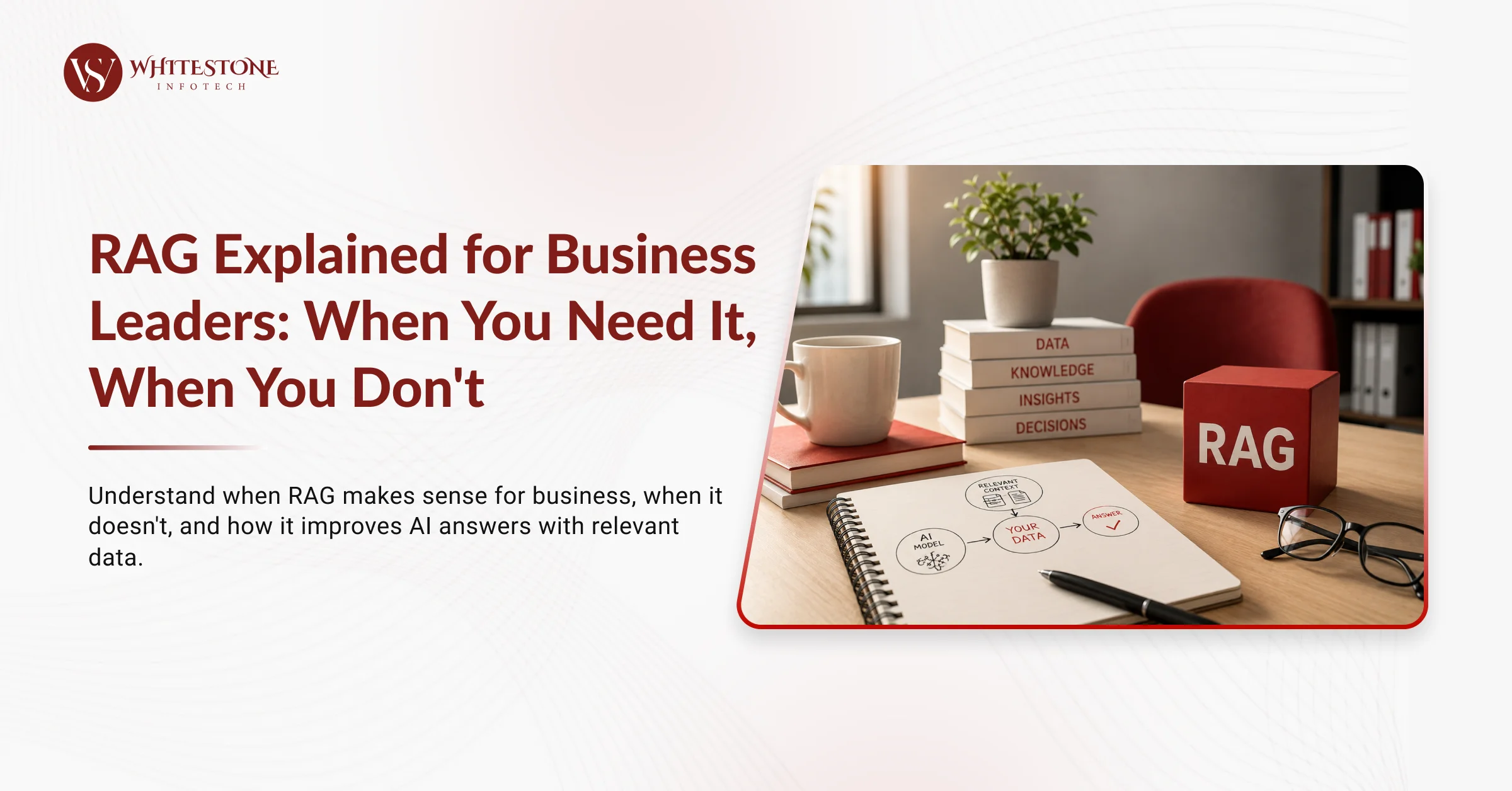
Think of RAG like a smart consultant. Broad general knowledge, but doesn't know your company specifics. Ask about general best practices, they answer from what they know. Ask about your specific enterprise onboarding policy, they need to read your document first, then answer. RAG works the same way: when a user asks the AI a question, RAG retrieves relevant documents from your knowledge base first, gives them to the AI with the question, and the AI answers using both its general knowledge and your specific documents.
Three components in every RAG system.
Knowledge base. Your company documents, policies, product data, customer records, or whatever the AI needs to answer accurately. Organised so a search system can find relevant items quickly.
Retrieval system. Software that finds the most relevant documents for any question. Typically uses vector search (semantic similarity) plus filtering (by date, category, permission, tags).
Language model. The AI (GPT-4, Claude, Gemini, or an open-source LLM like Llama) that answers the question using both its general knowledge and the retrieved documents.
Per OpenAI's RAG best practices documentation, well-designed RAG systems reduce factual errors by 40-80 percent versus a plain LLM answering the same questions without company-specific context.
When You Actually Need RAG
Three conditions must all be true for RAG to deliver ROI.
1. The AI needs to answer questions about your specific knowledge. Not general topics. Not coding help. Not general writing. Company-specific information that lives in your documents, systems, or databases.
2. Your knowledge base is too large to fit into an AI prompt every time. Modern language models have context windows up to 200k tokens (roughly 400-500 pages). If your entire knowledge base fits in this size, you might not need RAG; you can put it all in the prompt. RAG becomes valuable when knowledge exceeds this size.
3. Answers need to cite specific sources. Users must be able to see which document a fact came from. Compliance, legal, healthcare, and enterprise contexts almost always require this. Consumer chatbots often do not.
If all three are true, RAG is probably the right pattern. If one or two are missing, consider simpler alternatives.
When You Do NOT Need RAG
Four scenarios where RAG is overkill or the wrong choice.
Plain LLM is enough. AI answering general knowledge questions. Coding help. General writing. Marketing content generation. No company-specific context required. Save the RAG budget.
Prompt engineering is enough. Knowledge base under 20-30 documents that fit in a modern context window. Put the documents directly in the prompt. Simpler and cheaper than RAG.
Structured queries are the right answer. User asks "what were our Q3 sales in the UK". This is a database query, not a knowledge question. Direct database query returns exact numbers faster and cheaper than RAG guessing from documents.
Fine-tuning is the right answer. AI needs to consistently follow a specific style or format (write in your brand voice, format outputs as your specific report template). Fine-tuning a language model on your examples typically works better than RAG for stylistic consistency. RAG is for factual accuracy; fine-tuning is for stylistic consistency.
Real 2026 Cost Bands for RAG
The bands below are pragmatic for 2026 UK and US RAG implementation pricing.
RAG scale | Build cost | Monthly run cost | Timeline |
Simple RAG (under 500 documents, single language, standard search) | £15k-£45k | £400-£1500 | 6-10 weeks |
Mid-scale RAG (500-5000 documents, multi-language optional, filtered search) | £45k-£140k | £1500-£5000 | 10-18 weeks |
Enterprise RAG (5000+ documents, complex permissions, multi-language, high query volume) | £140k-£450k+ | £5000-£20000+ | 18-36 weeks |
Add for custom evaluation and safety layers | +25-40 percent | +15-25 percent | +4-8 weeks |
Add for regulated industries (healthcare, financial services) | +30-50 percent | +20-35 percent | +6-12 weeks |
Two rules that hold at every tier. Monthly run cost is dominated by LLM API calls at query time and vector database hosting. Query volume drives cost more than knowledge base size. And ongoing knowledge management (adding new documents, updating old ones, deprecating superseded content) typically adds 10-20 percent of build cost annually as internal effort.
Business Use Cases Where RAG Delivers ROI
Five categories where RAG typically pays back within 12-18 months.
Customer support automation. RAG connects support AI to product documentation, policy documents, and past resolved tickets. Handles Tier 1 questions (product features, common issues, policy explanations) without human agent involvement. Typical ROI: 30-50 percent Tier 1 ticket deflection, £4-£12 saved per deflected ticket depending on labour costs.
Internal knowledge search. RAG lets employees search company knowledge (HR policies, engineering documentation, sales playbooks) in natural language rather than keyword search. Typical ROI: 20-40 percent time saving on knowledge retrieval tasks, faster onboarding for new employees.
Sales enablement. RAG connects sales AI to product data, pricing, and competitive intel. Sales teams get accurate answers during calls. ROI: 15-25 percent higher win rate on questions-heavy deals.
Compliance and legal research. RAG on internal policies, contracts, and regulatory documents. ROI: 30-50 percent time saving on contract review.
Product knowledge for AI features. RAG powers in-product chatbots, recommendations, and decision assistants that need company-specific context. ROI varies by product.
Per Anthropic's practical RAG guidance, the highest-ROI RAG use cases share three characteristics: high query volume (justifies infrastructure cost), clear correct answers exist in the knowledge base (RAG can find them), and consequences of wrong answers are manageable (not high-stakes decisions).
What We Learned Building RAG for IELTSArena and TrackVid
WhiteStone runs RAG in production for IELTSArena teacher review and TrackVid merchant knowledge. Three lessons transfer to any business considering RAG.
IELTSArena teacher review RAG paid back within 6 months. IELTSArena teachers review AI-scored student essays. Teachers need instant access to the specific IELTS band descriptor for each score criterion. RAG connects the review interface to the official IELTS band descriptors so teachers see the exact descriptor language while reviewing. Reduced teacher review time by 32 percent. Direct cost saving justified the £38k build within 6 months.
TrackVid merchant knowledge RAG required 8 weeks of knowledge cleanup before it worked. TrackVid needed RAG to answer merchant onboarding questions from a knowledge base of 400+ articles. Initial build produced 60 percent accuracy because the knowledge base had duplicates, out-of-date policies, and inconsistent product terminology. 8 weeks of knowledge cleanup (deduplication, dating, terminology standardisation) before the RAG system reached 90+ percent accuracy. Knowledge management preceded RAG value.
The evaluation layer took longer than the RAG itself. Building a RAG system in 2026 is straightforward with mature tooling (LlamaIndex, LangChain, Pinecone, Weaviate). Building a proper evaluation layer (accuracy testing, hallucination detection, source-citation validation, ongoing quality monitoring) took 40-50 percent as long as the RAG itself. Without evaluation, RAG accuracy degrades silently as the knowledge base evolves.
See our portfolio of shipped work for other AI-in-production case studies. For a scoped RAG conversation, book an AI implementation call with WhiteStone.
Limits Every Business Leader Should Understand
Five limits that vendors typically underplay.
RAG can still hallucinate. Language models can generate plausible-sounding answers that are not actually in the retrieved documents. Well-designed RAG reduces hallucination substantially but does not eliminate it. Systems handling high-stakes decisions need human review paths.
RAG accuracy depends entirely on knowledge base quality. Scattered, out-of-date, or inconsistent underlying documents produce scattered, out-of-date, or inconsistent RAG answers. Knowledge cleanup typically takes 30-50 percent as long as the RAG build itself for organisations with unmaintained document repositories.
RAG requires ongoing knowledge management. New documents must be added. Old documents must be updated or deprecated. Permissions must be maintained. Terminology must stay consistent. Typical ongoing effort: 10-20 percent of initial build cost annually as internal effort.
RAG cost scales with query volume, not user count. A system with 100 users making 500 queries daily costs more than a system with 500 users making 100 queries daily. Budget planning should account for query volume forecasts.
RAG is not always the right pattern. Structured database queries, simple prompt engineering, or fine-tuning are often better answers for specific business problems. Vendors that pitch RAG as the answer to every AI question are hiding the harder work of choosing the right pattern.
Common Failure Modes
Building RAG without knowledge base cleanup. CEO commissions £180k RAG build. RAG returns wrong answers from scattered outdated documents. Six months wasted. Fix: knowledge base cleanup precedes RAG build; typical cleanup 30-50 percent as long as build itself.
Under-scoping the evaluation layer. Team ships RAG without proper accuracy testing, hallucination detection, or ongoing quality monitoring. Accuracy degrades silently over 6-12 months. Fix: evaluation layer scoped from day one, budgeted at 40-50 percent of RAG build effort.
Choosing RAG when structured query or fine-tuning is the answer. Business leader wants AI to answer "what were our Q3 sales in the UK" (structured query, not RAG) or "write in our brand voice" (fine-tuning, not RAG). Match the AI pattern to the business question: RAG for factual accuracy from documents, structured queries for exact numbers, fine-tuning for stylistic consistency.
Frequently Asked Questions
What is RAG (Retrieval Augmented Generation) in plain business language?
RAG connects a language model (like GPT-4 or Claude) to your specific company knowledge (documents, policies, product data) so it can answer questions accurately about your context. Without RAG, a language model only knows general information it was trained on. With RAG, it can look up your specific documents first, then answer using both general knowledge and your specific information.
When does a business actually need RAG versus a plain LLM?
RAG is needed when three conditions are all true: the AI needs to answer questions about your specific company knowledge (not general topics), your knowledge base is too large to fit in an AI prompt every time (over 20-30 documents typically), and answers need to cite specific sources so users trust them. If any condition is missing, simpler alternatives like plain LLM or prompt engineering often work.
How is RAG different from fine-tuning an LLM?
RAG connects the AI to your documents at query time; fine-tuning trains a new version of the model on your examples. RAG is for factual accuracy (the AI needs to know your specific facts). Fine-tuning is for stylistic consistency (the AI needs to write in your specific voice or format). They can be combined: fine-tune for voice, add RAG for facts.
How much does RAG implementation cost in 2026?
Simple RAG (under 500 documents) £15k-£45k build plus £400-£1500 monthly run. Mid-scale RAG (500-5000 documents) £45k-£140k build plus £1500-£5000 monthly run. Enterprise RAG (5000+ documents, complex permissions, high query volume) £140k-£450k+ build plus £5000-£20000+ monthly run. Custom evaluation and safety layers add 25-40 percent. Regulated industries add 30-50 percent.
What are the business use cases where RAG delivers ROI?
Five categories that typically pay back within 12-18 months: customer support automation (30-50 percent Tier 1 ticket deflection), internal knowledge search (20-40 percent time saving), sales enablement (15-25 percent higher win rate on questions-heavy deals), compliance and legal research (30-50 percent time saving on contract review), and product knowledge for AI features (varies by product).
What are the limits of RAG that business leaders should understand?
Five limits: RAG can still hallucinate (does not eliminate wrong answers), accuracy depends entirely on knowledge base quality (garbage in, garbage out), requires ongoing knowledge management (10-20 percent of build cost annually), cost scales with query volume not user count, and is not always the right pattern (structured queries or fine-tuning are sometimes better).
Why choose WhiteStone Infotech for RAG implementation?
We run RAG in production for IELTSArena (teacher review with official IELTS band descriptors) and TrackVid (merchant knowledge base with 400+ articles). Every engagement starts with honest scope assessment (we tell you when RAG is not the right pattern), includes knowledge base cleanup as a required first phase, and budgets evaluation layer at 40-50 percent of RAG build effort. Contact WhiteStone Infotech at whitestoneinfotech.com/contact.
The One Thing to Remember
RAG connects a language model to your specific company knowledge so it can answer accurately about your context. You need it when the AI must answer from your specific knowledge, the knowledge base is too large to fit in a prompt, and answers need source citations. Real 2026 costs: £15k-£45k simple, £45k-£140k mid-scale, £140k-£450k+ enterprise plus monthly run. The single decision that determines ROI: is your underlying knowledge base clean and well-organised, or scattered and inconsistent. RAG amplifies good knowledge management. It does not create good knowledge management where none exists.