I speak with business leaders regularly about multimodal AI. The same question keeps surfacing. Their vendor pitches all mention "multimodal" capability. Their product teams are excited. They cannot tell which use cases genuinely work in production versus which are demos that will disappoint in six months.
That is the multimodal AI conversation across UK and US enterprises in 2026. The capability has matured materially since 2024. Real production use cases ship reliably. Other use cases still fail at production scale despite impressive demos. The gap between the two is where product decisions succeed or fail.
This article is a candid guide for CTOs, Product Leads, and Heads of Innovation scoping multimodal AI. What multimodal actually means in 2026. Seven use cases that genuinely ship. Model comparison. Real cost bands. And what still fails despite the marketing.
What Multimodal AI Actually Means in 2026
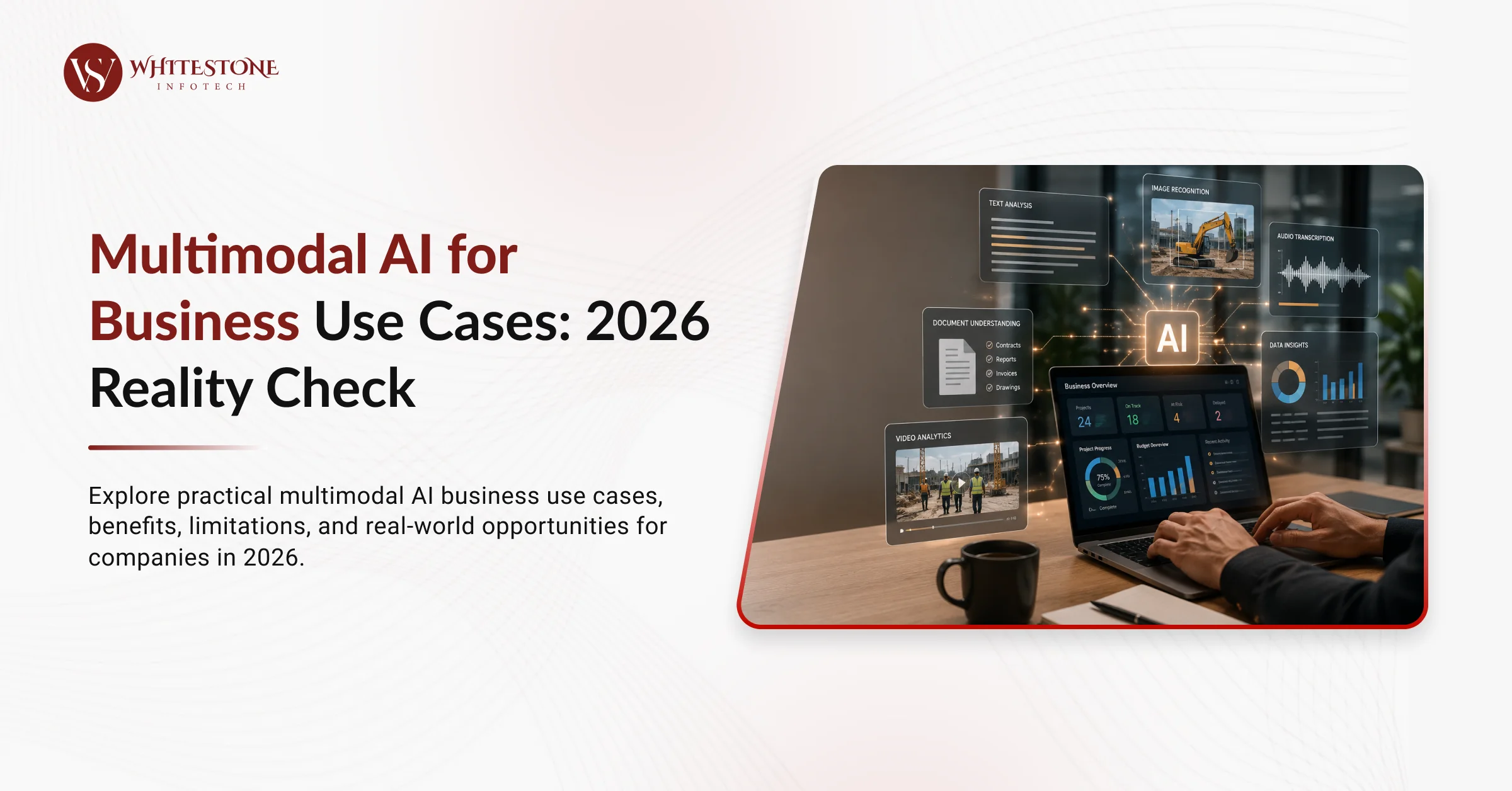
Six modality combinations at different maturity levels.
Text + image. Mainstream and reliable. GPT vision, Claude vision, Gemini all handle image understanding, chart reading, product photo analysis, screenshot interpretation. Works well in production.
Text + PDF and document. Mainstream. Document understanding including structure, tables, embedded images, forms. Works well for most business documents.
Text + spreadsheet. Mainstream. Reasoning over tabular data with column and row understanding. Works well for standard business spreadsheets.
Text + audio. Working reliably. Typically via transcription (Whisper, Deepgram, or vendor-native) then LLM reasoning over transcript. Native audio-in models improving but transcription still dominant pattern.
Text + video. Working but expensive. Typically via frame sampling plus transcript rather than continuous video reasoning. Cost order of magnitude higher than text alone.
True cross-modal reasoning. Still limited. Reasoning that genuinely requires simultaneous understanding across modalities (e.g., "why does the graph on slide 4 contradict the number the speaker said at 3:22?") works better in demos than production.
Marketing "multimodal" often implies more than 2026 models actually deliver. Match your use case to the maturity level of the specific modality combination.
Seven Real Business Use Cases That Ship
Seven use cases we see shipping reliably.
1. Document + image analysis. Invoices with signatures, receipts with itemised layouts, contracts with embedded diagrams, purchase orders with product photos. Multimodal AI extracts structured data from mixed content. Common workflow: capture, extract, route, approve.
2. Video analysis. Customer support screen recordings, delivery proof video, ecommerce packing video, quality inspection recordings. Frame sampling plus optional transcript enables searchable, queryable video content. Common workflow: ingest, sample, analyse, index.
3. Multi-format enterprise Q&A. Knowledge base spanning PDFs, slide decks, spreadsheets, and Word documents. Multimodal RAG retrieves and reasons across formats. Common workflow: ingest, embed, retrieve, generate answer with citations.
4. Visual inspection. Manufacturing quality control, insurance damage assessment, construction safety compliance, retail shelf audit. Photo or video input, structured issue detection output. Common workflow: capture, analyse, report, action.
5. Video meeting analysis. Transcript plus shared screen plus slides analysed together. Action items, decisions, sentiment, follow-up detection. Common workflow: record, transcribe, analyse, distribute summary.
6. Retail and e-commerce. Product photo + specifications + review text analysed together. Auto-catalogue enrichment, quality control, comparative shopping, visual search. Common workflow: ingest, enrich, index, serve.
7. Regulated content review. Medical imaging with patient records, insurance claims with damage photos, legal contracts with exhibits. Domain-specific reasoning across text and image. Common workflow: ingest, analyse, flag, human review.
These seven are not exhaustive. They are the categories where we see production deployments reliably in 2026. See OpenAI platform documentation and Anthropic Claude vision documentation for capability details on each modality.
GPT vs Claude vs Gemini: Multimodal Comparison
Three model families dominate business multimodal deployment.
GPT (OpenAI). Strong vision capability with mature ecosystem. Competitive audio. Broad model tier options (GPT-4o for flagship, mini for cost). Best for teams already committed to OpenAI ecosystem or needing broad third-party integration.
Claude (Anthropic). Strong vision especially for document and diagram reasoning. Long-context multimodal (200k+ tokens including images). Best for document-heavy workloads, technical reasoning, and long-context requirements.
Gemini (Google). Native multimodal architecture (built multimodal from ground up rather than added). Competitive on video reasoning. Strong integration with Google Workspace ecosystem. Best for teams already in Google Cloud or needing native video handling.
Capability rankings shift month by month as each vendor releases updates. Test all three on your specific use case rather than choosing on general reputation. Real capability differences on your workload often reverse the general narrative.
Real 2026 Cost Bands
Vision API costs.
Text + image: roughly 2 to 4 times text cost per equivalent input token, depending on image resolution and model tier
Small model + image: cheapest multimodal option, adequate for many workloads
Flagship model + image: higher cost but stronger reasoning
Video costs.
Continuous video reasoning: order of magnitude more expensive than text
Frame sampling (1 frame per 5-30 seconds): much cheaper, works well for most inspection and analysis workloads
Video-first models (Gemini): competitive when video is central to use case
Infrastructure costs.
Multimodal RAG setup: £15k to £80k depending on complexity and data volume
Vector database with image embeddings: £500 to £5k monthly
MLOps for evaluation: engineering time to build and maintain
Per-workload budget estimates.
Document + image workflow (invoice processing at moderate volume): £2k to £15k monthly
Video analysis (moderate volume): £5k to £30k monthly with sampling, higher without
Enterprise multi-format Q&A: £5k to £25k monthly at moderate volume
Budget realistically for the specific workload rather than extrapolating from text-only benchmarks.
What Still Fails in Production
Four categories where multimodal still disappoints.
Very small text in images. OCR quality dependent. Handwriting on low-resolution photos. Small text on badly-lit receipts. Preprocessing (image enhancement, dedicated OCR) helps but does not eliminate failure.
Complex diagram reasoning. Standard business charts work. Unusual architecture diagrams, complex flowcharts with many crossing lines, hand-drawn diagrams often fail or produce plausible-sounding wrong answers.
Long-form video reasoning without sampling. Reasoning across 2+ hour video content at production cost is still not viable. Frame sampling plus transcript analysis is the workable pattern.
Real-time video analysis at production cost. Live video analysis (surveillance, drone feeds, streaming) is possible in demos but cost prohibitive at production scale for most workloads.
Design around these limits. Product bets on capability that is not there yet cost 6-12 months of engineering.
What We Learned Building TrackVid
TrackVid is our video proof and claim management platform for Indian ecommerce sellers. Video analysis at scale is core to the product. Two lessons transfer directly.
Frame sampling beats continuous video reasoning economically. Our first architecture attempted continuous video analysis. Cost was prohibitive at target volume. Second architecture uses frame sampling (1 frame per 2-5 seconds depending on content type) plus optional transcript. Cost dropped 80-plus percent. Quality on our workload was comparable.
Domain-specific evaluation harness catches what general benchmarks miss. General multimodal benchmarks did not reflect our specific use case (packing verification, damage detection, quantity confirmation). We built domain-specific golden test set with real customer scenarios. Model updates now get evaluated against real workload, not vendor benchmark suite.
You can see TrackVid at our portfolio. If you want a candid conversation about your multimodal use case, book a multimodal AI call with WhiteStone.
Common Failure Modes
Three failure modes we see repeatedly.
Choosing model on general reputation without workload testing. Vendor A wins general benchmarks. Team commits to Vendor A. Real workload reveals Vendor B is materially better. Six months of engineering on wrong foundation.
Skipping evaluation harness. Model updates ship without regression testing. Quality drifts. Users notice before team does.
Attempting continuous video reasoning at production scale. Demo works on 5-minute video. Production requires 5-hour video volume. Cost prohibitive. Programme cancelled. Frame sampling was the answer from the start.
Frequently Asked Questions
What is multimodal AI in 2026?
AI that reasons across multiple input modalities (text, image, video, audio, document, spreadsheet). In 2026, text + image and text + document are mainstream and reliable. Text + video works via frame sampling. True cross-modal reasoning on complex tasks is still limited.
Which business use cases actually work with multimodal AI?
Seven categories ship reliably: document + image analysis (invoices, receipts, contracts), video analysis via frame sampling, multi-format enterprise Q&A, visual inspection (quality, damage, safety), video meeting analysis, retail and e-commerce enrichment, and regulated content review.
GPT-4o vs Claude vision vs Gemini multimodal?
GPT for mature vision plus audio ecosystem. Claude for strong document and diagram reasoning with long-context. Gemini for native multimodal architecture with strong video. Test all three on your specific workload rather than choosing on general reputation. Capability differences shift monthly.
How much does multimodal AI cost in 2026?
Vision API roughly 2 to 4 times text cost per equivalent token. Video costs order of magnitude more than text alone. Multimodal RAG infrastructure £15k to £80k setup. Per-workload budget varies from £2k monthly for document processing to £30k plus monthly for video analysis at moderate volume.
What multimodal AI use cases still fail in production?
Very small text in images (OCR-dependent), complex diagram reasoning on architecture drawings, long-form video reasoning without frame sampling, and real-time video analysis at production cost. Design around these limits rather than betting on capability that is not yet reliable.
The One Thing to Remember
Multimodal AI in 2026 is mature for text + image, text + document, and text + video via sampling. It is still limited for continuous video reasoning, complex diagram reasoning, and real-time video at production cost.
The teams that ship successful multimodal products match use case to genuine capability, test their specific workload against multiple vendors rather than choosing on general reputation, and design around known limitations rather than betting on capability that is not yet there.
If you want a candid conversation about your specific use case, browse our AI development services or come to the call.