
A UK SaaS CTO we spoke to last quarter had built a pool multi-tenant B2B SaaS 18 months earlier. First 200 tenants were SMB customers at £80 per month. Recently his sales team had closed 3 enterprise customers at £4000 per month each, and each demanded dedicated database, data residency in specific regions, and SOC 2 evidence that their data was not co-mingled with other tenants. His pool architecture could not support this. Migration to hybrid meant 4-6 months of engineering work while the enterprise customers waited. He asked whether he should have built hybrid from day one.
The honest answer was yes, but only if he had known enterprise customers were coming within 18 months. He had built pool because that was the right answer for his original SMB customer profile. It was still the right answer for those 200 tenants. The mistake was not the pool architecture; it was the lack of migration path to hybrid when the customer profile changed. Adding silo capacity to an existing pool architecture is expensive but achievable in months if the tenant boundaries were clean from day one. It becomes impossible if tenant_id leaks throughout the codebase without discipline.
That is the multi tenant saas architecture conversation across UK and US SaaS teams in 2026. Pool is the right starting point for most SaaS. Silo is the right answer for enterprise-heavy SaaS from day one. Hybrid is where most SaaS ends up at scale. And the migration paths between them determine whether architecture decisions in year 1 constrain business options in year 3.
This article is a candid guide to multi-tenant SaaS architecture from an agency running multi-tenant systems in production for TrackVid and IELTSArena. Three main patterns. Trade-offs on cost, isolation, ops burden, and noisy neighbour risk. Real 2026 cost bands. Tenant isolation strategies. Migration paths between patterns. What we learned building pool for TrackVid Indian merchants and hybrid for IELTSArena global teachers.
The Three Main Multi-Tenant Patterns
Every multi-tenant SaaS lands on one of three architectural patterns.
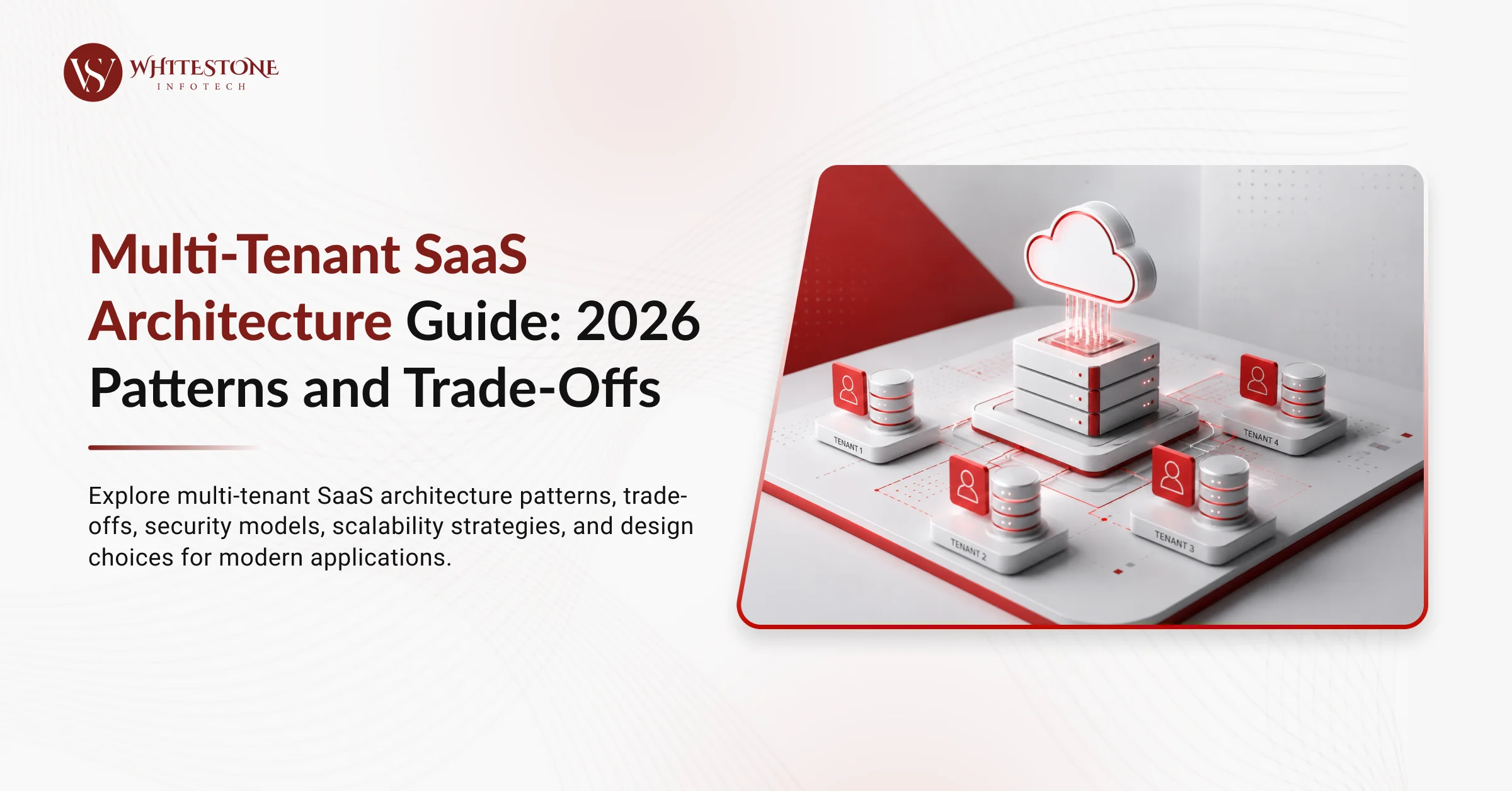
Pool (all tenants share database and app). Single shared database with tenant_id column on every table. Single shared app instance. Row-level isolation enforced at query time. Lowest cost per tenant. Highest noisy-neighbour risk. Compliance-adjacent workloads face harder audit story.
Silo (each tenant gets dedicated database and app). Dedicated database instance per tenant. Dedicated app instance or namespace per tenant. Physical isolation. Highest cost per tenant. Zero noisy-neighbour risk. Cleanest compliance and audit story. Complex tenant provisioning and management.
Hybrid (shared app tier, tier-specific database strategy). Shared app tier serves all tenants. Free and pro tenants share pooled database. Enterprise tenants get dedicated database instances routed by tenant tier. Balance between cost and isolation. Most complex to build but most flexible at scale.
Per Martin Fowler's multi-tenancy patterns, the choice between these patterns is not primarily technical but economic: which pattern best matches your tenant economics and isolation requirements at the scale you actually operate.
Pool Multi-Tenancy: When It Is the Right Answer
Pool multi-tenancy is the right starting point when:
Tenants are SMB, prosumer, or B2C (low ACV per tenant)
Cost per tenant matters heavily (£1-£100/month range)
Tenants can accept shared resources (no contractual demand for dedicated infrastructure)
Compliance requirements are baseline (GDPR, general privacy) rather than tenant-specific isolation
Ops team is small and cannot manage many database instances
Product does not have data-heavy workflows that create noisy-neighbour risk
Implementation. Every table has tenant_id column. Every query filters by tenant_id. Middleware enforces tenant context on every request. Row-level security policies at database layer as second-line defence. Postgres row-level security, MySQL views, or application-layer enforcement.
Advantages. Lowest infrastructure cost per tenant. Simplest ops (one database to backup, one app to deploy). Easy to onboard new tenants (row insert). Cost scales sub-linearly with tenant count.
Trade-offs. Noisy neighbour risk (heavy tenant slows all tenants). Compliance story harder (need to prove isolation to auditors). Data residency by region requires physical database duplication. Difficult to migrate individual tenants to dedicated infrastructure without downtime.
Silo Multi-Tenancy: When It Is the Right Answer
Silo multi-tenancy is the right starting point when:
Tenants are enterprise (high ACV, typically £50k+ annually per tenant)
Regulated industries with strict isolation requirements (healthcare with HIPAA, financial services)
Contract-required infrastructure separation
Data residency in specific regions is contractual
Tenants have heavy variable workloads (batch processing, data-heavy analytics)
Compliance and audit story is a sales requirement
Implementation. Dedicated database instance per tenant. Kubernetes namespace or separate app deployment per tenant. Tenant provisioning automation (Terraform, Pulumi, custom scripts). Centralised identity and access management with tenant routing.
Advantages. Zero noisy-neighbour risk. Cleanest compliance story (physical isolation demonstrable). Data residency straightforward (deploy in target region). Tenant-specific customisation and versioning possible. Failures isolated to single tenant.
Trade-offs. Highest infrastructure cost per tenant. Complex ops (many databases to backup, many app instances to deploy). Provisioning automation is a significant engineering investment. Cost scales linearly with tenant count.
Hybrid Multi-Tenancy: When It Is the Right Answer
Hybrid multi-tenancy is the right pattern when:
Product has clear tenant tier separation (free/pro/enterprise)
Enterprise customers are on the roadmap but not immediate (build for the transition)
Some tenants have compliance requirements the pool cannot meet
Data-heavy workflows create noisy-neighbour risk for some tenants
SaaS is scaling past £2m-£5m ARR with mixed customer profile
Implementation. Shared app tier serves all tenants. Tenant routing layer determines which database backend serves each request. Pool database for free/pro tenants. Dedicated database instances for enterprise tenants. Consistent tenant context propagation regardless of backend.
Advantages. Cost efficient for low-value tenants (pool economics). Compliance-ready for high-value tenants (silo economics). Migration path between tiers built-in. Flexible enterprise sales response.
Trade-offs. Most complex to build. Tenant routing layer adds latency. Two database maintenance strategies to manage. Migration between pool and silo requires careful data movement.
Real 2026 Cost Bands
Pattern | Build cost (MVP tenant-aware architecture) | Monthly infrastructure (100 tenants) | Ops burden |
Pool | £15k-£80k | £500-£3000 | Low |
Silo (20 enterprise tenants) | £80k-£300k | £3000-£15000 | High |
Hybrid | £120k-£450k | £5000-£25000 | Medium-High |
Two rules that hold at every pattern. Total 3-year TCO is typically 2-2.5x initial build cost due to ongoing architecture evolution, tenant provisioning, and monitoring. And migration from pool to hybrid typically costs 40-70 percent of a hybrid greenfield build if tenant boundaries were clean from day one; 200+ percent if they were not.
Tenant Isolation Strategies
Regardless of pattern, tenant isolation must be enforced at multiple layers.
Application layer. Middleware injects tenant context on every authenticated request. Repository or ORM layer filters by tenant_id automatically. No query can execute without tenant context.
Database layer. Row-level security policies (PostgreSQL RLS, similar in other DBs) as second-line defence. Tenant_id column on every table with foreign key discipline. Automated tests that verify cross-tenant queries return empty.
API layer. JWT or session token carries tenant context. Rate limiting per tenant to prevent noisy neighbour impact. API keys scoped to tenant with no cross-tenant permissions.
Cache layer. Cache keys include tenant_id (prevent tenant A seeing tenant B's cached data). Cache invalidation scoped to tenant.
Background jobs. Job payloads carry tenant context. Job workers filter by tenant. Worker pools per tenant tier if noisy neighbour risk high.
Observability. Logs, metrics, and traces tagged with tenant_id. Ability to audit "what did tenant X do in the last 30 days" straightforwardly.
Per AWS's SaaS Lens best practices, tenant isolation failures are the most common security incident category for multi-tenant SaaS, typically caused by missing tenant context in one code path rather than architectural failure.
What We Learned Running Multi-Tenant SaaS Across Our Own Products
WhiteStone runs multi-tenant SaaS in production for TrackVid and IELTSArena. Three lessons transfer to any UK or US SaaS choosing multi-tenant architecture.
TrackVid runs pool multi-tenancy and it is the right answer. TrackVid serves 4000+ Indian ecommerce merchants at £15-£40 per merchant per month. Pool database with tenant_id on every table. Row-level security policies at PostgreSQL. Application-layer tenant context on every request. Infrastructure cost per merchant is roughly £0.50 monthly. Silo economics would be uncompetitive at TrackVid's price point.
IELTSArena runs hybrid multi-tenancy for student vs teacher accounts. Free-tier students share pooled infrastructure at effectively zero cost per user. Teacher and school accounts (paid tier) run in dedicated database instances with data residency options. This split matched the customer economics: students needed to be free at scale, teachers needed the isolation and residency guarantees for their institutional buyers.
We rebuilt tenant boundaries once in TrackVid and it took 4 months. Original TrackVid architecture had tenant_id enforced at application layer but not database layer. Rebuild added PostgreSQL row-level security policies, automated cross-tenant isolation tests, and cache key isolation. 4 months of engineering time we could have avoided with 2 weeks of extra work in the original build.
See our portfolio of shipped work for other multi-tenant SaaS case studies. For a scoped multi-tenant architecture conversation, book a SaaS architecture call with WhiteStone.
Common Failure Modes
Building silo when pool was the right answer. Team assumes enterprise customers will arrive within 6 months and builds silo from day one. Enterprise customers do not arrive. Infrastructure cost per tenant is 10x competitors. Fix: build for the customer profile you have; add silo capability when enterprise deals are 3-6 months out, not before.
Building pool with no migration path to hybrid. Team builds pool with tenant_id enforcement only at application layer. Enterprise customers arrive. Migration to hybrid requires rewriting isolation across 30+ tables. Fix: enforce tenant_id at database layer from day one even in pool architecture; the migration path is what matters.
Underestimating tenant provisioning automation for silo. Team builds silo assuming manual tenant provisioning is fine at 10 tenants. Reaches 30 tenants. Manual provisioning becomes bottleneck. Fix: tenant provisioning automation is not optional for silo above 15-20 tenants.
Ignoring noisy neighbour risk in pool. Team runs pool with no per-tenant rate limiting or resource quotas. One heavy tenant degrades experience for all. Fix: per-tenant rate limits and resource quotas from day one in pool architecture.
Frequently Asked Questions
What is multi-tenant SaaS architecture and why does it matter?
Multi-tenant SaaS architecture serves multiple customer organisations (tenants) from shared infrastructure. It matters because the pattern chosen determines cost economics per tenant, compliance capability, ops burden, and business model flexibility. Wrong pattern for the customer profile costs 5-10x more than right pattern and constrains business options for years.
What are the main patterns for multi-tenant SaaS in 2026?
Three patterns: pool (all tenants share database and app, lowest cost, highest noisy-neighbour risk), silo (each tenant gets dedicated database and app, highest cost, cleanest compliance), and hybrid (shared app tier with tier-specific database strategy, balances cost and isolation). Most modern SaaS at scale runs hybrid rather than pure pool or pure silo.
What is the difference between pool, silo, and hybrid multi-tenancy?
Pool: all tenants share one database and app; row-level isolation via tenant_id. Silo: each tenant has dedicated database and app; physical isolation. Hybrid: shared app tier; pool database for free/pro tenants and dedicated databases for enterprise tenants, routed by tenant tier. Pool is cheapest and most noisy. Silo is most isolated and expensive. Hybrid balances both.
How do you handle tenant isolation in a multi-tenant SaaS?
Multi-layer enforcement: application middleware injects tenant context on every authenticated request, database row-level security policies (Postgres RLS or similar) as second-line defence, JWT or session tokens carry tenant context, cache keys include tenant_id, background job payloads carry tenant context, and observability tags logs/metrics/traces with tenant_id. Isolation failures typically caused by missing tenant context in one code path.
When should a SaaS use single-tenant instead of multi-tenant?
Single-tenant makes sense for very high-value enterprise SaaS (£100k+ ACV), regulated industries with strictest isolation requirements, on-premises deployment models, or products where per-tenant customisation is significant. Most modern SaaS above £2m ARR runs hybrid multi-tenant, not single-tenant. Pure single-tenant SaaS is uncommon at scale in 2026 outside specific enterprise verticals.
How much does multi-tenant SaaS architecture cost to build in 2026?
Pool multi-tenant £15k-£80k build for MVP tenant-aware architecture, £500-£3000 monthly infrastructure for 100 tenants. Silo multi-tenant £80k-£300k build for tenant provisioning automation, £3000-£15000 monthly infrastructure for 20 enterprise tenants. Hybrid multi-tenant £120k-£450k build, £5000-£25000 monthly for 100+ mixed tenants. Migration from pool to hybrid: 40-70 percent of hybrid greenfield if boundaries clean, 200+ percent if not.
Why choose WhiteStone Infotech for multi-tenant SaaS architecture?
We run multi-tenant SaaS in production for TrackVid (4000+ Indian ecommerce merchants on pool) and IELTSArena (hybrid for free students plus dedicated infrastructure for teacher accounts). Every architecture engagement starts with honest customer profile assessment (we tell you when pool is enough versus when hybrid is worth building from day one) and enforces tenant boundaries at every layer. Contact WhiteStone Infotech at whitestoneinfotech.com/contact.
The One Thing to Remember
Multi-tenant SaaS architecture choice in 2026 should be driven by your actual customer profile and 18-month roadmap, not by architectural preference. Pool is the right starting point for SMB and prosumer SaaS at £15-£100 monthly per tenant. Silo is the right starting point for enterprise SaaS above £50k ACV per tenant. Hybrid is where most successful SaaS lands at scale. The single decision that determines whether year-1 architecture constrains year-3 business options: is tenant isolation enforced at the database layer as well as application layer, or only at application layer. Database-layer enforcement is what makes migration between patterns achievable in months rather than years.
 for SaaS Products_ 2026 Compliance Guide.webp)
.webp)