A UK SaaS founder we spoke to last quarter had bought an enterprise zero-trust suite at £84k annual licence expecting it would unlock enterprise deals. His SaaS had 340 mid-market customers and was in early conversations with 3 enterprise prospects. Twelve months in, the enterprise suite had passed 2 SOC 2 audits, satisfied security questions from 2 of the 3 enterprise prospects, and consumed roughly 20 percent of his lead engineer's time on configuration and maintenance. Neither enterprise deal had closed. The founder asked whether the £84k was worth it.
The honest answer was more complicated than yes or no. The enterprise suite had over-solved his current situation. His actual security posture had been strong before the suite (WorkOS for SSO, MFA on admin actions, service-to-service auth with mTLS, encryption everywhere, comprehensive audit logging). The suite added device trust, formal micro-segmentation, and continuous monitoring that were valuable but not essential for his customer profile. Two enterprise prospects had asked for the specific answers he could now give but had also required contractual terms he could not accept, so those deals would not have closed even without the security spend.
His cheaper alternative would have been to keep the pre-existing setup (£12k annually for WorkOS plus internal engineering time), add device trust for admin actions only (Cloudflare Access at £8k annually for team size), and formalise his existing audit logging into a SOC 2 evidence portal. Total £22k annually instead of £84k. Same enterprise sales conversation outcomes at his current customer profile.
He kept the enterprise suite because switching cost exceeded first-year savings, but he wished he had scoped the decision more carefully before signing.
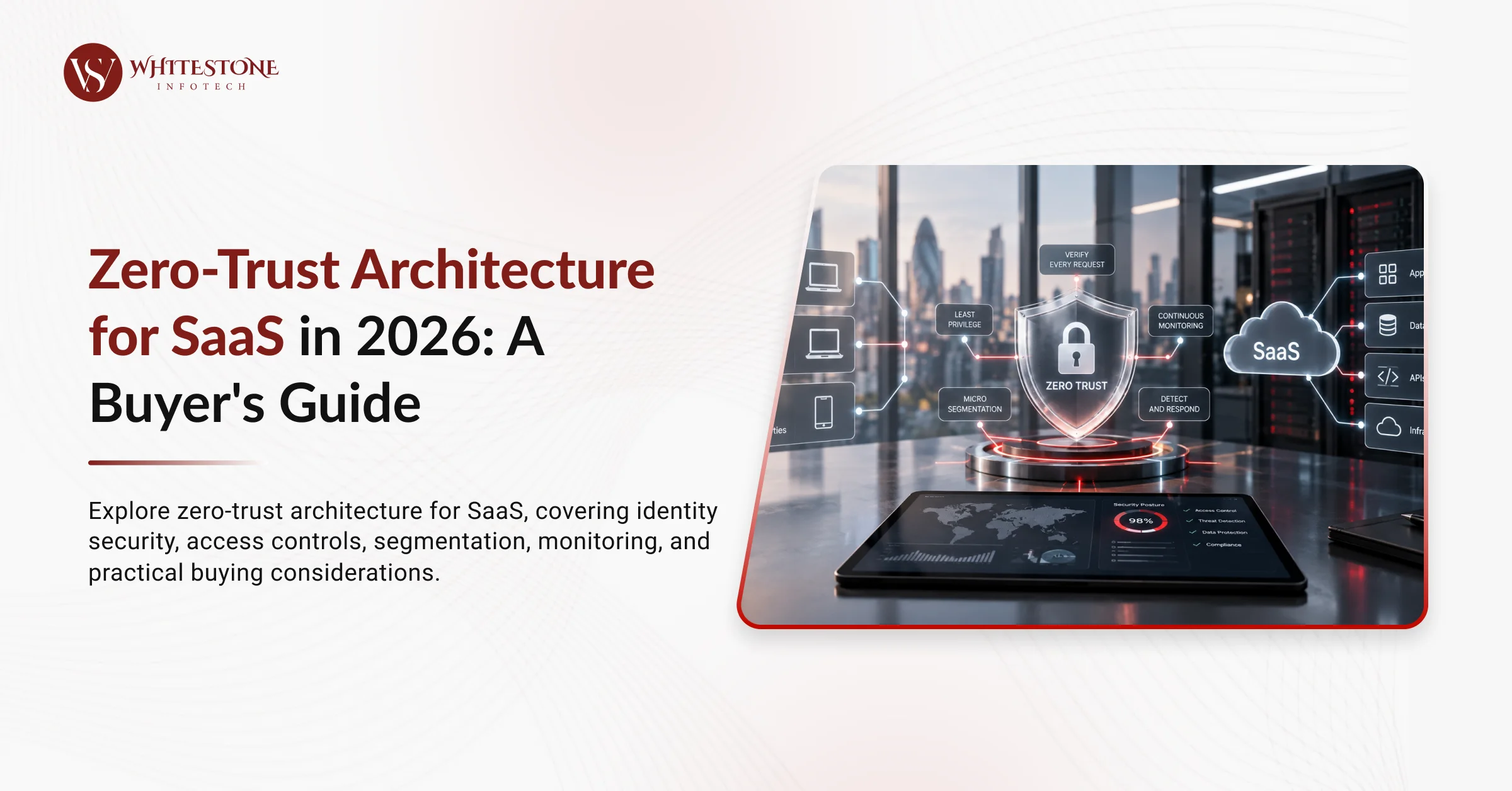
That is the zero trust architecture for saas 2026 conversation across UK and US SaaS founders and CTOs. Zero-trust architecture has matured into four practical layers with clear implementation patterns. Vendor marketing has expanded to cover almost anything cybersecurity-adjacent under the "zero trust" label. SaaS teams get sold enterprise zero-trust suites when their customer profile and threat model would be served by right-sized identity plus service-to-service authentication implementation at 15-25 percent of the cost.
This article is a candid buyer's guide for SaaS founders, CTOs, and security leaders scoping zero-trust investment. What zero trust actually means for a SaaS in 2026. Four practical layers with implementation guidance. Real cost bands at three SaaS scales. Vendor options with honest evaluation. What is actually vendor marketing. How to right-size implementation to customer profile and threat model.
The Four Practical Zero-Trust Layers for SaaS in 2026
Layer 1: Identity. SSO (SAML, OIDC), MFA on privileged actions, session validation, token refresh, secure logout, password policies, account lockout. Foundation of zero-trust for any SaaS. Every SaaS needs this layer implemented properly. Identity providers: Auth0 (Okta-owned), Clerk, WorkOS, Frontegg, Microsoft Entra External ID, AWS Cognito, custom on Keycloak.
Layer 2: Device trust. Device posture verification (managed device, patched OS, antivirus running), certificate-based device access, endpoint compliance checks. Applied to admin actions and privileged access in most SaaS; applied more broadly in high-security SaaS or SaaS serving regulated customers. Tooling: Cloudflare Zero Trust (Access), Zscaler ZPA, Microsoft Entra Conditional Access, Twingate, Tailscale for smaller setups.
Layer 3: Network micro-segmentation and service-to-service authentication. No implicit trust between services. mTLS between microservices. Service mesh (Istio, Linkerd) or vendor equivalent (AWS App Mesh, GCP Traffic Director). Network policies limiting service-to-service communication to explicit allow rules. Increasingly standard for mid-market and enterprise SaaS.
Layer 4: Data. Encryption in transit (TLS 1.3 everywhere), encryption at rest (native cloud KMS or dedicated key management), access logging with tamper-evident audit trail, minimum-privilege data access, data classification and handling policies. Foundation for SOC 2, HIPAA, GDPR compliance.
Per NIST Special Publication 800-207 Zero Trust Architecture and CISA's Zero Trust Maturity Model 2.0, zero-trust implementation matures across these layers over time; no organisation deploys all four layers at full depth on day one, and starting with identity is universally recommended.
Zero-Trust for Startup SaaS (Under 1000 Customers)
Focus at startup scale:
Identity layer first. SSO, MFA on admin actions, session security, token refresh done properly. Vendor: WorkOS, Clerk, or Auth0 free tier.
Basic data encryption. TLS 1.3 everywhere, cloud KMS for at-rest encryption, comprehensive audit logging.
Service-to-service authentication between backend services. mTLS or shared-secret authentication between internal services. Standard practice, not optional.
Skip device trust and heavy network segmentation. Not required at startup customer profile. Add when first enterprise customer demands it.
Realistic expectation: £5k-£30k initial implementation cost plus £4k-£15k annually for identity vendor. Enough for early SOC 2 Type I audit and mid-market customer security reviews.
Common mistake at startup scale: buying enterprise zero-trust suite that the customer profile does not require. £60k-£100k annual spend that delivers no additional revenue or security posture improvement.
Zero-Trust for Mid-Market SaaS (1000-10000 Customers)
Focus at mid-market scale:
Full identity layer. Enterprise SSO with SAML for customer-side SSO, granular RBAC, comprehensive session management. Vendor: WorkOS, Auth0 professional tier, Okta Workforce.
Device trust for admin and privileged access. Cloudflare Access, Twingate, or similar for admin panels and internal tools. Optional for customer-facing.
Service-to-service micro-segmentation. mTLS everywhere via service mesh or cloud native (AWS App Mesh, GCP Traffic Director). Network policies limiting communication.
Comprehensive access logging. Tamper-evident audit trail for all sensitive actions. Ready for SOC 2 Type II audit.
Formal encryption key management. Cloud KMS with customer-managed keys option for regulated customers.
Realistic expectation: £30k-£150k initial implementation cost plus £15k-£80k annually for identity plus device trust tooling. Ready for enterprise customer security reviews and SOC 2 Type II audit.
Zero-Trust for Enterprise SaaS (Over 10000 Customers or Regulated Customers)
Focus at enterprise scale:
Full four-layer implementation with formal zero-trust maturity assessment. External auditor or consultant scores maturity against NIST or CISA framework.
Enterprise identity platform. Okta Workforce, Microsoft Entra ID Governance, or equivalent. Advanced session management, adaptive authentication, identity governance.
Comprehensive device trust. Cloudflare Zero Trust or Zscaler ZPA across all access. Continuous device posture monitoring. Endpoint detection and response integration.
Formal micro-segmentation. Service mesh with dedicated platform team. Network policies audited and updated as services evolve.
Enterprise key management. Dedicated HSM or cloud HSM with formal key rotation policies. Customer-managed keys standard for regulated customers.
Continuous compliance evidence generation. Automated evidence collection for SOC 2 Type II, ISO 27001, HIPAA, or FedRAMP as customer profile requires.
Realistic expectation: £150k-£1m+ initial implementation cost plus £80k-£500k+ annually. Enterprise sales conversations require this maturity level.
Real 2026 Cost Bands
SaaS scale | Initial implementation | Annual ongoing | Primary vendor cost |
Startup (under 1000 customers) | £5k-£30k | £4k-£15k | WorkOS, Clerk, or Auth0 free tier |
Mid-market (1000-10000 customers) | £30k-£150k | £15k-£80k | WorkOS or Auth0 Pro + Cloudflare Access |
Enterprise (over 10000 or regulated) | £150k-£1m+ | £80k-£500k+ | Okta Workforce + Cloudflare Zero Trust or Zscaler |
Two rules that hold at every scale. Engineering time to implement and maintain zero-trust typically 40-60 percent of first-year cost; vendor licence alone significantly underestimates true cost. And zero-trust maturity is a journey, not a purchase; SaaS teams that treat zero-trust as a vendor decision without engineering investment produce compliance theatre rather than security improvement.
Vendor Options with Honest Evaluation
Auth0 (Okta-owned). Mature identity platform with wide feature coverage. Strong for mid-market SaaS. Pricing scales with monthly active users, becomes expensive at enterprise scale (5000+ MAUs enterprise-tier). Best for teams wanting proven vendor with wide ecosystem.
Clerk. Newer identity platform designed for modern JavaScript-first SaaS. Excellent developer experience. Best for startup and early mid-market SaaS on Next.js, Remix, or similar. Less mature enterprise features than Auth0.
WorkOS. Enterprise-focused identity platform. Excellent SSO/SAML for customer-side. Strong compliance features. Best for SaaS selling into enterprise from early stage. Simpler pricing than Auth0.
Cloudflare Zero Trust. Comprehensive zero-trust platform including Access (device trust), Gateway (network filtering), Browser Isolation. Best for teams already on Cloudflare. Competitive pricing at mid-market and enterprise scale.
Zscaler. Enterprise zero-trust incumbent. Comprehensive ZPA (Zero Trust Access) and ZIA (Zero Trust Internet Access). Enterprise pricing and enterprise sales cycle. Best for SaaS with enterprise customer commitments already in place.
Microsoft Entra (formerly Azure AD). Zero-trust integrated into Microsoft stack. Excellent for SaaS with substantial Microsoft customer base. Native integration with Conditional Access. Best for Microsoft-integrated SaaS.
Custom on Keycloak or Ory. Open-source foundation for teams with security engineering capacity. Lowest licence cost, highest engineering investment. Best for teams with dedicated platform engineering team.
What Is Actually Vendor Marketing in 2026
Zero-trust rebranded as anything cybersecurity-adjacent. Vendors selling firewalls, DLP, SIEM, or endpoint tools under zero-trust label without clear tie to the four practical layers. Read the actual product features, not the marketing framing.
Zero-trust point solutions sold as complete zero-trust. A single-product deployment (identity only, or network only) marketed as "zero-trust". Complete zero-trust requires all four layers implemented proportionately to threat model.
Zero-trust as universal replacement for perimeter security. Marketing suggesting zero-trust eliminates need for perimeter security. Reality: hybrid perimeter-plus-zero-trust is often the pragmatic answer, especially for SaaS with predictable customer network patterns.
Enterprise zero-trust suites sold to SaaS startups. Vendor pitches £80k-£150k enterprise suite to startups where identity provider alone at £6k-£12k would deliver 80 percent of the value. Right-size to customer profile and threat model.
Continuous verification everywhere at all times. Marketing suggesting every request to every service should be continuously re-verified against fresh device posture and identity signals. Reality: continuous verification has performance and cost implications; most SaaS need periodic re-verification (per session, per privileged action) not continuous.
What We Learned Shipping SaaS in Regulated Industries
WhiteStone has shipped SaaS in regulated industries including IELTSArena (education with student data), SAGE (Shopify merchant automation with commercial data access), and healthcare projects with patient data handling. Three lessons transfer to any SaaS scoping zero-trust investment.
Identity done properly is 60-70 percent of zero-trust value at startup and mid-market scale. SAGE, IELTSArena, and our healthcare projects all invested first in proper identity implementation (SSO, MFA on privileged actions, session security, token refresh, secure logout, comprehensive audit logging on identity events). This single layer implemented properly delivers most of the zero-trust value that startup and mid-market SaaS actually need. Adding device trust, formal micro-segmentation, and continuous monitoring layers ahead of demand consistently under-delivers value versus cost.
Service-to-service authentication is non-negotiable regardless of SaaS scale. Every SaaS with more than one backend service should authenticate service-to-service communication (mTLS, shared secrets rotated, or service-mesh-managed identities). This is not optional and does not require enterprise zero-trust vendor tooling; standard practice with modern service infrastructure.
SOC 2 evidence generation is often more valuable than additional zero-trust capability. For SaaS selling into mid-market and enterprise, comprehensive audit logging with tamper-evident storage and SOC 2 evidence generation often unlocks more customer deals than additional zero-trust vendor capability. Right-size zero-trust investment against actual customer security review questions, not vendor pitches.
See our portfolio of shipped work for SaaS security case studies. For a scoped zero-trust conversation, book a SaaS security call with WhiteStone.
Common Failure Modes
Buying enterprise zero-trust suite without customer demand. UK SaaS founder buys £84k enterprise suite for 340-customer mid-market SaaS. Passes SOC 2 audits but does not close additional enterprise deals versus what right-sized £22k implementation would have. Fix: implementation depth should follow customer profile and demonstrated demand, not vendor pitches.
Skipping identity fundamentals for exotic zero-trust features. Team buys advanced device trust and micro-segmentation while identity layer has gaps (weak MFA, poor session management, missing audit logs). Fix: identity layer done properly first; other layers only after identity is solid.
Treating zero-trust as vendor purchase rather than engineering journey. Team buys vendor platform expecting it will make them zero-trust compliant. Discovers implementation requires substantial engineering time on integration, configuration, and ongoing maintenance. Vendor tools become expensive shelf-ware. Fix: budget engineering time (40-60 percent of first-year cost) alongside vendor licence.
Ignoring hybrid perimeter-plus-zero-trust as pragmatic answer. Team implements pure zero-trust everywhere including customer-facing services with predictable access patterns. Adds latency and cost without corresponding security benefit. Fix: hybrid pattern (perimeter for predictable customer access, zero-trust for internal and privileged access) is often more practical than universal zero-trust.
Frequently Asked Questions
What is zero trust architecture and how does it apply to SaaS in 2026?
Zero-trust architecture treats every access request as untrusted until verified, regardless of network location. For SaaS in 2026, it applies across four practical layers: identity (SSO, MFA, session validation), device trust (device posture verification), network (micro-segmentation, service-to-service authentication), and data (encryption, access logging, minimum-privilege). Not every SaaS needs every layer at every depth; implementation should match SaaS scale, customer profile, and regulatory context.
What are the actual components of zero trust that a SaaS needs?
Every SaaS needs: proper identity implementation (SSO, MFA on privileged actions, session security, token refresh, audit logging on identity events), service-to-service authentication (mTLS or shared secrets), and data encryption (TLS 1.3 in transit, KMS at rest). Mid-market SaaS adds device trust for admin access and comprehensive access logging. Enterprise SaaS adds continuous device posture monitoring, formal micro-segmentation, and enterprise key management.
How much does zero trust cost for a SaaS in 2026?
Startup SaaS (under 1000 customers): £5k-£30k initial plus £4k-£15k annually for identity vendor (WorkOS, Clerk, Auth0). Mid-market SaaS (1000-10000 customers): £30k-£150k initial plus £15k-£80k annually for identity plus device trust. Enterprise SaaS (over 10000 or regulated): £150k-£1m+ initial plus £80k-£500k+ annually. Engineering time typically 40-60 percent of first-year cost beyond vendor licence.
Should a small or mid-size SaaS implement zero trust?
Yes, right-sized to scale. Startup SaaS needs identity layer, basic data encryption, and service-to-service authentication (£5k-£30k initial cost). Skip device trust and heavy network segmentation until enterprise customers demand them. Common mistake is buying enterprise zero-trust suite before customer profile requires it, spending £80k-£150k when right-sized implementation at £15k-£30k would deliver same security posture and customer confidence.
What is the difference between zero trust and traditional perimeter security?
Traditional perimeter security trusts anything inside the network perimeter and defends the perimeter itself. Zero trust treats every access request as untrusted regardless of location. In practice, most modern SaaS run hybrid: perimeter security for predictable customer-facing access patterns, zero-trust for internal services, admin access, and privileged actions. Pure zero-trust everywhere adds cost and latency without corresponding benefit for predictable customer access patterns.
Which zero trust vendor should a SaaS choose in 2026?
Startup: WorkOS, Clerk, or Auth0 free tier for identity. Mid-market: Auth0 Pro or WorkOS plus Cloudflare Access for device trust. Enterprise: Okta Workforce or Microsoft Entra plus Cloudflare Zero Trust or Zscaler. Custom on Keycloak or Ory for teams with dedicated platform engineering capacity and lowest licence cost. Match vendor to SaaS scale and customer profile, not to vendor sophistication.
Why choose WhiteStone Infotech for SaaS zero-trust implementation?
We ship SaaS in regulated industries including IELTSArena (education with student data), SAGE (Shopify merchant automation), and healthcare projects with patient data handling. Every engagement starts with threat model and customer profile assessment (we tell you when enterprise zero-trust suite is overkill for your actual customer requirements) and implements identity fundamentals first. Contact WhiteStone Infotech at whitestoneinfotech.com/contact.
The One Thing to Remember
Zero-trust architecture for SaaS in 2026 has settled into four practical layers (identity, device trust, network, data). Not every SaaS needs every layer at every depth. Startup SaaS focuses on identity done properly plus service-to-service authentication (£5k-£30k initial, £4k-£15k annually). Mid-market SaaS adds device trust for admin and comprehensive access logging (£30k-£150k initial, £15k-£80k annually). Enterprise SaaS adds continuous device posture, formal micro-segmentation, and enterprise key management (£150k-£1m+ initial, £80k-£500k+ annually). The single decision that determines zero-trust ROI: is the SaaS implementing components proportionate to actual customer requirements and threat model, or is it buying vendor sophistication ahead of demand. Right-sized delivers security improvement and enterprise sales enablement. Over-scoped drains engineering time and inflates cost without corresponding gain.

 for SaaS Products_ 2026 Compliance Guide.webp)
.webp)