
I speak with CTOs and AI Leads regularly about their LLM implementation decisions. The same conversation keeps happening. Their vendor pitches recommend fine-tuning as the default. Their AI Lead is ready to commit six figures to a training programme. Their CTO cannot tell if the approach is right for the workload.
The honest answer is usually: prompting is enough, RAG solves what prompting cannot, and fine-tuning is only justified when the first two combined cannot deliver. Fine-tuning has become the last resort, not the default. Frontier model capability improved so much between 2023 and 2026 that workloads which would have required fine-tuning are now solved by good prompting alone.
This article is a candid decision framework for CTOs, AI Leads, and Heads of Engineering choosing an LLM implementation approach in 2026. What the three approaches actually are. When each fits best. Real cost comparison. And the hybrid pattern that almost every serious production system uses.
The Three Approaches Defined
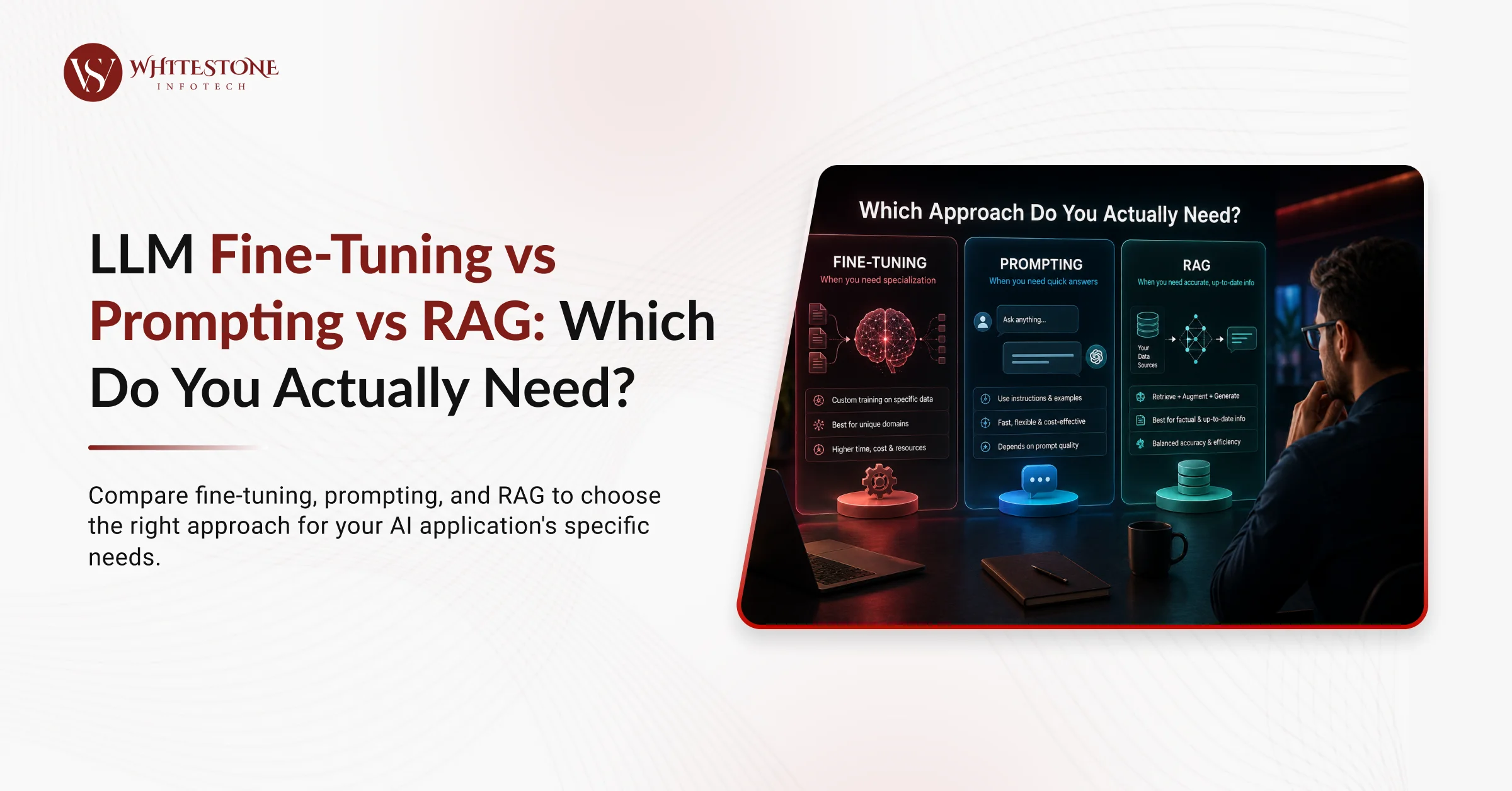
Prompting. Instructions in the input. System prompt sets behaviour, examples show format, few-shot demonstrations shape output. Zero training required. Fast to iterate. Effectively free to change tomorrow. Frontier models in 2026 have capability that makes prompting alone sufficient for most enterprise workloads.
RAG (Retrieval Augmented Generation). At query time, retrieve relevant chunks from your knowledge base (typically via vector database), include them in the prompt, model generates answer grounded in that retrieved context. Grounds LLM in your data without retraining. Enables citation trails. Handles updates by refreshing the knowledge base rather than retraining.
Fine-tuning. Retrain the model on domain-specific data. Changes model weights. Persistent behaviour change. Requires training data (typically 500 to 10,000+ curated examples), training infrastructure or vendor fine-tuning service, evaluation harness, and ongoing retraining as data or requirements evolve.
The three are not mutually exclusive. Production systems typically combine them: fine-tuned base model with RAG context and carefully engineered prompting on top.
Decision Framework: When Each Fits Best
Start with prompting. Add RAG when you need to ground answers in your data. Fine-tune only when prompting and RAG combined cannot deliver.
When prompting alone wins. General reasoning tasks, structured output with clear format requirements, tasks where flagship model quality is already sufficient. Anthropic and OpenAI both publish extensive prompting guides; the Anthropic Claude product page and OpenAI platform documentation are useful starting references.
When RAG wins.
Question answering over enterprise knowledge (Slack history, wiki, contracts, product documentation)
Regulated content requiring current authoritative sources with citations
Reducing hallucination risk on factual claims
Any workload where "what does OUR data say" is the actual question
Content that updates frequently and needs to reflect current state
When fine-tuning wins.
Specific output format that prompting cannot reliably enforce (very rare in 2026 with frontier models)
Cost sensitivity at very high volume: fine-tuned smaller model beats prompted flagship model at scale
Domain vocabulary where general models genuinely struggle (specialist medical, legal, scientific)
Consistent brand voice or tone requirement across all outputs
Latency requirements that only smaller fine-tuned models can meet
When fine-tuning does NOT win. Most enterprise workloads. Fine-tuning has become the last resort in 2026, not the default. Vendor sales pitches suggesting fine-tuning as first move should trigger scrutiny.
Real Cost Comparison
Prompting. Near-zero setup cost. Iteration cost is engineering time only. Pay-per-token inference at chosen model tier. Total 2026 monthly cost for typical enterprise workload: £500 to £15k depending on volume and model tier.
RAG. Setup cost £15k to £100k depending on complexity: data pipeline, embedding, vector database, retrieval logic, and evaluation harness. Ongoing infrastructure (vector database, retrieval compute): £500 to £5k monthly. Inference cost similar to prompting.
Fine-tuning. Setup cost £30k to £150k for a full programme: data curation (often the largest component), training run, evaluation harness, deployment infrastructure. Vendor fine-tuning fees: variable based on model and training tokens. Ongoing retraining cost when data or requirements change: £5k to £30k per retrain, typically every 3 to 6 months.
Combined. A production system using prompting + RAG typically costs £15k to £120k in initial setup, £500 to £8k monthly to run at moderate scale. Adding fine-tuning to that adds £30k to £150k initial plus retraining costs.
Match investment to actual need. Fine-tuning six figures a workload that prompting alone would solve is a common expensive mistake I see.
The Hybrid Reality: Almost Every Production System Uses All Three
The "vs" framing in the title is misleading. In 2026, serious production LLM systems typically combine all three approaches.
Prompting layer. Carefully engineered system prompt and few-shot examples for every LLM call. Baseline behaviour.
RAG layer. Retrieval from knowledge base at query time. Grounds LLM in enterprise data.
Fine-tuning layer (sometimes). For specific tasks where prompting and RAG cannot deliver the required cost, format, or vocabulary, a fine-tuned model handles that specific workload while other tasks route to the flagship prompted+RAG system.
Real-world architecture example:
Customer support triage: fine-tuned small model for classification (fast, cheap, high volume) → route to appropriate queue
First-response draft: prompted flagship model with RAG over knowledge base and product docs
Escalation summary: prompted flagship model with RAG over customer history
Same system uses three approaches for three different tasks. This hybrid pattern is the discipline that ships production value. Treating implementation as single-approach either/or leaves value on the table.
What We Learned Deploying AI in IELTSArena
IELTSArena is our AI IELTS preparation platform. We use LLMs for writing feedback and speaking evaluation. Two lessons transfer directly to the implementation decision.
Prompting solved workloads we thought needed fine-tuning. Our initial roadmap assumed we would fine-tune models for IELTS band descriptor evaluation. We started with careful prompting and few-shot examples. Prompting alone delivered accuracy within a few percentage points of trained IELTS examiners. We never needed the fine-tuning we had budgeted. Saved £80k plus ongoing retraining cost.
RAG grounds the model in current IELTS policy without retraining. IELTS policy updates periodically. Our RAG layer over IELTS official guidance, band descriptors, and past examiner reports means model responses reflect current policy. When guidance updates, we update the RAG source, not retrain the model. See our earlier post on Claude for business automation for the broader pattern.
You can see IELTSArena at our portfolio. If you want a candid conversation about your LLM implementation, book an LLM strategy call with WhiteStone.
Common Failure Modes
Three failure modes we see repeatedly.
Fine-tuning as default. AI team recommends fine-tuning without first trying prompting properly. Six figures spent on a training programme where good prompting would have delivered comparable results.
Skipping RAG for hallucination problems. LLM hallucinates on factual questions. Team's response is to fine-tune. Correct response is RAG with authoritative source grounding.
Treating implementation as single-approach. Team picks fine-tuning, prompting, or RAG as "the approach." Real production systems use all three. Locking to one limits solution space.
Frequently Asked Questions
When does prompting beat fine-tuning in 2026?
Almost always as the first attempt. Frontier models in 2026 have capability that eliminated many workloads that would have required fine-tuning in 2023. Start with prompting, add RAG if grounding needed, fine-tune only when prompting and RAG together cannot deliver required quality, format, or cost profile.
When does RAG beat both?
When the workload is "what does OUR data say" (enterprise knowledge Q&A, regulated content needing citations, reducing hallucination on factual claims). RAG grounds LLM in your knowledge base without changing model weights. Fine-tuning teaches the model general patterns; RAG provides specific current information.
How much data do you need to fine-tune?
Typically 500 to 10,000+ curated examples depending on task complexity. Below 500 you rarely see meaningful benefit vs prompting with few-shot examples. Above 10,000 diminishing returns unless training a genuinely specialist model. Data curation cost is usually larger than training compute cost.
How does RAG connect to fine-tuning?
They solve different problems and typically coexist. RAG grounds a model in current knowledge without retraining. Fine-tuning teaches model persistent patterns like format, vocabulary, or brand voice. A fine-tuned model with RAG on top is a common production architecture where both are justified.
Should we use OpenAI or Anthropic for fine-tuning?
Both offer fine-tuning services with different model families and pricing. OpenAI has broader model tier options for fine-tuning. Anthropic Claude fine-tuning is available for enterprise Bedrock customers with different constraints. Verify current fine-tuning capability and pricing at both vendors before deciding.
The One Thing to Remember
Fine-tuning is the last resort in 2026, not the default. Start with prompting. Add RAG when you need to ground the LLM in your knowledge. Fine-tune only when prompting and RAG together cannot deliver the quality, format, or cost profile you need. Almost every production LLM system uses two or three of these approaches in combination. Vendor pitches suggesting fine-tuning as first move should trigger scrutiny.
If you want a candid conversation about your specific implementation, browse our AI development services or come to the call.