A UK mid-market services firm CFO we spoke to last quarter had spent £1.6m on an "AI transformation" programme over 18 months. The programme had commissioned 14 pilots across departments. Two had reached production (customer support triage delivered £180k annualised value, contract review delivered £120k annualised value). Twelve were stuck at pilot stage for reasons that included data quality, integration friction, unclear ownership, or ROI that did not materialise.
He asked whether the programme was a failure. The honest answer was partial. Two pilots reached production with strong ROI on a £1.6m programme, so measured on adoption maturity the programme underperformed but was not a total loss. Measured on organisational learning, the programme identified which use cases had genuine ROI and which did not, which is valuable in itself. Measured on next-round investment, the CFO could now scope the next 12 months around what actually works rather than what sounded compelling in decks.
The consultancy that had built the programme framework had described a linear six-step methodology that assumed data quality was adequate, integration was straightforward, and users would adopt AI-augmented workflows. In practice each of these assumptions failed at some pilots. The methodology was not wrong; the assumptions were treated as given rather than as gates.
We advised the CFO to fund three specific expansions: expand customer support triage from the successful pilot to the full support organisation (well-defined workflow, clear ROI hypothesis, known integration approach); expand contract review to two additional legal workflows (specific scope, clear ROI); and end the ten stuck pilots that lacked data quality, integration approach, or clear ROI. He funded the three expansions and closed the others. Six months later the expanded programme was delivering £680k annualised value against £320k additional investment.
That is the enterprise ai adoption 2026 conversation across UK and US enterprises. Consulting frameworks describe a linear six-step process that assumes prerequisites. In production, each prerequisite is a gate that stops half the pilots. Scoped high-value use cases with disciplined phase gates consistently deliver ROI. Broad "AI transformation" programmes deliver mixed results because they scope by ambition rather than by workflow-specific ROI hypothesis.
This article is a candid playbook for UK and US enterprise leaders scoping AI adoption. Six phases that actually work. Six failure modes that consulting decks miss. Real ROI patterns. Real cost bands. How to operationalise governance beyond policy. What we learned shipping 50-plus AI-integrated products across enterprise use cases.
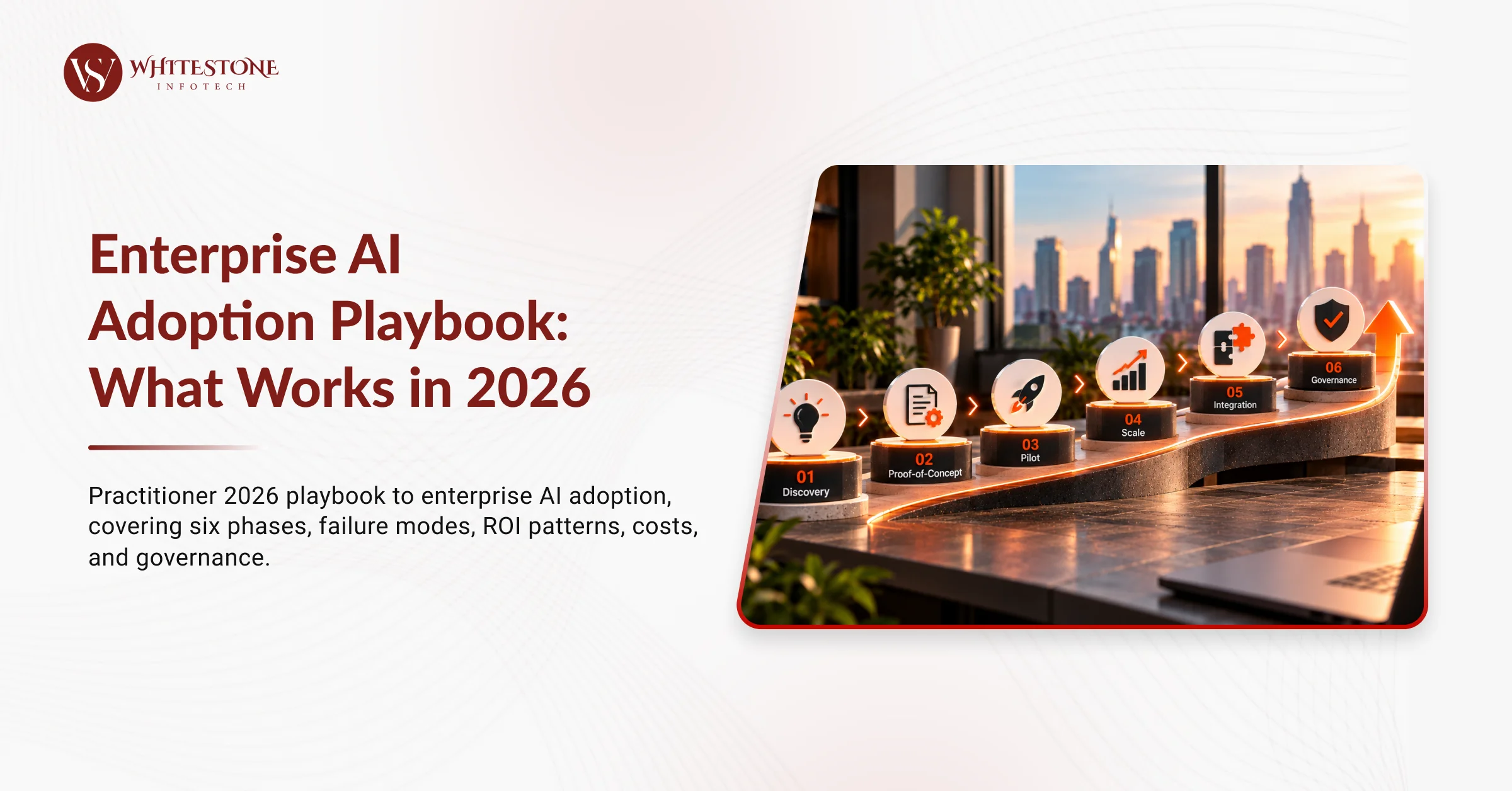
The Six-Phase Enterprise AI Adoption Framework
Phase 1: Discovery (4-8 weeks per use case). Workload identification (what specifically), feasibility assessment (can AI do this well enough), ROI hypothesis (what specifically will improve, by how much, over what timeframe). Output: prioritised use case list with ROI hypothesis and feasibility rating per use case.
Phase 2: Proof-of-Concept (6-12 weeks per use case). Scoped POC on real production data (not curated demo data). Offline evaluation against clear success metrics. Cost projection at production scale. Data quality assessment. Output: POC results with go/no-go decision for production pilot.
Phase 3: Production Pilot (8-16 weeks per use case). Production deployment with limited user scope. Monitoring, guardrails, and human-in-the-loop where appropriate. Real-world evaluation of user adoption and value delivery. Output: production pilot results with go/no-go decision for scale.
Phase 4: Scale (12-24 weeks per use case). Expand to full user base or workflow. Cost optimisation. Model refresh cadence establishment. Ongoing monitoring maturity. Output: production-scale AI capability delivering measured ROI.
Phase 5: Integration (12-24 weeks per use case). Embed AI into existing workflows and systems where decisions get made (CRM, ERP, ticketing, workflow tools). Users adopt AI-augmented workflows rather than AI as standalone features. Output: AI capability integrated into daily operations.
Phase 6: Governance (ongoing). Responsible AI monitoring, drift detection, model refresh, compliance, audit trail. Ongoing rather than time-bounded. Output: AI capability maintained at production quality over time.
Per McKinsey's 2026 State of AI report and IEEE's Responsible AI framework, the pattern that consistently delivers enterprise AI ROI in 2026 is scoped adoption with disciplined phase gates rather than broad transformation programmes; phase gate failure is common and expected, not exceptional.
The Six Failure Modes That Consulting Decks Miss
Failure mode 1: Data quality gates fail at Phase 2. Team assumes data quality is adequate for AI. POC reveals data is inconsistent, incomplete, or unreliable. Consulting deck said POC would take 8 weeks; actual takes 20 weeks including data quality remediation. Fix: data quality assessment before Phase 2 commitment; budget data quality work explicitly.
Failure mode 2: Integration effort under-scoped in Phase 5. Team completes Phase 4 (scale) then discovers Phase 5 (integration into existing workflows and systems) is 40-60 percent of total programme effort but consulting deck described it in one slide. Fix: integration architecture and effort scoped in Phase 1 discovery, not deferred to Phase 5.
Failure mode 3: Change management treated as afterthought. Team ships AI capability. Users do not adopt it because it does not fit their existing workflow, or they trust their existing approach more than AI output. Fix: change management (workflow design, user training, incentives, feedback loops) is scoped from Phase 1 as programme requirement.
Failure mode 4: POC cost is not predictive of production cost. Team runs POC on small scale. Cloud inference costs are manageable. Production scale reveals inference costs 10-100x POC. Fix: cost projection at production scale in Phase 2, not deferred until Phase 3 pilot reveals it.
Failure mode 5: Model drift and refresh cadence not planned. Team ships model into production. Six months later model quality degrades due to data drift, changed patterns, or upstream data changes. No refresh cadence exists. Fix: model refresh cadence and drift monitoring designed from Phase 3 pilot as production requirement.
Failure mode 6: Governance operationalised as policy without monitoring. Team develops responsible AI policy document. No monitoring, enforcement, or ongoing operation. Policy exists but does not prevent problems. Fix: governance operationalised with monitoring (bias detection, drift detection, prediction logging, audit trail) and enforcement (model rollback capability, incident response), not just policy documents.
Real Enterprise AI ROI Patterns in 2026
Four ROI patterns consistently emerge across enterprise AI adoption.
Pattern 1: High-value narrow use cases deliver 3-8x ROI within 12-18 months. Specific workflow automation (customer support triage, contract review, invoice processing, document classification) with clear scope and ROI hypothesis consistently delivers strong ROI. Requires disciplined scoping and phase gates.
Pattern 2: Broad "AI transformation" delivers mixed results. Programmes that scope by "transform the business with AI" deliver strong ROI in some areas while other areas underperform. Programme-level ROI is diluted; individual use case ROI within the programme varies widely.
Pattern 3: Documentation and knowledge management AI delivers immediate productivity gains. Enterprise search, document summarisation, and knowledge assistants deliver productivity gains but harder to measure ROI directly. Productivity gains often become obvious only after 6-12 months of consistent use.
Pattern 4: Customer-facing AI delivers ROI when integrated into existing workflows. Support AI, personalisation, and recommendation delivers ROI when it augments existing customer touchpoints rather than adding new AI-labelled features. Standalone "AI chatbot" adoption is typically low; embedded AI within existing flows adoption is high.
Real 2026 Cost Bands
Programme scale | Initial cost | Annual ongoing | Timeline to first ROI |
Small (single high-value use case, 1-3 workflows) | £150k-£500k | £50k-£150k | 6-12 months |
Mid-market (5-10 use cases across departments) | £500k-£2m | £150k-£600k | 9-18 months per use case |
Enterprise (broad AI adoption programme, 15+ use cases) | £2m-£12m+ | £600k-£3m+ | 12-24 months per use case |
Two rules that hold at every programme scale. Managed AI services cost (Bedrock, Azure OpenAI, Vertex AI) is typically 10-25 percent of total programme cost; integration effort, change management, and governance operationalisation dominate. And Phase 5 (integration) is consistently the highest-effort phase and consistently under-scoped in initial planning; explicitly budget 40-60 percent of programme effort for integration and change management.
How Enterprise AI Governance Actually Works in 2026
Governance operationalisation has four practical layers.
Layer 1: Policy. Responsible AI principles, use case approval criteria, model card requirements, incident response process. Foundation but not sufficient alone.
Layer 2: Monitoring. Bias detection across protected attributes, drift detection, prediction logging, quality metrics dashboarding. Continuous rather than periodic.
Layer 3: Enforcement. Model rollback capability, incident response with defined response times, audit trail sufficient for regulatory review, model card updates when models change.
Layer 4: Culture. Responsible AI training for developers, product managers, and business stakeholders. Incentives aligned with responsible AI outcomes. Escalation paths for concerns.
Policy without monitoring is compliance theatre. Monitoring without enforcement is data collection. Enforcement without culture is friction that gets worked around. All four layers matter.
What We Learned Shipping 50-Plus AI-Integrated Products
WhiteStone has shipped 50-plus AI-integrated products across enterprise use cases including customer-facing AI (TrackVid dispute detection and Auto Claim for 4000+ Indian ecommerce merchants), production AI at scale (IELTSArena AI scoring for tens of thousands of assessments monthly with responsible AI patterns), and various client AI use cases across UK and US enterprises. Three lessons transfer to any UK or US enterprise leader scoping AI adoption.
Scoped high-value use cases consistently beat broad transformation programmes. TrackVid dispute detection (specific workflow, clear ROI hypothesis, disciplined scoping) delivers measurable value for merchants. Broad "AI transformation" programmes at client enterprises consistently deliver mixed results (some use cases strong, others stuck). Adoption maturity is programme-level; ROI is use-case-level. Scope by use case with clear ROI hypothesis.
Integration and change management determine whether AI capability becomes AI value. IELTSArena AI scoring works because scoring is integrated into the assessment workflow that students already use and results integrate into feedback that students already read. Same for enterprise: AI capability that is not integrated into existing workflows delivers little value regardless of model quality. Budget integration and change management as first-class programme scope.
Governance operationalisation is not optional at production scale. IELTSArena AI scoring at scale requires bias monitoring across student demographics, drift detection as English test patterns evolve, prediction logging for dispute resolution, and model card updates when scoring model changes. Enterprise adoption of AI at scale requires the same. Policy documents without operational governance are compliance theatre.
See our portfolio of shipped work for enterprise AI case studies. For a scoped AI adoption conversation, book an enterprise AI advisory call with WhiteStone.
Frequently Asked Questions
What is enterprise AI adoption and what does it involve in 2026?
Enterprise AI adoption in 2026 is the disciplined process of identifying, developing, deploying, and operationalising AI capabilities that deliver measurable business value at production scale. Involves six phases: discovery (use case identification and ROI hypothesis), proof-of-concept (POC on real data), production pilot (deployment with limited scope), scale (expand to full user base), integration (embed into existing workflows), and ongoing governance (responsible AI monitoring). Scoped adoption with disciplined phase gates delivers ROI; broad transformation without workflow-specific scope delivers mixed results.
What is the standard enterprise AI adoption framework?
Six phases in sequence. Discovery (4-8 weeks): workload identification, feasibility, ROI hypothesis. Proof-of-concept (6-12 weeks): scoped POC on real data with offline evaluation. Production pilot (8-16 weeks): production deployment with limited scope. Scale (12-24 weeks): expand to full user base. Integration (12-24 weeks): embed into existing workflows and systems. Governance (ongoing): responsible AI monitoring, drift detection, compliance.
What are the common enterprise AI adoption failure modes?
Six failure modes. Data quality gates fail at POC (data assumed adequate, actually inconsistent). Integration effort under-scoped (Phase 5 is 40-60 percent of programme effort but described in one consulting slide). Change management treated as afterthought (users do not adopt AI-augmented workflows). POC cost not predictive of production cost. Model drift and refresh cadence not planned. Governance operationalised as policy without monitoring, enforcement, and culture.
How long does enterprise AI adoption typically take?
Timeline per use case: 6-12 months from discovery to first production ROI for high-value narrow use cases. 12-24 months for complex use cases requiring significant integration and change management. Broad "AI transformation" programmes typically require 18-36 months to deliver measurable programme-level ROI, with individual use cases delivering ROI at varying timescales within the programme.
What is the ROI of enterprise AI adoption in 2026?
High-value narrow use cases (specific workflow automation, targeted decision augmentation) consistently deliver 3-8x ROI within 12-18 months when scoped correctly. Broad "AI transformation" delivers mixed results with programme-level ROI diluted. Documentation and knowledge management AI delivers productivity gains harder to measure directly. Customer-facing AI delivers ROI when integrated into existing customer workflows rather than added as standalone features.
How does enterprise AI governance work in 2026?
Four operational layers. Policy (responsible AI principles, use case approval, model card requirements). Monitoring (bias detection, drift detection, prediction logging, quality metrics). Enforcement (model rollback capability, incident response, audit trail). Culture (training, incentives, escalation paths). Policy without monitoring is compliance theatre; monitoring without enforcement is data collection; all four layers matter for operational governance.
Why choose WhiteStone Infotech for enterprise AI adoption?
We have shipped 50-plus AI-integrated products across enterprise use cases. TrackVid AI (dispute detection, Auto Claim) delivers measurable value for 4000+ Indian ecommerce merchants. IELTSArena AI scoring runs at scale for tens of thousands of assessments monthly with responsible AI patterns. We have advised UK and US enterprises on scoped AI adoption with disciplined phase gates, and helped a UK mid-market services CFO restructure a struggling £1.6m programme into three expansions delivering £680k annualised value against £320k additional investment. Contact WhiteStone Infotech at whitestoneinfotech.com/contact.
The One Thing to Remember
Enterprise AI adoption in 2026 works through six phases in sequence: discovery, proof-of-concept, production pilot, scale, integration, and ongoing governance. What consulting decks consistently miss: data quality gates fail at POC, integration effort is 40-60 percent of programme (not one slide), change management is not optional, POC cost is not predictive of production cost, model drift requires refresh cadence, and governance requires monitoring plus enforcement plus culture (not just policy). Real cost: £150k-£500k small programme, £500k-£2m mid-market, £2m-£12m+ enterprise, with managed AI services 10-25 percent of programme cost and integration and change management dominating. Real ROI: scoped high-value use cases deliver 3-8x within 12-18 months; broad "AI transformation" delivers mixed results. The single decision that determines enterprise AI adoption ROI: scoped high-value adoption with disciplined phase gates and clear ROI hypotheses per use case, or broad "AI transformation" with vague benefits and diffuse ownership? Scoped adoption consistently wins.