
A UK SaaS founder we spoke to last quarter had built an AI-powered translation feature entirely on cloud inference (OpenAI GPT-4 API) for a mobile app with 12,000 monthly active users. Average round-trip latency 1.4 seconds. Monthly OpenAI bill £4,200. Users complained about the delay, and support tickets consistently mentioned "translation is slow".
He asked whether edge computing would help. The honest answer was that his specific translation workload (short phrases, 20 common language pairs, quality bar high but not GPT-4 required) was a strong fit for on-device inference using smaller specialised translation models via CoreML on iOS and TensorFlow Lite on Android. Hybrid architecture: on-device for the 20 most common language pairs and short-phrase translation, cloud inference only for less common pairs or long-form content.
We rebuilt the translation stack over 5 weeks. On-device models handled roughly 88 percent of translation requests with sub-80ms latency. Cloud inference retained for the remaining 12 percent where model size or language coverage required it. Monthly OpenAI bill dropped from £4,200 to £520. User-perceived latency dropped from 1.4 seconds average to 90ms for the common case. Support tickets about slow translation stopped.
That is the edge computing for ai apps 2026 conversation across UK and US AI product teams. Edge computing has matured significantly in 2024-2026 across all three tiers (on-device, edge platforms, cloud inference), and workload-appropriate placement often delivers 5-10x latency improvement and 60-90 percent cost reduction for the right workloads. But edge is not universally right. Large-model workloads, complex workflows, and state-heavy applications still win with cloud. The question is workload fit, not fashion.
This article is a candid guide for CTOs, product engineers, and technical founders scoping AI app architecture in 2026. Three tiers of AI inference. When each wins. Real cost bands. Common failure modes. What we learned shipping AI in production across all three tiers.
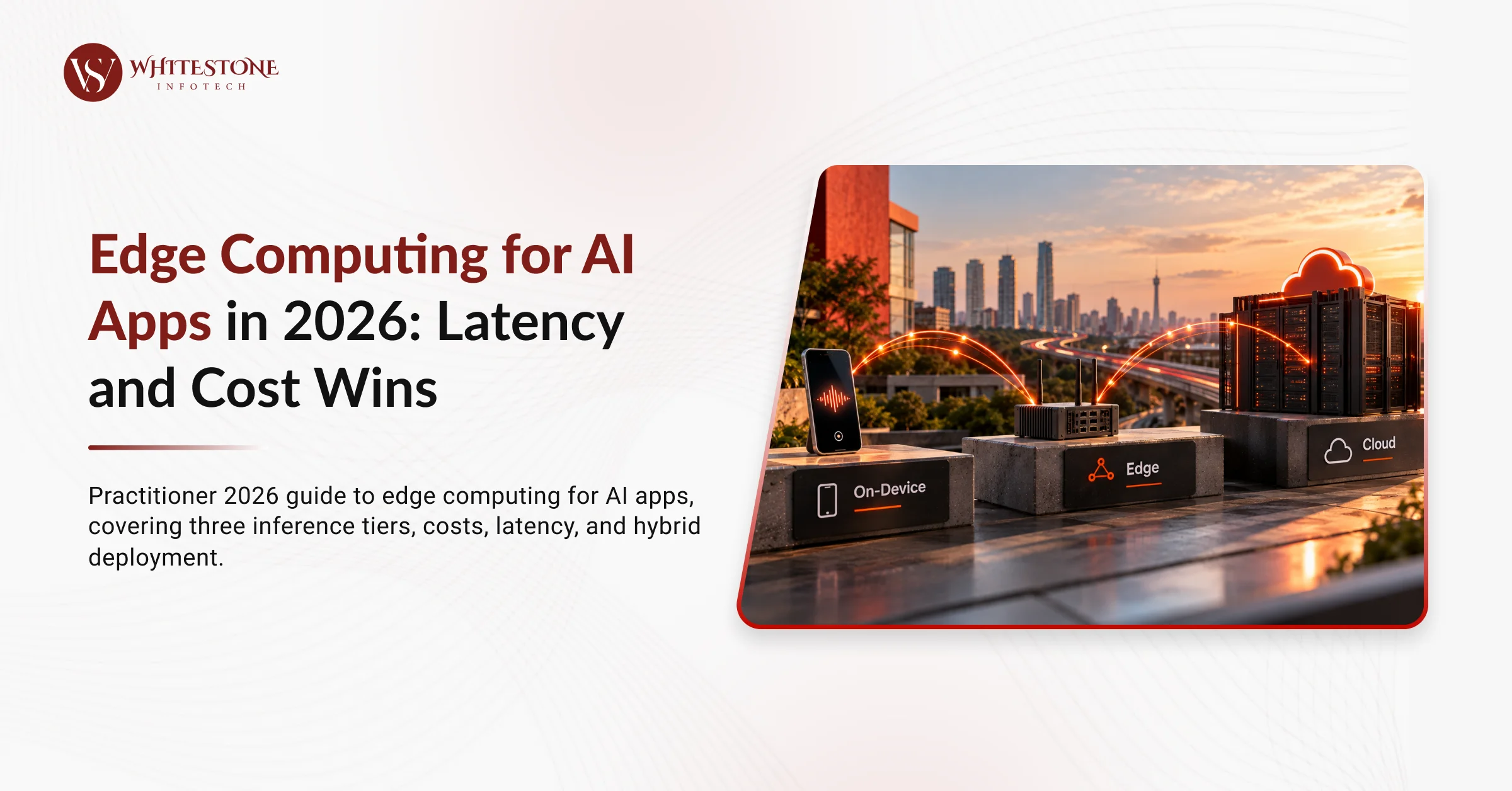
The Three Tiers of AI Inference in 2026
Tier 1: On-device inference. Mobile CoreML on iOS, TensorFlow Lite on Android, ONNX Runtime cross-platform. Delivers sub-50ms latency, near-zero per-inference cost after model download, privacy-preserving processing (data never leaves device). Best for small models (under 1B parameters typically), latency-critical UX, and privacy-sensitive workloads.
Tier 2: Edge platform inference. Cloudflare Workers AI (global edge inference at 300+ locations), Vercel Edge (Node.js edge functions with AI SDK integration), AWS Wavelength (5G edge computing at carrier locations), Azure Edge Zones (regional edge inference). Delivers 50-150ms latency globally with per-request pricing. Best for mid-sized models and workloads with global distribution needs.
Tier 3: Cloud inference. AWS Bedrock (managed access to Anthropic Claude, Meta Llama, Amazon Titan), Azure OpenAI (managed OpenAI models), GCP Vertex AI (managed Gemini and other models), plus self-hosted GPU on cloud VMs. Delivers 200-2000ms latency but supports the largest models with per-token pricing. Best for large-model workloads where latency is acceptable, complex multi-step workflows, and batch processing.
Per Cloudflare Workers AI 2026 documentation and AWS Wavelength architectural guidance, edge computing for AI apps in 2026 delivers material latency and cost improvements for workloads that fit the edge model size and workflow constraints; cloud inference remains the choice for large-model and complex-workflow scenarios.
When On-Device Inference Wins in 2026
Choose on-device inference (Tier 1) when at least three apply:
Latency-critical UX (voice assistants, real-time translation, interactive AR/VR, camera features)
Privacy-sensitive workloads where data cannot leave device (healthcare, financial, personal content)
Offline capability required (field apps, travel, connectivity-limited environments)
Small model fits use case (under 1B parameters typically; whisper-small, Llama-3.2-1B, small vision models)
Mobile-first product where iOS CoreML and Android TensorFlow Lite deployment is acceptable
Per-inference cost matters at scale (near-zero cost after model download)
Realistic expectation: model download and update infrastructure £2k-£20k development effort. Model size 100MB-2GB typically. Sub-50ms latency. Best for latency-critical, privacy-sensitive, or offline-capable workloads with model size fits.
When Edge Platform Inference Wins in 2026
Choose edge platform inference (Tier 2) when at least three apply:
Global user base where cloud round-trip to single region adds unacceptable latency
Mid-sized models (1B-8B parameters typically) that edge platforms host
Cost-sensitivity at scale where per-inference cost matters
Cloudflare Workers AI, Vercel Edge, AWS Wavelength, or Azure Edge Zones platform fits deployment model
Server-side inference required (device is not iOS or Android, or cross-device consistency matters)
Stateless inference (no long context or session state required)
Realistic expectation: £0.001-£0.05 per inference depending on model size and platform. 50-150ms latency globally. Model catalogue varies by platform (Cloudflare Workers AI has broad selection, Vercel Edge integrates with AI SDK, AWS Wavelength focuses on 5G scenarios). Best for global distribution and cost-sensitivity at scale with mid-sized models.
When Cloud Inference Still Wins in 2026
Choose cloud inference (Tier 3) when at least three apply:
Large-model workloads (over 7B parameters typically) where edge platforms cannot host
Complex multi-step workflows involving retrieval, orchestration, and multiple model calls
Batch processing where latency is not user-facing
State or long context requirements that edge stateless functions cannot support
Existing cloud infrastructure (AWS, Azure, GCP) where inference alongside existing services simplifies
Latest frontier models (GPT-4-class, Claude Opus-class, Gemini Ultra-class) required for quality
Realistic expectation: £0.0005-£0.15 per 1000 tokens for managed cloud inference (Bedrock, Azure OpenAI, Vertex AI). Self-hosted GPU £400-£12000+ monthly per GPU. 200-2000ms latency typical. Largest model selection. Best for large-model, complex-workflow, and latest-frontier-model workloads.
Real 2026 Cost Comparison
Workload pattern | On-device inference | Edge platform | Cloud inference |
Small model, mobile app, high volume | Near-zero per-inference (best) | £0.001-£0.01 per inference | £0.001-£0.02 per inference |
Mid-sized model, global user base | Not applicable (model too large) | £0.005-£0.05 per inference (best for global) | £0.005-£0.03 per inference (single-region only) |
Large model, complex workflow | Not applicable (model too large) | Not applicable (model too large) | £0.0005-£0.15 per 1000 tokens (best) |
Real-time voice or video | £0 per inference (best for privacy and latency) | £0.01-£0.05 per inference | Prohibitive latency for real-time |
Batch processing | Not applicable | Not applicable | £0.0005-£0.05 per 1000 tokens (best) |
Two rules that hold at every workload. On-device inference is dramatically cheaper at scale for the workloads that fit its model size limits. And edge platforms often win for global distribution because cloud inference latency from single region to global users routinely exceeds edge platform latency for the same workload.
What Has Changed 2024 to 2026 for Edge AI
Four material shifts in 2024-2026 have expanded when edge computing wins for AI apps.
Shift 1: On-device model quality improved dramatically. Small models (Llama 3.2 1B and 3B, Phi-4 mini, Qwen 2.5 small variants) now deliver quality that required 7B+ models in 2023. Many workloads that required cloud inference in 2023 now run acceptably on-device.
Shift 2: Edge platforms matured. Cloudflare Workers AI expanded model catalogue significantly. Vercel Edge integrated with AI SDK for typescript workflows. AWS Wavelength added inference-specific features. Edge platform inference is production-grade in 2026, not experimental.
Shift 3: Cloud inference prices dropped. Per-token pricing for cloud inference (Bedrock, Azure OpenAI, Vertex AI) has decreased across 2024-2026. Cloud remains dominant for large models but the cost gap versus edge for equivalent smaller models has narrowed.
Shift 4: Hybrid patterns became standard. Most AI apps at scale in 2026 use hybrid patterns (some workload on-device, some on edge platforms, some in cloud) rather than single-tier deployments. Tier selection per workload is the mature pattern.
Common Failure Modes
Building latency-critical UX on cloud inference. Team builds voice assistant, real-time translation, or interactive AR/VR feature on cloud inference. User-perceived latency exceeds acceptable UX threshold. Fix: latency-critical UX belongs on on-device inference or edge platforms.
Ignoring on-device inference for privacy-sensitive workloads. Team builds healthcare, financial, or personal-content AI feature on cloud inference. Data privacy concerns emerge, regulatory questions arise. Fix: privacy-sensitive workloads should default to on-device inference where model size permits.
Adopting edge platforms without checking model catalogue. Team commits to edge platform without confirming required models are available or that per-inference pricing is acceptable at projected scale. Fix: model catalogue and pricing check before platform commitment.
Using cloud inference for global distribution without regional awareness. Team deploys cloud inference in single region for global user base. Users in other regions experience 500ms+ latency. Fix: edge platforms for global user base, or multi-region cloud inference deployment.
Building single-tier deployment when hybrid would fit better. Team commits entire AI stack to single tier (cloud only, or edge only, or on-device only). Different workloads within the app have different optimal tiers. Fix: hybrid architecture with tier selection per workload.
What We Learned Shipping AI in Production Across All Three Tiers
WhiteStone has shipped AI products across cloud inference (TrackVid dispute detection AI, TrackVid Auto Claim AI, IELTSArena AI scoring at scale for tens of thousands of assessments monthly), edge platform inference (client work using Cloudflare Workers AI and Vercel Edge for global-distribution scenarios), and on-device inference (client work using CoreML and TensorFlow Lite for privacy-sensitive mobile features). Three lessons transfer to any UK or US AI product team scoping edge vs cloud architecture.
TrackVid AI scoring runs on cloud, and that is correct. TrackVid uses AI to score packing quality, detect disputes, and generate auto-claim evidence. These workloads use large models with complex multi-step workflows (video frame analysis, evidence assembly, decision reasoning) that require cloud inference. Edge would be architectural fashion here; cloud is engineering discipline.
IELTSArena scoring workflow is hybrid: cloud for scoring, on-device for practice mode audio processing. AI scoring of IELTS speaking and writing responses runs on cloud because it requires large models and complex evaluation logic. Practice mode audio processing (echo cancellation, noise reduction, VAD) runs on-device because latency matters for practice UX and privacy matters for user recordings. Right tier per workload.
Client rebuild from cloud-only translation to hybrid on-device plus cloud delivered 88 percent on-device coverage and 88 percent cost reduction. UK SaaS mobile app translation feature. Rebuild: on-device for 20 most common language pairs and short-phrase translation (88 percent of requests), cloud for remaining 12 percent (less common pairs, long-form content). Latency 1.4s to 90ms for common case. Bill £4,200 to £520 monthly. Hybrid architecture beats cloud-only for latency-critical mobile AI features.
See our portfolio of shipped work for AI architecture case studies. For a scoped AI architecture assessment, book a technical architecture call with WhiteStone.
Frequently Asked Questions
What is edge computing for AI apps and how does it work in 2026?
Edge computing for AI apps means running AI inference closer to users rather than in centralised cloud data centres. In 2026 it has three tiers: on-device (mobile CoreML, TensorFlow Lite, ONNX Runtime), edge platforms (Cloudflare Workers AI, Vercel Edge, AWS Wavelength, Azure Edge Zones), and hybrid patterns combining edge with cloud. Delivers lower latency, reduced cost at scale, better privacy, and offline capability for workloads that fit edge model size constraints.
When does edge computing actually win for AI apps vs cloud inference?
Edge wins for latency-critical UX (voice assistants, real-time translation, interactive AR/VR), privacy-sensitive workloads, global user bases where cloud round-trip adds unacceptable latency, cost-sensitive workloads at scale, and offline-capable apps. Cloud still wins for large-model workloads (over 7B parameters typically), complex multi-step workflows, batch processing, and workloads requiring state or long context.
What are the main edge AI platforms in 2026?
Three tiers. On-device: CoreML (iOS), TensorFlow Lite (Android), ONNX Runtime (cross-platform). Edge platforms: Cloudflare Workers AI (global edge inference at 300+ locations), Vercel Edge (Node.js edge with AI SDK), AWS Wavelength (5G edge at carrier locations), Azure Edge Zones (regional edge). Cloud inference for comparison: AWS Bedrock, Azure OpenAI, GCP Vertex AI, self-hosted GPU.
How much does edge AI inference cost vs cloud?
On-device inference: near-zero per-inference cost after model download (model download infrastructure typically £2k-£20k development effort). Edge platforms: £0.001-£0.05 per inference depending on model size and platform. Cloud inference: £0.0005-£0.15 per 1000 tokens for managed services (Bedrock, Azure OpenAI, Vertex AI). Self-hosted cloud GPU: £400-£12000+ monthly per GPU. Edge often wins at scale for workloads that fit edge model size constraints.
What are the limitations of edge computing for AI in 2026?
Edge platforms limited to models they host (typically under 8B parameters). On-device limited to models device can run (typically under 2B parameters on modern smartphones). Complex multi-step workflows involving retrieval and orchestration are difficult on edge. State and long-context requirements are difficult on stateless edge functions. Cloud remains the choice for largest frontier models and complex workflows.
Should a new AI app default to edge, cloud, or hybrid inference?
Most AI apps at scale in 2026 use hybrid patterns: on-device for latency-critical UX and privacy-sensitive workloads, edge platforms for global distribution and cost-sensitivity, cloud for large models and complex workflows. Default to hybrid architecture with tier selection per workload rather than single-tier deployment. New apps should assess workload characteristics per feature and place each on the appropriate tier.
Why choose WhiteStone Infotech for AI architecture decisions?
We ship AI products across all three inference tiers in production. TrackVid AI (dispute detection, Auto Claim) runs on cloud for large-model complex workflows. IELTSArena runs hybrid (cloud scoring plus on-device practice audio). Client work uses Cloudflare Workers AI and Vercel Edge for global distribution, and CoreML plus TensorFlow Lite for privacy-sensitive mobile features. We migrated a UK SaaS translation feature from cloud-only to hybrid on-device plus cloud, cutting monthly cost from £4,200 to £520 and improving common-case latency 15x. Contact WhiteStone Infotech at whitestoneinfotech.com/contact.
The One Thing to Remember
Edge computing for AI apps in 2026 has three tiers, each with its own workload fit. On-device inference (CoreML, TensorFlow Lite, ONNX Runtime) wins for latency-critical UX, privacy-sensitive workloads, and offline capability with small models. Edge platform inference (Cloudflare Workers AI, Vercel Edge, AWS Wavelength, Azure Edge Zones) wins for global distribution and cost-sensitivity at scale with mid-sized models. Cloud inference (Bedrock, Azure OpenAI, Vertex AI, self-hosted GPU) still wins for large-model workloads, complex multi-step workflows, and batch processing. Real cost: on-device near-zero per inference, edge £0.001-£0.05 per inference, cloud £0.0005-£0.15 per 1000 tokens. Most AI apps at scale in 2026 use hybrid patterns with tier selection per workload. The single decision that determines edge-vs-cloud ROI: does the workload have latency-critical UX, privacy requirements, global distribution needs, or cost-sensitivity that edge addresses, or does it have large-model requirements, complex workflows, or state requirements where cloud still wins? Workload fit beats architectural fashion.