
A UK CTO we spoke to last week had been asked by his CEO to choose one LLM vendor to standardise on for 2026. His team had used all three. Different engineers had different opinions. The CEO wanted "one throat to choke." The CTO knew that framing was wrong but needed to defend an alternative to the board.
That conversation is happening across UK and US enterprises right now. The CEO wants standardisation. The CTO knows workloads differ. The AI leads know different vendors have different strengths. The board wants clean vendor economics. Everyone is partly right.
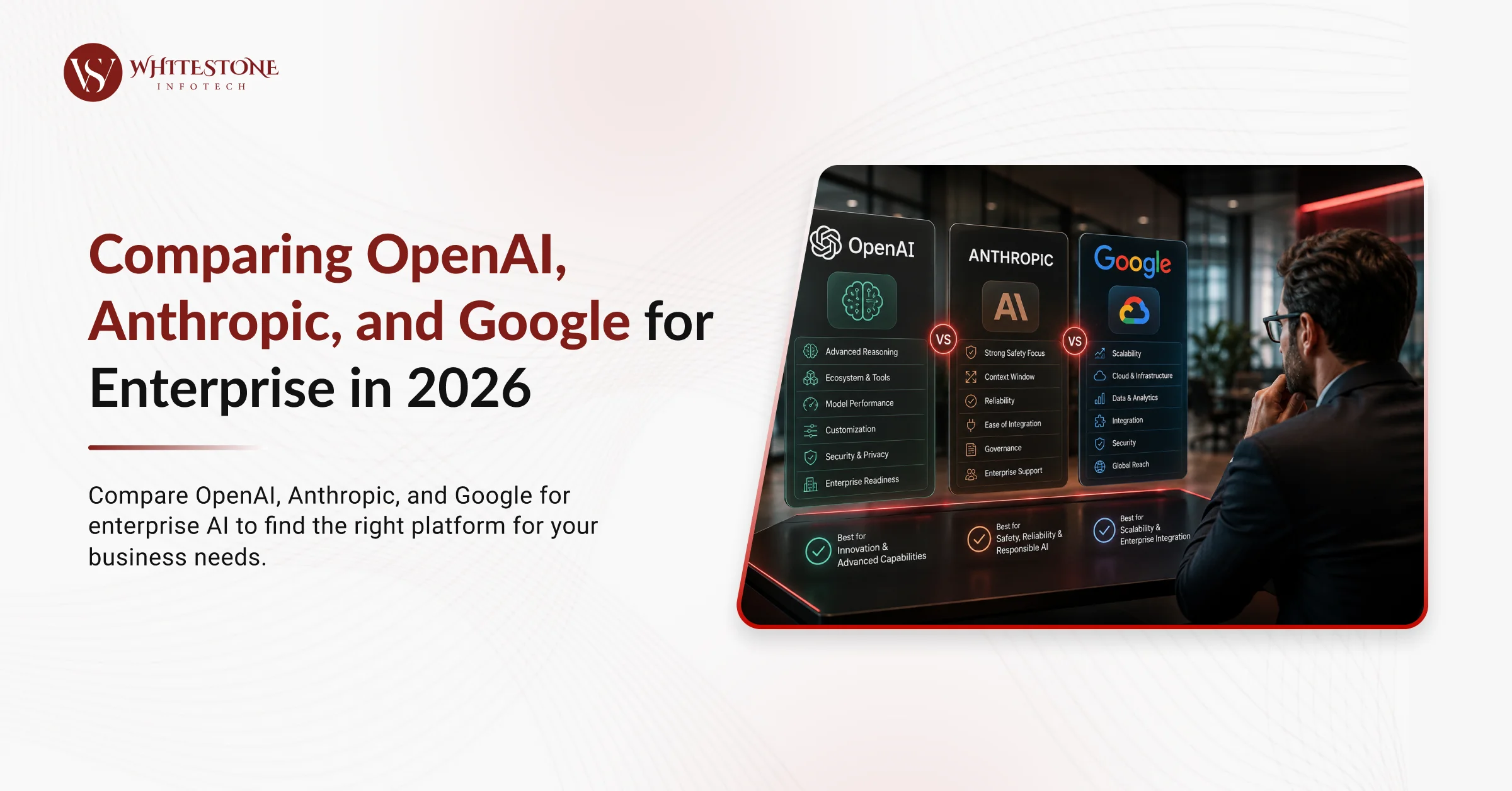
This article is a candid engineering read for CTOs, CIOs, and Heads of AI Strategy making the choice. What each vendor genuinely leads on in 2026. Eight-dimension comparison. Workload-by-workload winners. And the argument for not standardising at all.
The Three Vendors at a Glance
OpenAI. GPT family remains the reference for frontier reasoning on the hardest tasks. Broadest consumer footprint means engineers arrive knowing GPT prompt patterns. Sora for video generation, Operator for agentic browsing, GPT-4o and successors for multimodal. Deep Microsoft partnership means GPT powers Copilot for M365. Best for Microsoft-shop enterprises and workloads requiring frontier reasoning quality.
Anthropic. Claude Opus, Sonnet, and Haiku family with clear tier positioning. Safety was a core design priority from Anthropic's founding, translating to safer defaults on ambiguous requests. Mature tool use since 2024. Anthropic released Model Context Protocol (MCP) in late 2024 as the open standard for connecting LLMs to tools and data; now widely adopted across the AI industry. Computer use at flagship tier. Deep Amazon partnership. Best for regulated industries, long-document reasoning, and agent workflows with tool use.
Google. Three Gemini surfaces: Gemini for Workspace (embedded in Docs, Sheets, Gmail, Meet), Vertex AI Gemini (platform for custom AI on Google Cloud), and Gemini API direct. Longest context windows in the industry (2M+ tokens on flagship). Best multimodal breadth (image plus video plus audio plus PDF). Native Workspace integration. Best for Google Workspace shops, long-document workflows, and multimodal use cases.
Reference OpenAI pricing and models and Anthropic Claude product page for current model tiers, capabilities, and per-token pricing.
Head-to-Head on 8 Dimensions
1. Frontier reasoning quality. OpenAI GPT frontier models lead on hardest tasks (complex multi-step reasoning, hardest coding). Anthropic Claude Opus close second. Google Gemini flagship competitive for most enterprise reasoning. For most business workloads all three are adequate; for the hardest tasks, OpenAI still has a real edge.
2. Long-context handling. Google Gemini leads decisively at 2M+ token context. Anthropic Claude at 200k standard, 500k+ for enterprise. OpenAI GPT models narrower at 128k-200k range. If your workload involves entire codebases, book-length documents, or extensive conversation history, Google has a genuine advantage.
3. Multimodal capability breadth. Google leads on breadth (image, video, audio, PDF natively). OpenAI strong on image, Sora for video, GPT-4o for audio. Anthropic Claude strong on image and PDF, lighter on video and audio. Most enterprise multimodal needs go to Google or OpenAI.
4. Tool use and agent workflows. Anthropic MCP is now the automation standard across the industry, adopted by hundreds of servers. OpenAI function calling mature and reliable. Google function calling adequate but less ecosystem depth. For serious agent workflows in 2026, Anthropic MCP has the ecosystem lead.
5. Enterprise ecosystem depth. OpenAI via Microsoft Copilot for M365 (100M+ paid seats). Google via Workspace Gemini (enormous existing base). Anthropic via Amazon Bedrock (broad enterprise Cloud reach). Match to your enterprise stack: Microsoft shop = OpenAI via Copilot; Google shop = Google Gemini; AWS-heavy = Anthropic via Bedrock.
6. Safety and regulated-industry defaults. Anthropic wins on safer defaults for ambiguous requests, particularly for legal, healthcare, financial services. OpenAI safety tuning strong but less consistent on edge cases. Google safety adequate. For regulated content, Anthropic reduces compliance work materially.
7. Consumer product footprint. OpenAI ChatGPT dominates (500M+ users). Engineers arrive with GPT prompt patterns pre-loaded. Tribal knowledge and community prompt libraries deepest for OpenAI. Google Gemini growing. Anthropic Claude smaller consumer footprint.
8. Cost per million tokens. All three offer tiered pricing (flagship, mid, fast). Cost varies materially across tiers. Verify at each vendor before assuming. Cost differences of 3-5x common between fastest/cheapest tier and flagship. Route by task complexity, not vanity.
Which Wins Which Workload
Nine common enterprise workloads and defensible vendor picks for each.
Long-document analysis (contracts, RFPs, research). Google Gemini for 2M+ context. Anthropic Claude if 200k is enough (typically is).
Complex reasoning (hardest coding, novel problem solving). OpenAI GPT frontier or Anthropic Claude Opus.
Multimodal work (image + video + audio + PDF). Google Gemini for breadth. OpenAI GPT-4o for image + audio, Sora for video.
Agent workflows with tool use. Anthropic Claude with MCP for mature standard. OpenAI function calling if MCP not required.
Regulated content (legal, healthcare, finance). Anthropic Claude for safer defaults.
Microsoft M365 shop. OpenAI via Copilot integration.
Google Workspace shop. Google Gemini for Workspace.
AWS-heavy infrastructure. Anthropic via Amazon Bedrock.
Very high volume with cost sensitivity. Google Gemini fast-tier or open-source self-hosted. See our earlier post on open source LLMs for enterprise for the self-hosted alternative.
The "Don't Standardise" Argument
CEOs want standardisation. Vendors want standardisation. Procurement teams want standardisation. The engineering reality is that different workloads have different best-fit LLMs, and forcing all workloads through one vendor leaves value on the table.
Three reasons multi-vendor architecture makes sense in 2026.
Different strengths, different workloads. OpenAI for hardest reasoning. Anthropic for tool use and safety. Google for long context and multimodal. No single vendor leads on all dimensions.
Vendor lock-in creates future switching cost. Building against one vendor's specific API surface makes vendor changes expensive. Multi-vendor architecture from day one keeps future optionality open.
Multi-vendor is now operationally viable. OpenRouter, LiteLLM, and MCP provide vendor-agnostic abstractions. Model routing by task complexity is standard practice. Ops complexity of two vendors is small compared to lock-in cost of one.
Standardisation makes sense for narrow use cases with clear vendor fit. Multi-vendor makes sense for enterprises with 5+ meaningful AI workloads across different domains.
Real 2026 Cost Bands
API pricing (per million tokens). Each vendor operates three tiers: flagship (most capable, most expensive), mid (balanced), fast (cheap for volume). Cost differences between tiers are 3-5x within one vendor. Cost differences between vendors at the same tier level are typically 1.5-2x. Verify at each vendor's current pricing page; do not budget from stale numbers.
Custom implementation on any vendor.
Proof of concept: £30k to £70k over 8 weeks
Pilot: £60k to £150k over 3 to 5 months
Production: £150k to £400k over 6 to 10 months
Add ongoing engineering (£3k to £10k monthly) plus API inference at scale (£3k to £30k monthly depending on volume and model mix).
Route by task complexity, not vanity. Route simple classification to fast tier. Route standard workloads to mid tier. Route hardest reasoning to flagship. Cost is a fraction of running everything through flagship; quality is preserved on workloads that matter.
What We Learned Deploying AI in IELTSArena
IELTSArena is our AI IELTS preparation platform. We deploy AI in production for writing feedback and speaking evaluation. Two lessons transfer to any LLM vendor decision.
Tiered routing beats vendor loyalty. We route simple grammar checks to fast tier, standard essay feedback to mid, complex band-descriptor evaluation to flagship. This principle applies across all three vendors: route by task, not by preference. Cost drops without quality loss on the workloads where it matters.
Evaluation harness is vendor-agnostic and mandatory. Golden test set of essays graded by trained IELTS examiners, re-run weekly. Same harness works whether we use Claude, GPT, or Gemini. Any serious enterprise LLM programme needs this discipline regardless of vendor choice.
You can see IELTSArena at our portfolio. If you want a candid conversation about your specific vendor decision, book an LLM selection call with WhiteStone.
Common Failure Modes
Three failure modes I see repeatedly.
Standardising on one vendor to please procurement. Wins operational simplicity. Loses quality on workloads that fit other vendors better.
Building hardcoded against one vendor's API. Cannot switch when pricing changes or a better model appears. Vendor changes become rewrite projects.
Skipping evaluation harness. All three vendors update models regularly. Without a golden test set, quality drift is invisible until users notice.
Frequently Asked Questions
Which LLM vendor wins in 2026 for enterprise?
None wins across all dimensions. OpenAI leads on frontier reasoning and Microsoft ecosystem. Anthropic leads on safer defaults, tool use with MCP, and regulated industries. Google leads on long context (2M+ tokens), multimodal breadth, and Google Workspace integration. Match vendor to workload rather than picking one for everything.
How do pricing models compare?
All three offer tiered pricing (flagship, mid, fast) with 3-5x cost difference between tiers. Cross-vendor differences at same tier level typically 1.5-2x. Route by task complexity to keep costs sane. Verify current pricing at each vendor before budgeting; pricing shifts every 3-6 months.
How do the top three compare on tool use?
Anthropic MCP is now the automation standard across the industry with hundreds of servers. OpenAI function calling mature and reliable. Google function calling adequate but smaller ecosystem. For agent workflows in 2026, Anthropic has the ecosystem lead.
Should we standardise or multi-vendor?
Standardise for narrow use cases with clear vendor fit. Multi-vendor for enterprises with 5+ meaningful AI workloads. Multi-vendor is now operationally viable with OpenRouter, LiteLLM, or MCP. Vendor lock-in creates real future switching cost.
Which is best for regulated industries?
Anthropic Claude for safer defaults. Fewer compliance edge cases. Better default behaviour on ambiguous requests. Reduces compliance work materially compared to alternatives.
The One Thing to Remember
OpenAI, Anthropic, and Google each lead on different dimensions in 2026. Standardising on one vendor across all workloads is comfortable for procurement and expensive for outcomes. The disciplined enterprises we work with run at least two vendors, routing workloads to best fit. Match vendor to task, keep an evaluation harness, and design for portability from day one. That is what actually ships value.
If you want a candid conversation about your specific selection, browse our AI development services or come to the call.