A UK managing partner we spoke to last month watched his juniors spend 8 hours per matter reviewing standard contract clauses. His firm handled 400 matters a year. Junior time cost the firm £480k annually on document review alone. His senior lawyers wanted AI-powered document review; his risk partner worried about confidentiality; his COO wanted a solution that worked across matter types, not just contracts. He needed guidance on where to start.
That is the automation conversation across UK and US professional services firms in 2026. Junior time is the main cost. Automation potential is genuine but confidentiality and compliance constraints shape every architectural decision. AI-powered workflow makes financial sense; deployment requires care specific to regulated verticals.
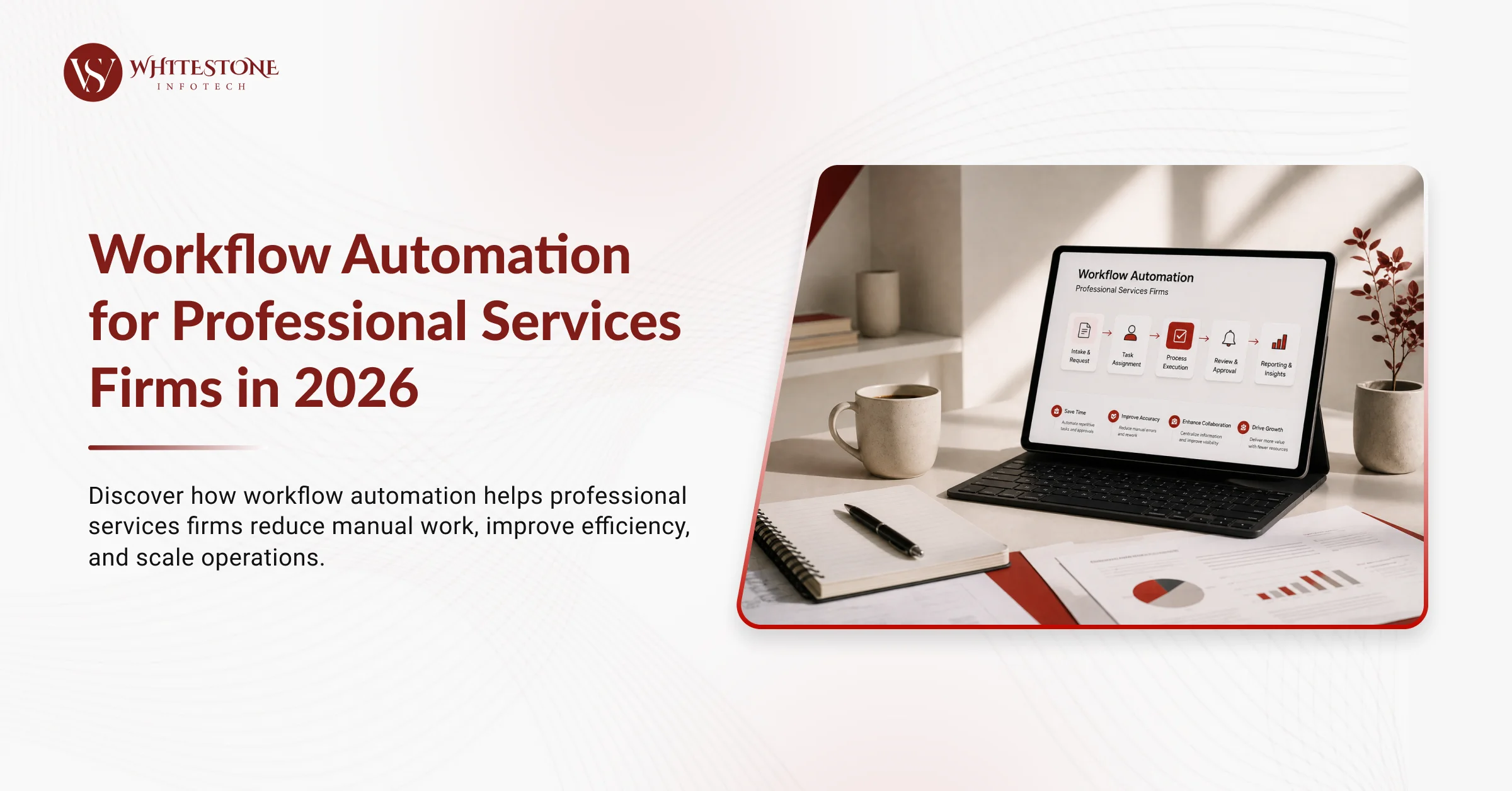
This article is a practical guide for managing partners, COOs, and innovation leads at law firms, accounting firms, and consulting practices. Which workflows automate first. AI-powered vs template-based. Document review reality. Confidentiality requirements. Real cost bands.
Which Workflows Automate First in Professional Services
Six workflows with clearest ROI.
Document review. Highest junior time cost across most firms. Contract review (legal), audit workpaper review (accounting), research synthesis (consulting). AI review with professional oversight typically saves 40-70 percent of time.
Client intake and KYC. Repetitive, rule-based. Form-to-matter creation, KYC checks via specialist providers (Onfido, Sumsub for UK; Alloy, Persona for US), engagement letter generation. Automation removes 50-80 percent of admin time.
Conflict checking. Structured search across historical matters. Rule-based initially, AI-enhanced for nuance detection. Reduces conflict-check time from days to minutes.
Time capture. Biggest source of billing leakage in most firms. Passive tracking via calendar, email, document integration reduces leakage by 15-30 percent. Direct revenue impact.
Billing preparation. Time entry assembly, WIP review, invoice generation, narrative drafting. Automation removes 60-80 percent of billing admin time.
Engagement letter drafting. Template-based with variable substitution. Automation reduces preparation from hours to minutes per matter.
Sequence depends on firm-specific pain. Document review typically delivers biggest single ROI. Time capture typically delivers fastest ROI. Billing preparation typically delivers most consistent ROI.
AI-Powered vs Template-Based Workflow: When Each Wins
Real trade-off, not preference.
Template-based wins when:
Workflow is structured and rule-driven
Deterministic behaviour required (billing, compliance, regulatory)
Hallucination risk unacceptable (financial or legal outputs)
Cost sensitivity (template automation cheaper to build and run)
Auditability requirement (rule-based decisions traceable)
AI-powered wins when:
Workflow involves unstructured content (documents, emails, transcripts)
Nuance detection required (contract clause interpretation, audit judgment)
Speed matters more than deterministic behaviour
Content generation useful (drafting, summarisation, extraction)
Volume too high for template rules to enumerate
Hybrid pattern. Template for structure + AI for content generation within structure. Engagement letter: template defines sections and required fields; AI drafts matter description based on intake data. Combines determinism where needed with AI capability where valuable.
The Gartner AI research publishes analysis showing hybrid AI-plus-template consistently outperforming pure-AI or pure-template on cost, quality, and compliance in regulated verticals.
Document Review Automation (Legal, Accounting, Consulting)
The biggest single ROI opportunity across professional services.
Legal. Contract review (specific clauses, obligations, risks), discovery review (privilege identification, responsive document tagging), due diligence (data room analysis). AI review flags issues, professional reviews decisions. Time savings 40-70 percent on document-heavy matters.
Accounting. Audit workpaper review (completeness, accuracy, testing coverage), journal entry review (anomaly detection, policy compliance), reconciliation review (variance analysis). Similar time savings, similar oversight model.
Consulting. Research synthesis (report generation from source materials), competitive analysis (structured extraction from public sources), deck preparation (draft slides from analysis). Different oversight model (less regulatory constraint) but same augmentation pattern.
What works. AI review with lawyer/accountant/consultant oversight. Not replacement of professional judgment; augmentation of the review process. Professional reviews AI output, applies judgment, takes accountability.
What does not work. Fully autonomous AI review of client-facing output. Regulatory constraint, professional liability, and quality all suffer. Human-in-the-loop remains essential in regulated verticals through 2026.
Client Intake, Matter Setup, Time Tracking, Billing
Four operational workflows with fast ROI.
Intake. Form-to-matter creation, KYC integration, engagement letter generation, retention setup. Template-based with rule-driven variation. Off-the-shelf platforms (Clio, iManage for legal; Karbon, TaxDome for accounting) cover basic needs. Custom for firms with unusual intake complexity.
Matter setup. File structure creation, team assignment, billing arrangement configuration, calendar setup. Template-based automation removes 60-80 percent of setup time. Standardises firm-wide practice.
Time tracking. Passive tracking via calendar integration, email pattern detection, document activity monitoring. Prompts professional to confirm time entries rather than enter from scratch. Reduces leakage by 15-30 percent (direct revenue impact).
Billing. Time entry assembly, WIP review with narrative generation, invoice generation, and integration with practice management. AI-assisted narrative writing dramatically speeds monthly billing cycle. Removes 60-80 percent of billing admin time.
Real 2026 Cost Bands
Off-the-shelf platforms.
Legal: Clio Manage £30k-£120k annually, iManage £80k-£300k, HighQ £100k-£400k
Accounting: Karbon £30k-£120k, TaxDome £20k-£100k, Xero Practice Manager £15k-£80k
Consulting: various specialist platforms £50k-£300k
Custom builds.
Proof of concept: £40k-£90k over 10 weeks
Pilot: £100k-£250k over 4-6 months
Production: £300k-£800k over 8-14 months
Add £30k-£120k annually run cost. Add £60k-£150k annually for in-house engineering ownership.
Payback periods.
Document review automation: 12-24 months (biggest absolute savings)
Time capture: 6-18 months (fastest payback)
Billing preparation: 12-24 months
Client intake and KYC: 18-36 months
Compliance and Confidentiality Requirements
Five constraints that shape architecture.
Client confidentiality. Attorney-client privilege (legal), accountant-client confidentiality (accounting), fiduciary duty (consulting). Automation must preserve confidentiality across all workflow stages. AI systems cannot inadvertently expose client data to training or third-party access.
Data residency. UK GDPR requires personal data protection. US state privacy laws (California CCPA, other states following) require jurisdiction-specific handling. EU clients require EU data residency. Multi-jurisdiction firms require region-specific deployment.
Regulated vertical rules. UK law firms regulated by SRA. UK accountants by ICAEW. US legal by state bar associations. Each has specific rules on client data handling, AI use disclosure, and professional oversight requirements. Automation must comply with vertical-specific rules.
AI-specific concerns. Training data usage (client data must not train models), PII in prompts (redaction or masking required), output storage (retention and access controls), model provider terms (some providers unsuitable for regulated data).
Deployment architecture. Self-hosted or private cloud often required for large firms. Public cloud with specific data controls acceptable for smaller firms and lower-sensitivity workflows. Fully-cloud consumer AI (ChatGPT, standard Claude) unsuitable for most client data.
The McKinsey Digital insights on professional services productivity publishes ongoing analysis of automation ROI in professional services, with 30-50 percent productivity gains typical when confidentiality and compliance architecture is properly designed.
What We Learned Building for Regulated Verticals
We built IELTSArena as production AI serving students daily with confidentiality-conscious architecture. Two lessons transfer to professional services.
Confidentiality-first architecture takes longer to build but ships production faster. Building AI with data controls, PII handling, and audit trails from day one prevents rebuild later. Firms that add these constraints after initial build often rebuild 40-60 percent of the system. Design for regulated deployment from the start.
Hybrid template-plus-AI outperforms pure AI in regulated verticals. Template structure provides determinism where required (billing, compliance). AI provides capability where valuable (content, review). Combining them respects regulatory constraint while capturing AI productivity. Pure AI approaches often fail deployment review.
You can see our shipped work at our portfolio. If you want a candid conversation about your firm's automation strategy, book a professional services automation call with WhiteStone.
Common Failure Modes
Three failure modes we see repeatedly.
Deploying AI without confidentiality architecture. Firm pilots ChatGPT for document review. Client data leaks into public model training. Regulatory response required. Reputation damage.
Skipping human-in-the-loop on client-facing output. AI generates client-facing content (legal advice, financial recommendations, consulting deliverables) without professional oversight. Quality problems, liability exposure, regulatory concerns.
Building fully custom before validating with off-the-shelf. Firm commits £600k to custom platform before validating workflow with off-the-shelf pilot. Off-the-shelf validation would have shaped the custom build materially. Rebuild required.
Frequently Asked Questions
Which workflows automate first in a law or accounting firm?
Six workflows with clearest ROI: document review (biggest single ROI), client intake and KYC (fastest to implement), conflict checking (removes friction), time capture (fastest payback), billing preparation (most consistent ROI), engagement letter drafting (template-based, easy win). Sequence based on firm-specific pain.
AI-powered workflow vs template workflow: which do we need?
Template for structured workflow (billing, intake, compliance) where deterministic behaviour matters. AI for unstructured content (document review, research) where nuance and speed matter. Hybrid (template structure + AI content) works best in regulated verticals. Not either-or; usually both in different workflows.
How does document review automation work for professional services?
AI review with professional oversight. Legal contract review, accounting audit workpaper review, consulting research synthesis. AI flags issues, professional reviews decisions, professional takes accountability. Time savings 40-70 percent typical on document-heavy work. Not replacement of professional judgment.
What confidentiality constraints apply to AI in professional services?
Client confidentiality (attorney-client privilege, accountant-client), data residency (UK GDPR, US state privacy laws), regulated vertical rules (SRA, ICAEW, state bars), and AI-specific concerns (training data usage, PII in prompts, output storage). Self-hosted or private cloud often required for large firms. Consumer AI (public ChatGPT) generally unsuitable.
How much does workflow automation cost for a professional services firm?
Off-the-shelf platforms £30k-£300k annually depending on scale. Custom builds: POC £40k-£90k, pilot £100k-£250k, production £300k-£800k. Add £30k-£120k annually run cost. Payback typically 12-24 months for document review; 6-18 months for time capture; 12-24 months for billing preparation.
The One Thing to Remember
Junior time is the main cost in professional services. Automation potential is genuine and material. Six workflows automate first with clearest ROI: document review, client intake and KYC, conflict checking, time capture, billing preparation, engagement letter drafting. AI-powered plus template-based hybrid outperforms pure approaches in regulated verticals. Confidentiality-first architecture takes longer to build but prevents rebuild later. Payback typically 12-24 months for the biggest opportunities.
If you want a candid conversation about your specific firm's automation strategy, browse our AI development services or come to the call.