
A UK marketing leader we spoke to last quarter had been sold Contentful by a modern digital agency for a straightforward B2B services website. The agency had built a Next.js frontend with Contentful backend at implementation cost of £48k plus £16k annual Contentful licences. Six months post-launch, the marketing team could not update the website without developer support. Every content change required a Git branch, code review, and deployment. Content team frustration was at breaking point. Two marketing hires had left partially because they could not do their jobs.
The website served no multi-channel content delivery need. There was no mobile app, no digital signage, no voice interface, no in-product content, no multi-brand or multi-region requirement. It was a marketing website that would have been better served by Webflow at £600 annually plus £8k implementation, giving the marketing team direct control over content and layout without developer involvement for routine changes.
The agency had sold Contentful because Contentful was the modern architectural choice and because agencies charge more for headless implementations than for Webflow builds. Neither reason mapped to the customer's actual need. The customer paid £64k first year for architecture their business did not require, plus ongoing operational friction that undermined their marketing team.
We rebuilt the website on Webflow over 6 weeks. Marketing team regained autonomy. Content velocity increased dramatically. Total rebuild cost £14k. Ongoing costs dropped from £16k annually to £600 annually. Same content, better outcome, because the architecture matched the actual use case.
That is the what is a headless cms conversation across UK and US marketing and tech leaders in 2026. Headless CMS is genuinely powerful for the right use cases (multi-channel content delivery, complex web applications, separate content and dev workflows). It is over-scoped for the majority of marketing websites, where traditional CMS delivers better outcomes for marketing teams at lower cost and complexity.
This article is a candid guide for UK and US marketing and tech leaders scoping CMS investment. What headless CMS actually means. When it wins. When traditional CMS is the right answer. Real vendor options with cost bands. How to avoid the modern-architecture-for-marketing-website trap.
What Is a Headless CMS
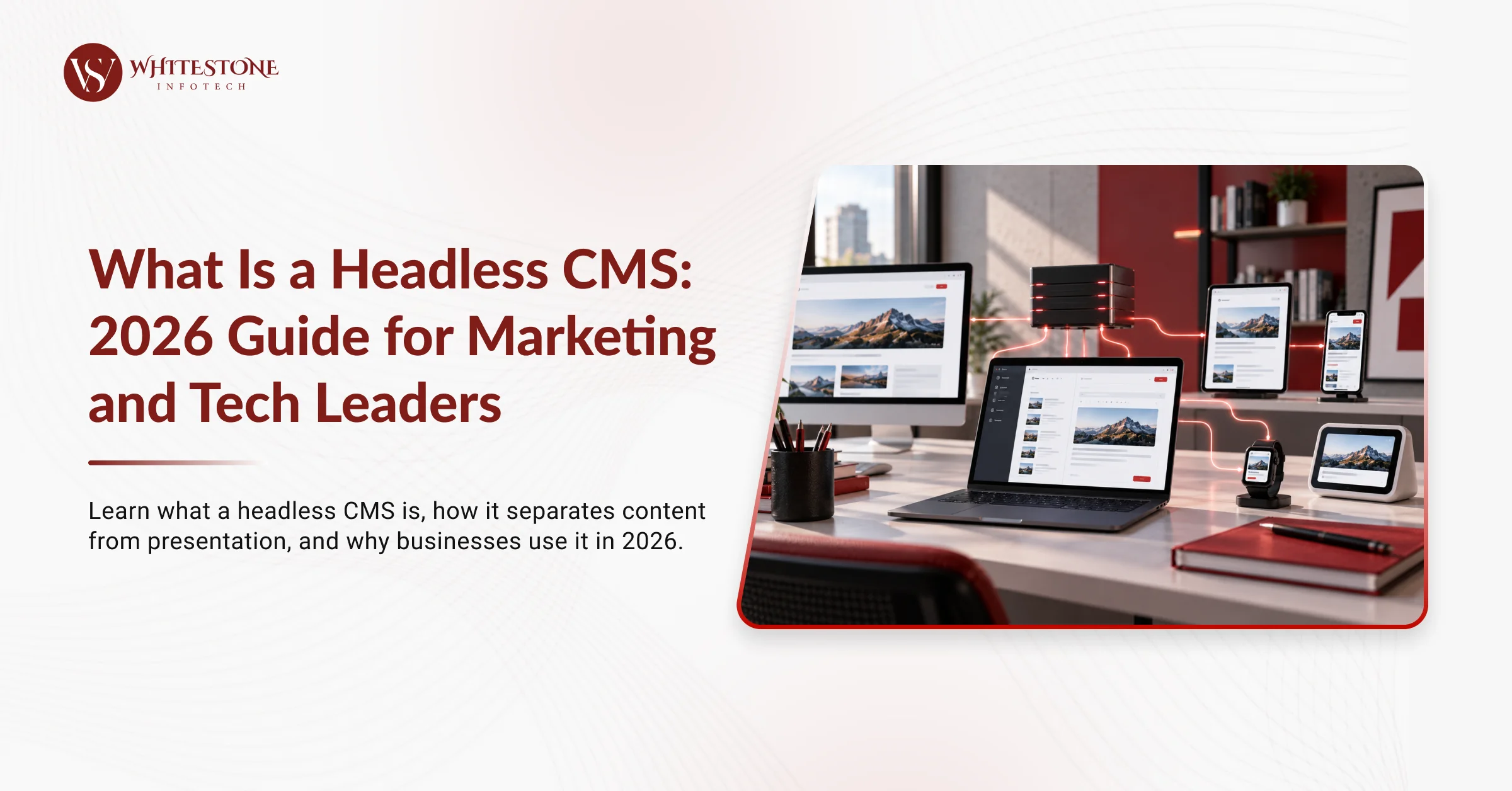
A headless CMS is a content management system that separates content storage and editing (the "body") from content presentation (the "head" or frontend). Content editors work in the CMS interface to create and manage content. That content is stored in a structured way and delivered via API (typically REST or GraphQL) to whichever frontend consumes it: a website built in Next.js, a mobile app built in React Native, digital signage running a custom player, a voice assistant integration, or a marketing automation platform.
The "headless" name comes from the CMS having no "head" (no built-in website frontend). This is the fundamental architectural difference from traditional CMS.
Modern examples of headless CMS: Contentful, Sanity, Storyblok, Strapi, Payload, Hygraph (formerly GraphCMS), Prismic, Directus, Kontent.ai, Butter CMS.
What Is a Traditional CMS
A traditional CMS bundles content management and website frontend together. Content editors work in the CMS interface to create and edit content, and the CMS also renders the website that visitors see. Templates, themes, and plugins determine the frontend appearance and behaviour.
Modern examples: WordPress (still the dominant traditional CMS), Webflow, Squarespace, Wix, Ghost, HubSpot CMS, Drupal, Joomla.
Traditional CMS is often called "monolithic" or "coupled" CMS in architecture discussions, emphasising the tight coupling between content management and frontend rendering.
Headless CMS vs Traditional CMS: The Actual Difference
Dimension | Traditional CMS | Headless CMS |
Frontend | Bundled with CMS | Separate, developer-built |
Editor experience | WYSIWYG page editing | Structured content editing |
Multi-channel delivery | No (website only) | Yes (any frontend that calls API) |
Time to launch | Faster (weeks) | Slower (months for complex builds) |
Ongoing content workflow | Independent of developers | Often requires developer support |
Total cost of ownership | Lower | Higher |
Flexibility | Constrained by CMS templates | Highest (any frontend framework) |
Best for | Marketing sites, blogs, simple landing pages | Multi-channel content, complex web apps, multi-site content libraries |
Two things people often get wrong. Headless CMS is not automatically "modern" or "better"; it is a different architecture with different tradeoffs. And traditional CMS is not automatically "legacy" or "worse"; for marketing websites it often delivers better outcomes at lower cost.
When to Use a Headless CMS
Use a headless CMS when at least two apply:
Multi-channel content delivery required. Content must reach beyond a website: mobile apps, digital signage, voice assistants, in-product content, marketing automation platforms, external partners via API.
Content team and development team are separate. Content team wants independent workflow to create and update structured content; development team wants to build frontend using their preferred framework independent of CMS constraints.
Website is complex web application. Substantial custom functionality beyond marketing pages: customer portals, dashboards, transactional workflows, complex integrations.
Frontend framework choice matters. Team wants React, Vue, Svelte, Next.js, Astro, or SvelteKit as frontend framework independent of CMS.
Multiple websites share content library. Multi-brand, multi-region, or multi-property scenarios where one content library feeds several frontends.
Content needs to be structured for programmatic use. Content will be queried, filtered, and combined programmatically rather than displayed as pre-composed pages.
Realistic expectation: 3-9 month implementation for complex builds. £15k-£120k+ annual vendor cost for enterprise headless CMS. Requires ongoing developer relationship for content changes that require new field types or new page templates.
When to Use a Traditional CMS
Use a traditional CMS when at least three apply:
Website is primarily marketing pages, blog, and simple landing pages
Marketing team wants direct visual editing without developer involvement for content changes, layout changes, or new page creation
Budget favours faster time-to-launch and lower ongoing cost over long-term flexibility
Content team is comfortable with WYSIWYG editing (they already use WordPress, Webflow, or similar)
Single website with no multi-channel delivery requirement
No plans to add mobile app or other channels within 24 months
No complex web application functionality planned
Realistic expectation: 4-12 week implementation for typical marketing website. £180-£3k annual vendor cost for most traditional CMS options. Marketing team autonomy on routine content changes.
Real 2026 Vendor Options with Cost Bands
Enterprise headless CMS.
Contentful: £15k-£120k+ annually. Market leader by enterprise adoption. Strong content modelling, weaker visual editing. Best for structured content at scale.
Sanity: £3k-£60k+ annually. Excellent structured content editing (Sanity Studio). Strong for editorial teams. Best for content-heavy sites with structured editorial workflow.
Storyblok: £3k-£48k annually. Visual editor bridging headless and traditional. Best for marketing teams that want headless benefits with more traditional editing experience.
Mid-market headless CMS.
Hygraph (formerly GraphCMS): £3k-£24k annually. GraphQL-first. Best for React and modern JS teams.
Prismic: £3k-£18k annually. Slice-based visual editor. Best for marketing sites with headless architecture.
Kontent.ai: £8k-£30k annually. Strong content operations features. Best for editorial teams.
Self-hosted / open-source headless CMS.
Strapi: £0 licence + hosting (£240-£2400 annually). Node.js-based. Strong developer experience. Best for teams with technical capacity.
Payload: £0 licence + hosting (£240-£2400 annually). TypeScript-first. Growing rapidly. Best for TypeScript teams.
Directus: £0 licence + hosting (£240-£2400 annually). Database-first. Best for teams wanting to build on existing SQL database.
Traditional CMS.
WordPress self-hosted: £500-£3k annually including hosting. Largest ecosystem. Best for marketing sites, blogs, e-commerce (with WooCommerce).
Webflow: £180-£2k annually. Excellent visual design and editing. Best for marketing teams wanting design control without developer.
Squarespace: £180-£720 annually. Simple template-based. Best for small business marketing sites.
HubSpot CMS: £8k-£60k annually. Bundled with HubSpot CRM/marketing platform. Best for HubSpot-centric organisations.
Real Cost Comparison Across Scenarios
Marketing website (10-30 pages).
Webflow: £8k-£20k implementation + £600-£1200 annually. Marketing team autonomy on ongoing changes.
Contentful + Next.js: £30k-£80k implementation + £16k-£40k annually. Content team dependent on developer for structural changes.
Content-heavy marketing site (50+ pages plus blog).
WordPress self-hosted: £15k-£40k implementation + £1500-£5k annually. Marketing team autonomy. Requires ongoing developer for plugin management.
Sanity + Next.js: £40k-£120k implementation + £18k-£48k annually. Content team autonomy on content, developer for structural.
Multi-brand website with 3+ regions.
Traditional CMS multi-site: complex to manage, workflow gaps between regions.
Contentful or Storyblok headless: £60k-£180k implementation + £30k-£80k annually. Strong workflow, single content library, region-specific frontends.
Marketing site plus mobile app plus in-product content.
Traditional CMS: not architecturally sound; content duplicated across channels.
Headless CMS: £80k-£250k+ implementation + £40k-£120k+ annually. Single content library feeds all channels.
What We Learned Building Websites with Both Approaches
WhiteStone builds websites with both traditional and headless CMS approaches. Recent traditional CMS work includes Volttic (EV charging infrastructure website) and Blip and Boom (agency marketing site). Recent headless work includes several SaaS marketing sites plus content libraries feeding SaaS products. Three lessons transfer to any marketing or tech leader scoping CMS investment.
Match architecture to actual multi-channel need, not to modernity. Headless CMS is the correct architectural choice when content genuinely needs to reach multiple channels or when the frontend is a complex web application. It is the wrong architectural choice for standalone marketing websites where a marketing team needs autonomous content control. Choosing headless CMS for a marketing website in 2026 is often architectural fashion rather than sound engineering.
Marketing team autonomy is a legitimate architectural requirement. Marketing teams that lose autonomy on content changes (because every change now requires developer involvement) become frustrated, slow down, and eventually rebuild the website on traditional CMS. Include marketing team autonomy in the architecture requirements from day one, not as an afterthought.
Hybrid patterns often win. For a marketing site with a small in-product content need, using WordPress or Webflow for the marketing site and a lightweight headless CMS or database for the in-product content often beats forcing everything into headless CMS. Match each content type to its best fit rather than defaulting to one architecture for all content.
See our portfolio of shipped work for website case studies with both approaches. For a scoped CMS conversation, book a website architecture call with WhiteStone.
Common Failure Modes
Choosing headless CMS for a marketing website that does not need it. Marketing leader buys Contentful + Next.js at £64k first year for a straightforward B2B services website with no multi-channel delivery need. Marketing team loses autonomy. Content velocity drops. Fix: match architecture to actual multi-channel need; traditional CMS often better for standalone marketing sites.
Underestimating developer dependency in headless CMS operations. Team chooses headless CMS expecting marketing team will operate it independently. Discovers that new field types, new page templates, new content models all require developer involvement. Content velocity slows. Fix: budget ongoing developer relationship as part of headless CMS TCO; do not scope headless CMS as marketing-team-only tool.
Choosing enterprise headless CMS for startup or small business use case. Team chooses Contentful at £24k annually when a headless CMS at £3k annually or a self-hosted Payload at £600 annually would have met the need. Fix: match vendor tier to actual scale and complexity, not to vendor prestige.
Building marketing site as complex web app because agency prefers React. Agency defaults to Next.js + headless CMS for every project because it is their preferred stack. Marketing website ends up with complexity and cost that does not match need. Fix: agency stack preference should not decide customer architecture; require agency to justify architecture against actual customer requirements.
Frequently Asked Questions
What is a headless CMS and how does it work?
A headless CMS is a content management system that separates content storage and editing (the body) from content presentation (the head or frontend). Content editors work in the CMS interface. That content is stored in a structured way and delivered via API (typically REST or GraphQL) to whichever frontend consumes it: a website, mobile app, digital signage, voice assistant, or marketing automation platform. Examples: Contentful, Sanity, Storyblok, Strapi, Payload, Hygraph, Prismic.
What is the difference between a headless CMS and a traditional CMS?
Traditional CMS bundles content management and website frontend together (WordPress, Webflow, Squarespace, Wix). Content editors use WYSIWYG editing and the CMS renders the visitor-facing website. Headless CMS separates them: content editors use structured content editing in the CMS, and a separate frontend (built by developers in React, Vue, or similar) consumes content via API. Traditional CMS is faster to launch and cheaper for marketing sites. Headless CMS wins for multi-channel content delivery and complex web applications.
When should a company use a headless CMS?
Use headless CMS when at least two apply: content must reach beyond a website (mobile apps, digital signage, voice assistants, in-product content, marketing automation), content team wants independent workflow from developers, website is complex web application with substantial custom functionality, frontend framework choice matters (React, Vue, Svelte, Next.js), multiple websites share content library (multi-brand or multi-region), or content needs to be structured for programmatic use.
What is the best headless CMS in 2026?
No single best answer. Enterprise: Contentful for structured content at scale, Sanity for content-heavy editorial workflow, Storyblok for marketing teams wanting more traditional editing. Mid-market: Hygraph for GraphQL-first, Prismic for marketing sites, Kontent.ai for content operations. Self-hosted: Strapi for Node.js teams, Payload for TypeScript teams, Directus for database-first approach. Match vendor to scale, technical stack, and editorial workflow requirements.
How much does a headless CMS cost in 2026?
Enterprise headless CMS (Contentful, Sanity, Storyblok Enterprise): £15k-£120k+ annually depending on user count and API calls. Mid-market headless CMS (Hygraph, Prismic, Kontent.ai): £3k-£30k annually. Self-hosted headless CMS (Strapi, Payload, Directus): £0 licence plus hosting £240-£2400 annually. Implementation cost typically 2-4x annual vendor licence for enterprise-tier deployments.
Is a headless CMS good for marketing teams or only developers?
Depends on the vendor and use case. Traditional CMS (WordPress, Webflow, Squarespace) is fundamentally better for marketing team autonomy on standalone websites. Some headless CMS (Storyblok, Prismic with slices) offer visual editing that reduces developer dependency for routine changes. However, structural changes (new field types, new content models, new page templates) require developer involvement in headless CMS regardless of vendor. Marketing teams that need full autonomy on all changes are usually better served by traditional CMS.
Can WordPress be used as a headless CMS?
Yes, WordPress can be used as a headless CMS via its REST API or WPGraphQL plugin. Popular for teams that want WordPress editorial experience with a modern frontend framework (React, Next.js, Vue). Not the best headless option for greenfield projects (purpose-built headless CMS are typically better designed for API-first delivery), but a legitimate migration path for teams already committed to WordPress ecosystem.
Why choose WhiteStone Infotech for CMS architecture assessment or website build?
We build websites with both traditional and headless CMS approaches. Recent traditional work includes Volttic (EV charging infrastructure) and Blip and Boom (agency marketing site). Recent headless work includes several SaaS marketing sites with content libraries feeding products. Every website engagement starts with architecture matching (we recommend traditional CMS when it is the better answer, headless when it genuinely is) and includes marketing team autonomy as a first-class architectural requirement. Contact WhiteStone Infotech at whitestoneinfotech.com/contact.
The One Thing to Remember
A headless CMS separates content storage and editing from content presentation, delivering content via API to any frontend. It is the correct architectural choice when content needs to reach multiple channels (website plus mobile app plus digital signage plus in-product), when the frontend is a complex web application, or when content team and development team need independent workflows. It is over-scoped for standalone marketing websites where traditional CMS (WordPress, Webflow, Squarespace) delivers better outcomes at lower cost with marketing team autonomy. Real 2026 vendor cost: £15k-£120k+ annually for enterprise headless CMS, £3k-£30k for mid-market, £0-£3k for self-hosted, versus £500-£3k for traditional CMS. The single decision that determines CMS ROI: does the content need to reach more than one channel, and does the content team need independence from developers? If yes to either, headless CMS pays back. If no to both, traditional CMS is the right answer.
 for SaaS Products_ 2026 Compliance Guide.webp)
.webp)