A UK COO we spoke to last month runs a 45-person industrial services firm turning over £8m. His CEO had come back from a peer conference convinced they needed a Salesforce CRM. His accounts team was on QuickBooks and spreadsheets; sales was tracking deals in a shared inbox; jobs were being logged in a fifth system. When a customer called to check status, three people had to be phoned. The CEO wanted CRM. The COO thought ERP was the bigger fire. They had £150k budgeted and a decision to make before the end of the quarter.
That is the "should I build ERP or CRM first" conversation across growing UK and US businesses in 2026. Every vendor sales call pushes their own system. Legal firms explain the categories. Analysts publish market maps. Nobody frames it as a bottleneck-diagnosis question, which is what it actually is. Get the diagnosis right and the vendor choice is nearly automatic; get it wrong and you spend a year fixing the smaller problem while the bigger one bleeds cash.
This article is a practical guide for CEOs, COOs, and founders running £2m-£30m businesses. The actual difference between ERP and CRM. The 6-question diagnostic. Real cost bands per tier. Off-the-shelf vs custom. The sequencing rule for building both. What we learned running the diagnostic on a UK property developer with no formal ERP or CRM.
The Actual Difference Between ERP and CRM in One Paragraph
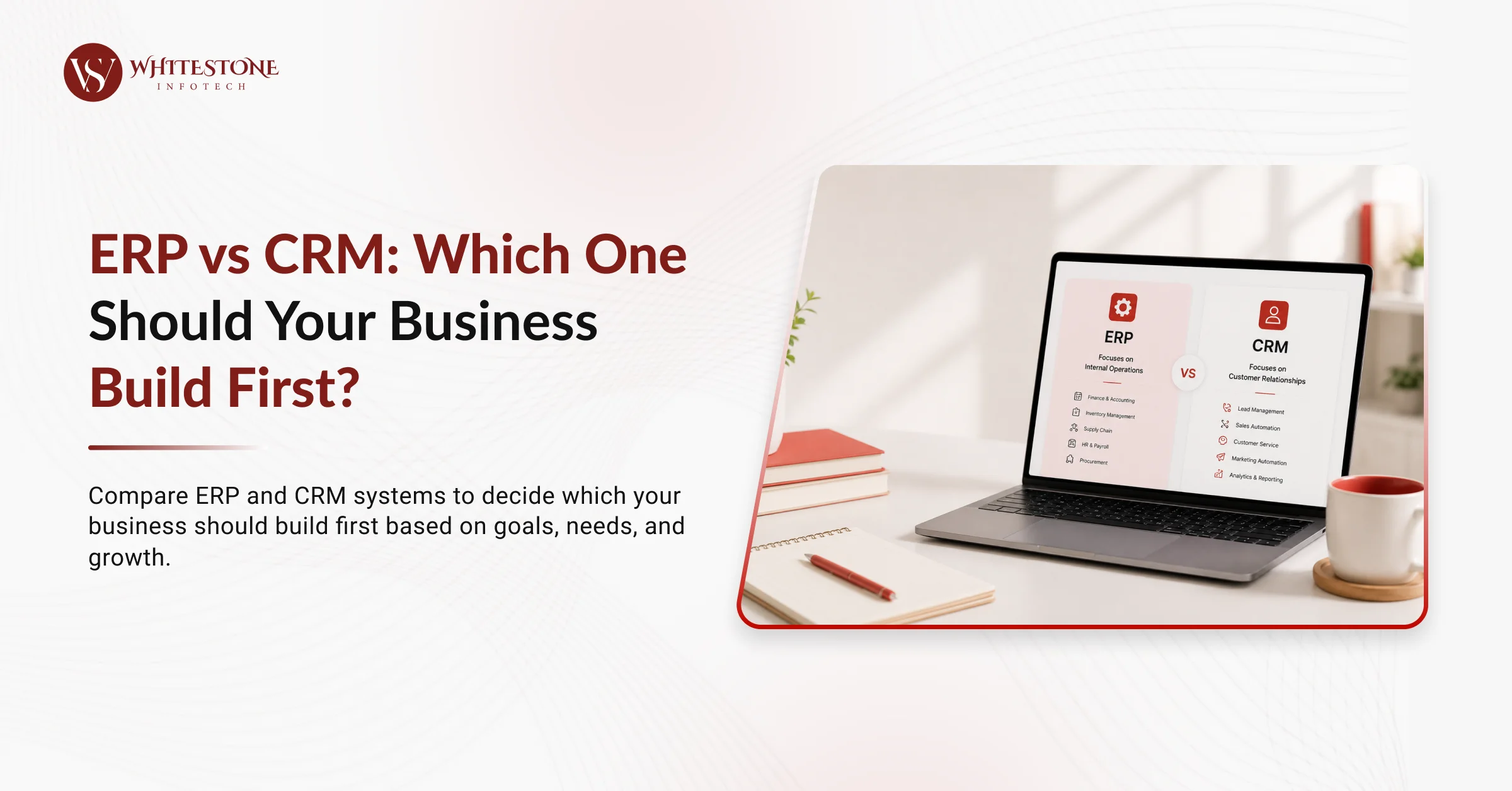
ERP (Enterprise Resource Planning) runs the back office: finance, invoicing, inventory, procurement, manufacturing, projects, supply chain. It answers the question "did we deliver, at what cost, and can we account for it?" CRM (Customer Relationship Management) runs the front office: leads, sales pipeline, deals, contacts, marketing automation, post-sale communication. It answers "who is buying, what stage are they at, and when will they close?" At Gartner ERP and CRM research, both categories are tracked separately for good reason: they solve different halves of the business and their maturity curves rarely rise in parallel.
The one-line rule: CRM helps you win business. ERP helps you deliver it. If both are broken, the one bleeding cash faster is where the money goes first.
The Bottleneck Diagnostic: Six Questions That Resolve the Debate
Six yes/no questions that resolve the debate for most growing businesses.
1. Can your sales leader tell you the pipeline value for next quarter, right now, without asking anyone? If no, and it matters, that is a CRM gap.
2. Do deals get lost because follow-up is inconsistent or nobody knows who owns the account? CRM.
3. Does your finance team spend more than 3 days on month-end because data has to be reconciled across systems? ERP.
4. Do you have inventory you cannot trust, or projects that lose money because there is no unified view of hours, costs, and revenue? ERP.
5. Is your marketing budget spent without clear attribution to closed revenue? CRM.
6. Are compliance or audit requests (tax, VAT, sector-specific) painful because underlying data lives in spreadsheets? ERP.
More yes answers in the CRM column, build CRM first. More in the ERP column, build ERP first. Roughly equal, look at which pain is costing more money right now. It is almost never both at equal severity.
For most growing UK and US B2B businesses under £30 million ARR, the CRM column wins because sales pain shows up before operational pain. Manufacturers, distributors, and services businesses with complex project accounting often flip that. The wrong sequence here is where the money goes: a manufacturer that builds Salesforce before its operations backbone still cannot answer "did we make money on that job".
ERP vs CRM Cost Comparison at Every Tier
System | Monthly per user | Implementation | Timeline |
Small CRM (HubSpot Starter, Pipedrive) | £15-£70 | £3k-£15k | 4-8 weeks |
Mid-market CRM (HubSpot Pro, Salesforce Pro) | £70-£180 | £15k-£80k | 8-16 weeks |
Enterprise CRM (Salesforce Enterprise, Dynamics 365) | £180-£400+ | £80k-£400k | 4-9 months |
Small ERP (Xero, QuickBooks Enterprise, Sage 50) | £30-£100 | £5k-£25k | 6-12 weeks |
Mid-market ERP (NetSuite, Sage Intacct, Business Central) | £100-£300 | £40k-£200k | 4-9 months |
Enterprise ERP (SAP S/4HANA, NetSuite Enterprise, D365 F&O) | £300-£1,000+ | £200k-£1.5m+ | 9-24 months |
Two rules from these bands hold consistently.
CRM is faster to implement than ERP at every tier. Even enterprise CRM is measured in months; enterprise ERP is measured in quarters. If speed to first value matters, CRM wins on that alone.
ERP is 2 to 4 times more expensive than CRM at every tier. Build costs and per-user pricing both scale with surface area, and ERP has more of it. Salesforce publishes current CRM pricing across tiers; NetSuite publishes ERP equivalents. Neither publishes implementation cost honestly, and that is where budgets die.
When Off-the-Shelf Wins vs When Custom Actually Pays Back
For 80 percent of growing businesses under £30 million ARR, off-the-shelf covers the requirement at a fraction of custom cost. HubSpot, Salesforce, Pipedrive, Xero, NetSuite, Dynamics 365 collectively handle most standard workflow.
When custom becomes defensible. Genuinely unusual workflow off-the-shelf cannot handle. Data residency requirements ruling out US-hosted SaaS. Specific regulatory needs (financial services, healthcare, regulated manufacturing). Long-term differentiation where the workflow itself is the moat.
When custom is the wrong answer. The team wants "control". The founder is uncomfortable with SaaS pricing. Consultants sold them on it. In all three, off-the-shelf plus modest customisation is 20 percent of the cost and delivers 80 percent of the value.
The Sequencing Rule: How to Phase Both Systems Without Wasted Effort
Nearly all growing companies above £5-£10m ARR need both an ERP and a CRM, or a unified platform. The question is order.
Phase 1 (choose one first). 4-9 months. Focus on the bottleneck the diagnostic identifies. Do not over-scope. Get the foundation live and adopted before touching the second system.
Phase 2 (integration foundation). 2-4 months. Before adding the second, put the integration surface in place. Middleware (Zapier, Make, MuleSoft, Boomi) or point-to-point APIs is what makes the handoff from won deal to fulfilled order work. Skip this and both systems become expensive silos.
Phase 3 (add the second system). 4-12 months. Now build the second, integrated to the first from day one.
Phase 4 (optimise the handoff). Ongoing. Interesting work is at the boundary: how a deal closed in CRM triggers an order in ERP, how ERP delivery data updates CRM account health.
The biggest cost is not choosing the wrong first system. It is running them disconnected. Budget for the integration layer explicitly.
What We Learned Running the Diagnostic on a UK Property Developer
WhiteStone built a barcode and QR-based site management platform for a UK property developer running large multi-block residential and mixed-use construction projects across London. Before we started, they had no formal ERP and no formal CRM. They had spreadsheets doing both jobs badly, an email chain for progress updates, and a WhatsApp group per site.
When we ran the ERP-vs-CRM diagnostic against their business, the answer was not what the CEO expected. He had assumed they needed a "single system" that did everything. The diagnostic showed sales pain was actually small (they had a stable pipeline of repeat and referred projects). Operations pain was enormous (they could not tell which jobs were profitable, could not close the books on time, and were losing money on materials tracking because nobody had a unified view of hours vs materials vs invoicing).
That answer changed the whole programme. Instead of a "single system" build, we built the ops backbone first: a construction-specific back-office platform that tracks progress from project down to room, handles drawing markup, snag lists, RFIs, and generates close-out PDFs automatically. Deployed in the EU region for GDPR data residency. Six months later the platform was live across five active sites. Only after that did we add light CRM features (lead capture, referral tracking, contact management) because by then the sales team was asking for them for the first time.
The lesson relevant to any "should I build ERP or CRM first" question: the answer is not a preference or a vendor preference; it is a diagnosis of which side is bleeding cash faster today. Run the diagnostic before committing budget to either system.
See our portfolio of shipped work for other custom platform examples. To run the diagnostic against your specific business, book a system-of-record consultation with WhiteStone.
Common Failure Modes
Three failures we see repeatedly on ERP-vs-CRM decisions.
Choosing the vendor before running the diagnostic. Team decides Salesforce because a competitor uses it, then realises 8 months in that the real fire was ERP. Six-figure spend on the wrong system. Fix: mandatory 1-2 week diagnostic before any vendor conversation.
Skipping the integration layer. Team builds CRM, adds ERP 12 months later, connects them via manual monthly data dumps. Sales and operations look at different numbers for the same customer. Trust erodes; adoption drops. Fix: budget middleware or API integration into every phase.
Buying enterprise tools at mid-market scale. SME with 40 users buys Salesforce Enterprise or SAP S/4HANA. Needs full-time admin they cannot afford. Usage collapses. Match tier to size; upgrade later if the numbers demand it.
Frequently Asked Questions
What is the core difference between ERP and CRM in 2026?
ERP runs the back office (finance, invoicing, inventory, procurement, manufacturing, projects). CRM runs the front office (leads, sales pipeline, deals, contacts, marketing automation). ERP answers "did we deliver, at what cost, and can we account for it?" CRM answers "who is buying and when will they close?" Both are essential above roughly £5 million ARR; sequence is the decision.
Can one unified system do both jobs?
Some unified platforms (NetSuite, Odoo, Dynamics 365) cover both surfaces. Trade-off: typically weaker at both than best-of-breed CRM plus best-of-breed ERP, but save the integration cost. Small to mid-market often wins with unified; enterprise usually needs best-of-breed. Run the diagnostic before assuming unified fits.
Which is faster to implement, ERP or CRM?
CRM at every tier. Enterprise CRM 4 to 9 months. Enterprise ERP 9 to 24 months. If speed to first value matters, CRM wins on that dimension alone.
How much does ERP or CRM cost for a growing UK SME?
Small CRM £3k-£15k plus £15-£70 per user monthly. Mid-market CRM £15k-£80k plus £70-£180 per user monthly. Small ERP £5k-£25k plus £30-£100 per user monthly. Mid-market ERP £40k-£200k plus £100-£300 per user monthly. Both bands double or triple with heavy customisation. Enterprise tiers add another 4-10 times cost.
What is the sequencing rule for building both?
Choose one first per the diagnostic. Get it live and adopted before touching the second. Put the integration surface in place before adding the second. Build the second integrated from day one. Optimise the handoff (deal to order to invoice) as ongoing work; that is where most of the ROI actually sits.
Should I build ERP or CRM first if I am a manufacturer?
Almost always ERP first. Manufacturing pain is dominated by inventory accuracy, production scheduling, and cost-per-unit visibility. CRM helps but is rarely the bottleneck at mid-market manufacturing scale. Distributors and complex-project services businesses follow the same pattern.
Why choose WhiteStone Infotech for the ERP-vs-CRM decision?
We built the SiteFlow platform for a UK property developer where the diagnostic said ERP-first even though the CEO expected CRM. We ship 50+ custom software and AI products across the UK, US, and Europe. Every engagement starts with the bottleneck diagnostic and vendor-neutral cost model before any code. We recommend HubSpot or Xero more often than we recommend custom, because the maths usually says so. Contact WhiteStone Infotech at whitestoneinfotech.com/contact.
The One Thing to Remember
The "should I build ERP or CRM first" question is answered by diagnosing your bottleneck, not by copying a competitor or accepting a vendor's default. For most growing businesses under £30 million ARR, CRM comes first because sales pain surfaces first, but manufacturers and complex-project businesses often flip the sequence. Off-the-shelf wins in 80 percent of cases. Whatever the sequence, budget explicitly for the integration layer, because that is where the compounding ROI sits and where most implementations quietly fail.