
A UK SaaS founder we talked to last quarter had built his 3-year-old product entirely on serverless (AWS Lambda plus API Gateway plus DynamoDB) because 2022 architecture blog posts said serverless was the default choice for new SaaS. Product had grown to 45 million monthly requests with steady traffic patterns. His monthly cloud bill was £22,000. Cold starts on the Lambda-backed customer-facing API were causing 300-500ms latency spikes that customer support was regularly hearing complaints about.
He asked whether he had made the wrong call three years ago. The honest answer was partial. Serverless was defensible in year one when traffic was unclear and the team was small. It stopped being the right call around year two when traffic pattern became clearly steady and product-market fit was established. The team had not reassessed. That is common in 2026: founders who defaulted to serverless when it was fashionable and never revisited the decision as the workload matured.
We rebuilt the customer-facing hot path on bare-metal Hetzner over 8 weeks. Kept Lambda for admin functions, batch jobs, and webhook receivers where serverless economics still won. Monthly bill dropped from £22,000 to £4,800. Cold-start latency spikes on the customer path eliminated. Same reliability, better latency, roughly 80 percent lower infrastructure cost. He hired two engineers with the savings.
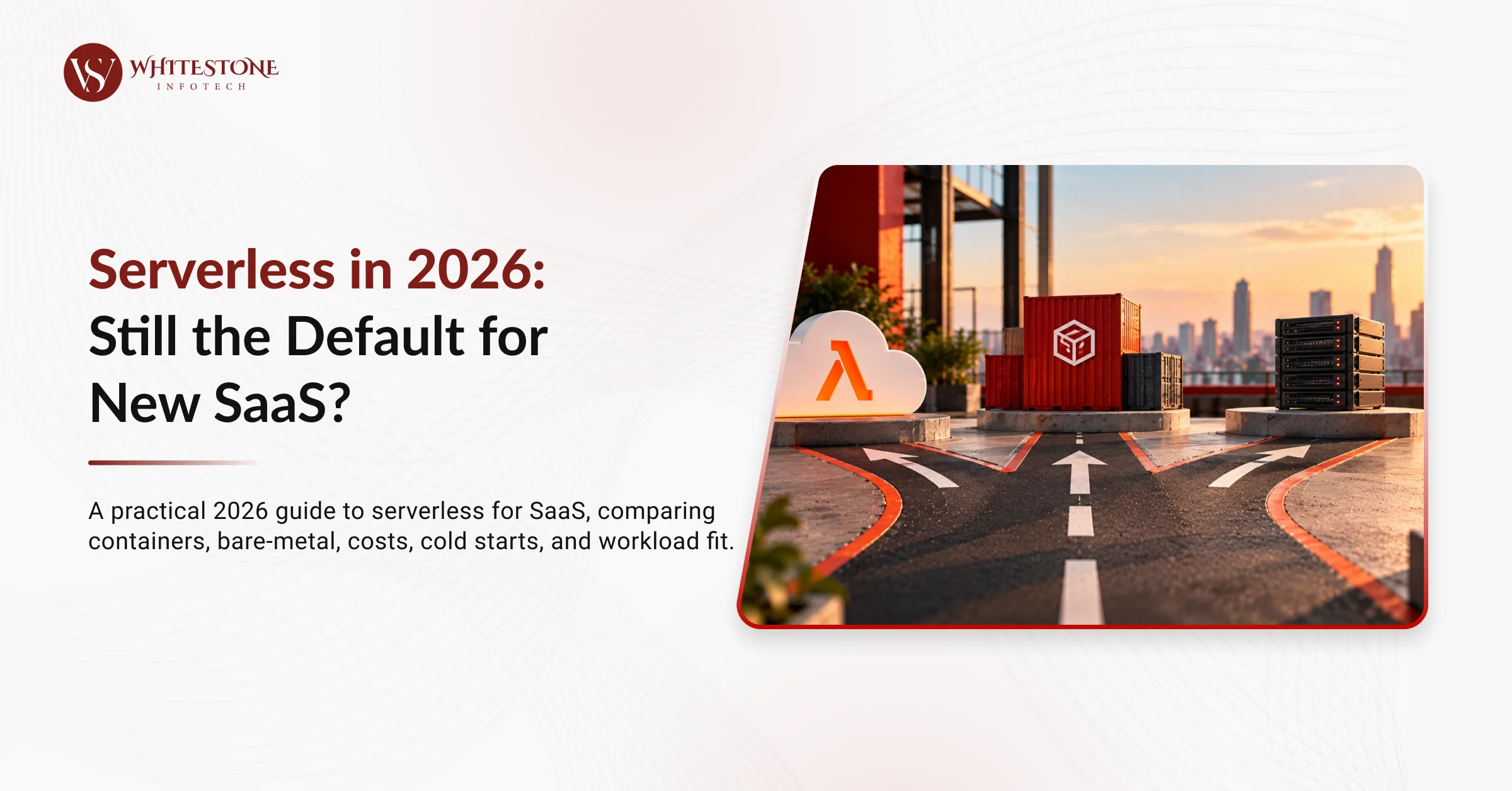
That is the serverless in 2026 conversation across UK and US SaaS teams. Serverless-as-default was the right advice for 2020-2023 when it was the newest option and alternatives were less mature. In 2026 that default is worth reassessing. Managed containers (ECS Fargate, Cloud Run gen2, Container Apps, Fly.io, Railway) offer serverless-like ops without cold starts or scale-cost issues. Bare-metal is dramatically cheaper for steady traffic. Serverless still wins at its sweet spot but the sweet spot is narrower than 2022 claimed.
This article is a candid 2026 reassessment for CTOs, engineering leaders, and technical founders choosing infrastructure for new SaaS. What has actually changed since 2024. When serverless still wins in 2026. When alternatives beat it. Real cost comparison at different scales. What we learned running production across all approaches. Companion to our serverless architecture for saas 2026 real cost and limits deep practitioner piece.
What Has Actually Changed 2024 to 2026
Four material shifts have narrowed the serverless default case since 2024.
Shift 1: Managed container platforms matured. AWS ECS Fargate is production-grade. GCP Cloud Run gen2 introduced always-on instances that eliminate cold starts. Azure Container Apps matched Cloud Run capabilities. Fly.io, Railway, and Render matured into production-grade platforms for teams wanting serverless-like ops without serverless limitations. In 2024, "serverless containers" like Cloud Run had rough edges; in 2026 they are production-ready.
Shift 2: Bare-metal became viable for steady-traffic SaaS again. Hetzner AX-series and equivalent dedicated servers offer excellent price-performance for steady-traffic workloads. Managed platforms on bare-metal (Coolify, Dokku, self-hosted Docker) matured. Bare-metal Hetzner infrastructure at £200-£3000 monthly typically delivers 60-80 percent cost savings versus equivalent serverless bill.
Shift 3: Serverless pricing did not improve at scale. Serverless remains excellent at low usage (free tier, then linear cost). At scale (millions of requests daily sustained), serverless economics deteriorate versus container or bare-metal alternatives. AWS Lambda per-request cost times sustained high throughput exceeds equivalent container-based deployment cost.
Shift 4: Cold-start problem remains, provisioned concurrency has cost. Serverless cold starts (100-500ms) remain a real user-facing issue for latency-sensitive APIs. AWS Lambda provisioned concurrency and equivalent features reduce cold starts but at cost that approaches container-based deployment cost. The cold-start-vs-cost trade-off has not fundamentally improved.
Per AWS Well-Architected serverless lens guidance and CNCF's 2026 Cloud Native Survey, serverless remains the recommended choice for event-driven pipelines, variable traffic, and specific workload patterns; steady-traffic production workloads increasingly benefit from managed containers or dedicated infrastructure.
When Serverless Still Genuinely Wins in 2026
Six workload patterns where serverless remains the right default in 2026.
Variable and spiky traffic. Workloads with 5x-100x traffic variance, unpredictable spikes, or event-triggered surges. Serverless auto-scaling handles this cleanly without capacity planning.
Event-driven pipelines. Webhook receivers, message processors, event fanout. Serverless per-event billing matches event-driven usage patterns.
Low-frequency admin and scheduled functions. Monthly reports, scheduled jobs, admin functions that run rarely. Serverless free tier plus scale-to-zero means near-zero cost for these workloads.
Background job processing. Event-driven pipelines, batch processing, asynchronous workflows. Serverless handles queue-driven work cleanly with parallelism.
Edge functions. Authentication, personalisation, geo-routing at the edge. Cloudflare Workers, Vercel Edge Functions, AWS Lambda@Edge deliver this cleanly.
New SaaS with unclear traffic patterns and small team. Very early-stage SaaS where traffic patterns are unknown and team is 1-3 engineers. Serverless removes capacity planning and infrastructure operations from the critical path. Reassess as traffic patterns become clear.
When Alternatives Beat Serverless in 2026
Six workload patterns where alternatives now win in 2026 that may have been serverless defaults in 2022.
Steady-traffic customer-facing APIs. Predictable traffic patterns without significant variance. Managed containers (ECS Fargate, Cloud Run gen2, Container Apps) or bare-metal beat serverless on cost and cold-start latency.
High-throughput sustained workloads. Millions of requests daily sustained. Serverless per-request cost times sustained throughput exceeds container or bare-metal cost. Migrate to containers or bare-metal for the sustained hot path.
Latency-sensitive user-facing APIs. Cold starts (100-500ms) hurt user experience. Provisioned concurrency reduces cold starts but at cost that approaches container-based deployment. Managed containers eliminate cold starts entirely.
Workloads requiring persistent connections. WebSockets, long-lived streams, server-sent events. Serverless still struggles with persistent connections. Managed containers or bare-metal handle these cleanly.
Cost-sensitive workloads at scale. SaaS approaching Series A or later with margin pressure. Serverless cost efficiency deteriorates at scale. Migration to containers or bare-metal often delivers 40-80 percent infrastructure cost reduction.
Stateful workloads with expensive initialisation. Workloads with expensive initialisation (large ML models, database connection pools, complex configuration). Serverless cold-start amortisation is poor for these; managed containers with always-on instances win.
Real 2026 Cost Comparison
Traffic pattern | Serverless (Lambda + API Gateway) | Managed containers (ECS Fargate, Cloud Run gen2) | Bare-metal (Hetzner) |
Very low (under 100k requests monthly) | £0-£30 monthly | £30-£150 | £30-£100 (VPS) |
Low (100k-10M requests monthly) | £30-£1500 | £150-£1200 | £100-£800 |
Medium (10M-100M requests monthly) | £1500-£15000 | £1200-£8000 | £600-£3000 |
High (100M+ requests monthly sustained) | £15000-£300k+ | £8000-£60k | £2000-£30k |
Two rules that hold at every scale. Managed containers typically deliver 20-40 percent cost savings versus serverless at steady traffic above a few hundred requests per second sustained. And bare-metal typically delivers 60-80 percent cost savings versus serverless for steady-traffic workloads that fit VM capacity; this is why UK SaaS bill £22k to £4.8k rebuild example works.
When Should a New SaaS Default to Serverless in 2026?
The 2022 default advice was "always start with serverless". The 2026 default advice should be more careful.
Default to serverless when. Very early stage SaaS with 1-3 engineers, traffic patterns unknown, admin and event-driven workloads dominant. Serverless removes operational burden while patterns become clear.
Default to managed containers when. New SaaS with reasonable traffic prediction, team of 3-10 engineers, mixed workload with some steady-traffic customer-facing APIs. Managed containers (Cloud Run gen2, ECS Fargate, Container Apps) offer serverless-like ops without cold-start or scale-cost issues.
Default to bare-metal or dedicated VMs when. New SaaS with clear steady-traffic prediction (rare for new SaaS), cost sensitivity from day one, team with basic ops capacity. Bare-metal delivers dramatic cost savings for steady traffic.
Do not default to serverless when. Traffic patterns are clearly steady from day one. Latency-sensitive user-facing APIs. Workloads requiring persistent connections. Team has containers experience and no serverless experience. Cost sensitivity from day one.
Common Serverless Mistakes to Avoid in 2026
Adopting serverless as default without reassessing at scale. Team defaults to serverless in year one (reasonable), never reassesses in year two or three as traffic pattern becomes clear (mistake). Fix: annual architecture review that reassesses infrastructure choices against current workload patterns.
Building latency-sensitive user-facing APIs on serverless. Team builds customer-facing hot path on Lambda. Cold-start latency spikes hurt user experience. Fix: managed containers with always-on instances for latency-sensitive user-facing paths; serverless for admin, batch, event-driven backend.
Using serverless for high-throughput sustained workloads without cost projection. Team scales serverless to millions of requests daily without projecting cost. Discovers serverless bill grew faster than expected. Fix: cost projection at 10x current usage before scaling serverless; migrate hot path to containers if projection is unfavourable.
Ignoring vendor lock-in from serverless-native architecture. Team builds Lambda-native architecture with SNS, SQS, EventBridge, Step Functions, DynamoDB. Migration to alternative platforms is difficult. Fix: acceptable trade-off if serverless is genuinely right, but budget migration cost in architecture decisions.
Choosing serverless for stateful workloads with expensive initialisation. Team builds ML inference or complex initialisation workloads on serverless. Cold-start amortisation is poor. Fix: managed containers with always-on instances for workloads with expensive initialisation.
What We Learned Running Production Across All Approaches
WhiteStone runs production workloads across AWS Lambda, GCP Cloud Run gen1 and gen2, Azure Functions, Vercel, Cloudflare Workers, AWS ECS Fargate, Azure Container Apps, Kubernetes, and bare-metal on Hetzner. Three lessons transfer to any UK or US SaaS team reassessing serverless in 2026.
TrackVid runs on bare-metal Hetzner, not serverless, and it works. TrackVid serves 4000+ Indian ecommerce merchants at steady traffic patterns with total infrastructure roughly £700 monthly. Serverless equivalent would cost significantly more (managed platform overhead, per-request cost times sustained throughput) without corresponding benefit. Steady-traffic SaaS often wins with bare-metal.
IELTSArena runs a mixed environment: hot path on bare-metal, event-driven on serverless, analytics on GCP BigQuery. Right architecture per workload rather than serverless-for-everything or containers-for-everything. Serverless where it wins (event pipeline, admin, batch); bare-metal where it wins (steady-traffic hot path); managed analytics where it wins (BigQuery).
Client rebuild from Lambda-only to bare-metal hot path plus retained serverless for admin and batch delivered 78 percent infrastructure cost reduction. UK SaaS founder mentioned above. Hot path (customer-facing API) migrated to bare-metal Hetzner. Admin functions, batch jobs, webhook receivers kept on Lambda. Bill £22k to £4.8k. Same reliability, better latency. Hybrid architecture beats pure-serverless at scale.
See our portfolio of shipped work for architecture case studies. For a scoped serverless reassessment, book a technical architecture call with WhiteStone.
Frequently Asked Questions
Is serverless still the default choice for new SaaS in 2026?
Serverless is still the right default for a specific set of new SaaS workloads (variable traffic, event-driven, low-frequency admin, background jobs, edge functions, very early-stage with 1-3 engineers), not for all. Managed containers (ECS Fargate, Cloud Run gen2, Container Apps) are increasingly the right default for new SaaS with reasonable traffic prediction and mixed workloads. Bare-metal is the right default for cost-sensitive SaaS with clear steady-traffic patterns.
What has changed in serverless between 2024 and 2026?
Four material shifts. Managed container platforms matured (ECS Fargate, Cloud Run gen2, Container Apps, Fly.io, Railway are production-grade). Bare-metal became viable for steady-traffic SaaS (Hetzner and equivalent). Serverless pricing did not improve at scale (economics deteriorate at high throughput). Cold-start problem remains, and provisioned concurrency cost approaches container-based deployment cost.
Serverless vs containers vs bare-metal: which for new SaaS in 2026?
Serverless for variable traffic, event-driven, low-frequency admin, background jobs, edge functions, very early-stage. Managed containers for reasonable traffic prediction, mixed workloads, teams of 3-10 engineers wanting serverless-like ops without cold-start or scale-cost issues. Bare-metal for cost-sensitive SaaS with clear steady-traffic patterns and basic ops capacity. Kubernetes only at enterprise thresholds (30+ engineers, dedicated platform team).
How much does serverless cost for a growing SaaS in 2026?
Very low usage (under 100k requests monthly): £0-£30 monthly (free tier). Low (100k-10M requests monthly): £30-£1500. Medium (10M-100M requests monthly): £1500-£15000. High (100M+ requests monthly sustained): £15000-£300k+ where cost efficiency deteriorates versus managed containers (20-40 percent cheaper) and bare-metal (60-80 percent cheaper) at scale.
What are the current limitations of serverless in 2026?
Cold starts (100-500ms) hurt latency-sensitive user-facing APIs. Provisioned concurrency reduces cold starts but at cost approaching container-based deployment. Persistent connections (WebSockets, long-lived streams) remain difficult. Cost efficiency deteriorates at high sustained throughput. Stateful workloads with expensive initialisation amortise poorly on serverless. Vendor lock-in from serverless-native architecture.
When should a new SaaS default to serverless in 2026?
Default to serverless when very early stage with 1-3 engineers, traffic patterns unknown, admin and event-driven workloads dominant. Default to managed containers when team of 3-10 engineers with reasonable traffic prediction and mixed workloads. Default to bare-metal when clear steady-traffic prediction and cost sensitivity from day one. Do not default to serverless for latency-sensitive user-facing APIs, workloads with persistent connections, or clearly steady traffic patterns.
Why choose WhiteStone Infotech for serverless and cloud architecture assessment?
We run production workloads across all approaches: AWS Lambda, GCP Cloud Run gen1 and gen2, Azure Functions, Vercel, Cloudflare Workers, ECS Fargate, Container Apps, Kubernetes, and bare-metal on Hetzner. TrackVid runs on bare-metal for 4000+ merchants at £700 monthly. IELTSArena runs mixed environment. We migrated a UK SaaS from Lambda-only to bare-metal hot path plus retained serverless for admin and batch, cutting monthly bill from £22k to £4.8k. Contact WhiteStone Infotech at whitestoneinfotech.com/contact.
The One Thing to Remember
Serverless in 2026 is still the right default for a specific set of new SaaS workloads (variable traffic, event-driven pipelines, low-frequency admin, background jobs, edge functions, very early-stage with 1-3 engineers), not for all. Managed containers (ECS Fargate, Cloud Run gen2, Azure Container Apps, Fly.io, Railway) matured 2024-2026 and are increasingly the right default for new SaaS with reasonable traffic prediction. Bare-metal (Hetzner and equivalent) delivers dramatic cost savings for steady-traffic workloads. Real cost: managed containers typically 20-40 percent cheaper than serverless at sustained traffic; bare-metal typically 60-80 percent cheaper for steady traffic. The single decision that determines whether serverless is right for new SaaS in 2026: does the workload have variable or spiky traffic where serverless economics win, or does it have steady traffic where managed containers or bare-metal win? Traffic pattern matters more than trendiness.