A UK CEO we spoke to last month was choosing between hiring 8 engineers in-house (12 months of recruitment, £900k fully loaded per year) and outsourcing to an agency (£110k monthly, less control, worried about quality). Both options felt bad. His CTO was frustrated. His board wanted a decision.
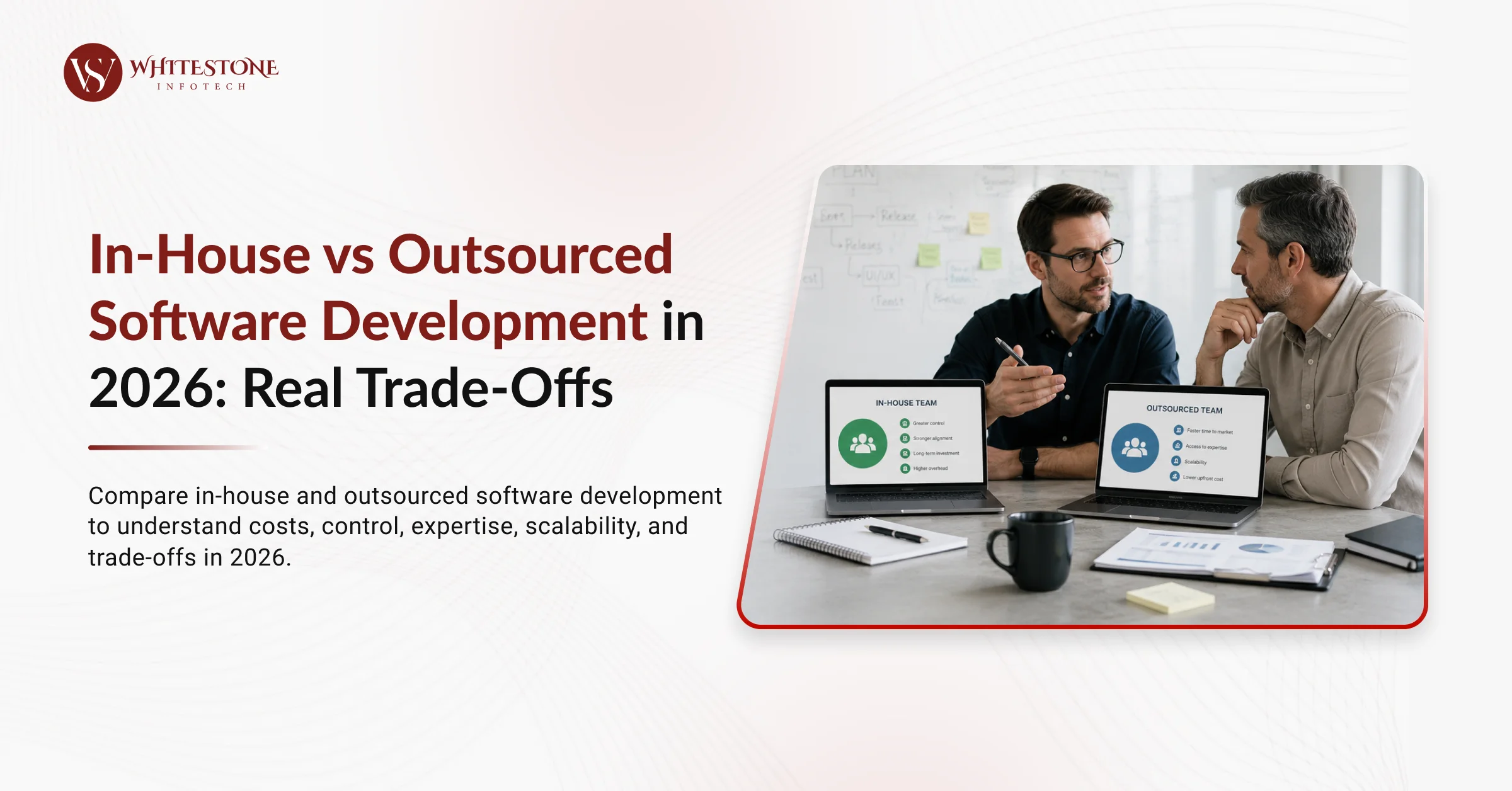
That is the sourcing conversation across UK and US businesses in 2026. The framing is often binary. Real options are broader. Successful engineering organisations mix in-house, outsourced, staff augmentation, and managed services deliberately based on the specific work rather than committing to a single model.
This article is a candid framework for CTOs, CEOs, and heads of engineering scoping sourcing strategy. The four real options. What fits when. Real cost comparison. The hybrid model that ships. And what we see across client engagements at WhiteStone.
The False Binary: Four Real Options
Four options with distinct trade-offs.
1. Full in-house team. All engineers on your payroll. Your process, your tools, your culture. Highest control. Highest management overhead. Best for domain-critical work over 18+ months where compounding knowledge matters.
2. Full outsourced (agency). Agency runs delivery end-to-end. Their process, their tools, their team management. Lower operational overhead. Predictable cost. Less control over how work gets done. Best for fixed-scope projects with clear boundaries and defined deliverables.
3. Staff augmentation. Agency provides engineers who join your team. They follow your process, use your tools, attend your standups. You manage them like in-house engineers; the agency handles employment, benefits, and bench continuity. Best when you need capacity immediately without recruitment overhead and want to maintain your engineering process.
4. Managed services. Agency owns a specific function to SLA (DevOps, QA, 24/7 monitoring, security operations, content moderation). Outcomes-based rather than time-based. Best for non-differentiating functions where sustained coverage matters more than deep integration with product engineering.
Most successful engineering organisations use two or three of these together deliberately. Pure in-house is uncommon above 30 engineers. Pure outsourced is uncommon at any serious scale. The Gartner IT services research publishes ongoing analysis showing hybrid sourcing models increasingly dominate at enterprise scale.
Decision Framework: What Actually Fits When
Match option to specific work type.
Full in-house fits when:
Domain-critical roadmap of 18+ months
Deep knowledge compounding matters (regulated vertical, complex algorithms, proprietary IP)
You are building the differentiating capability, not the plumbing
You have the leadership capacity to recruit and manage the team
Full outsourced fits when:
Fixed-scope project with clear boundaries and acceptance criteria
Time-bound programme (12 months or less)
Non-differentiating work that just needs to ship
You lack in-house engineering leadership to hire and manage
Staff augmentation fits when:
Need capacity immediately (weeks not months)
Want to maintain your engineering process and culture
Have engineering leadership to onboard and integrate augmented engineers
Workload is ongoing but variable in size
Managed services fits when:
Function is non-differentiating (DevOps, monitoring, QA, security ops)
24/7 or extended-hours coverage matters
Outcomes-based SLA is measurable
You lack scale to justify dedicated in-house team for the function
Most CTOs need two or three of these for different work streams. See our earlier post on how to choose a software development partner for the evaluation checklist that applies to options 2, 3, and 4.
Real 2026 Cost Comparison
Senior developer equivalent capacity, annual cost, UK-focused.
Full in-house UK senior engineer.
Salary: £75k to £110k
Employer NI, pension, benefits: approximately 20 percent uplift
Fully loaded: £90k to £132k
Add recruitment cost: £5k to £15k in year 1
Add management overhead: 15-25 percent of leadership capacity
Full outsourced UK agency (dedicated developer equivalent).
Monthly retainer: £8k to £15k for one senior developer equivalent
Annual: £96k to £180k
Includes project management overhead, backup coverage, delivery discipline
No recruitment or management overhead
Staff augmentation.
Offshore (India, Eastern Europe, Latin America): £60k to £110k annually
Nearshore (Portugal, Ireland, Poland): £80k to £130k annually
Onshore contractor: £120k to £200k annually
You manage the engineer like in-house; agency handles employment
Managed services (varies by function).
DevOps managed service: £30k to £120k depending on scope and scale
QA managed service: £40k to £150k depending on coverage
24/7 monitoring: £30k to £100k typically
Outcomes-based SLA rather than headcount-based
Total cost is often closer across options than founders assume. The deciding factor is usually not cost alone but reversibility, domain compounding, and management overhead. The McKinsey Digital insights published tech talent research consistently showing hybrid models outperforming pure in-house or pure outsourced on delivery predictability.
The Hybrid Model That Actually Ships
Three hybrid patterns we see working reliably.
Pattern 1: In-house senior architects with staff augmented delivery capacity.
2-4 in-house senior engineers holding architecture and technical direction
4-10 staff augmented engineers providing delivery capacity
Same process, same tools, same standups
Scales up and down without recruitment cycle
Best for growth-stage product with variable delivery needs
Pattern 2: In-house product with managed services for infrastructure.
In-house product engineering team owns feature development
Managed services for DevOps, monitoring, security operations
Product team focuses on differentiating work
Non-differentiating operations delivered to SLA
Best for growth-stage SaaS wanting to keep product engineering focused
Pattern 3: In-house on domain-critical work with outsourced on well-scoped adjacent projects.
In-house team on the differentiating platform
Outsourced agency delivers specific well-scoped adjacent projects (admin portal, integration project, mobile companion app)
Preserves in-house focus on core
Delivers adjacent value without hiring cycle
Best for established products with clear differentiating vs adjacent boundaries
The pattern that fits depends on which type of work dominates your roadmap. Hybrid design starts with the work, not with sourcing preference.
What We See Across Client Engagements
Across 50-plus client engagements at WhiteStone, three patterns recur.
Pure in-house often runs out of capacity or exhausts management capacity. Client tries to hire everything in-house. Recruitment cycle is 6-12 months per engineer. Founder or CTO spends 30-40 percent of time on recruitment. Delivery slips because leadership is not on the product.
Pure outsourced often loses domain-critical knowledge over time. Client commits fully to agency delivery. Agency team rotates over 18-36 months. Domain knowledge in agency engineers evaporates. Client rebuilds shared understanding periodically.
Hybrid models deliver most reliably. Clients that mix in-house domain leadership with agency or dedicated developer delivery capacity ship faster and cheaper than either pure model. This is why we structure our engagements to support this pattern (dedicated developers, staff augmentation, managed services) rather than pushing full outsourced by default.
You can see our shipped work at our portfolio. If you want a candid conversation about your sourcing strategy, book a sourcing strategy call with WhiteStone.
Common Failure Modes
Three failure modes we see repeatedly.
Treating the choice as binary. CTO believes it is in-house or outsourced. Picks one. Discovers the other three options would have fit specific workloads better. Reworks sourcing 18 months later.
Full outsourced for domain-critical work. Client outsources the differentiating platform. Agency team turnover eventually costs domain knowledge. Client rebuilds understanding periodically at real cost.
In-house for well-scoped adjacent projects. Client hires in-house for a 4-month admin portal build. Recruitment took 6 months. Engineer needs work when the project completes. Manufactures work to justify the hire.
Frequently Asked Questions
When does outsourcing beat in-house?
Fixed-scope projects with clear boundaries (12 months or less), non-differentiating work that just needs to ship, or when you lack engineering leadership to hire and manage in-house. Domain-critical work over 18+ months usually favours in-house or staff augmentation over full outsourced.
Is staff augmentation the same as outsourcing?
No. Staff augmentation means agency provides engineers who join your team and follow your process, tools, and culture. You manage them like in-house engineers. Full outsourcing means agency runs delivery end-to-end with their process. Staff augmentation preserves your engineering culture; outsourcing does not.
How does managed services differ from outsourced development?
Managed services owns a specific function to SLA (DevOps, QA, 24/7 monitoring, security operations). Outcomes-based rather than time-based. Outsourced development delivers specific projects or features. Managed services suits non-differentiating functions with sustained coverage needs; outsourced development suits fixed-scope work.
What is the real cost of in-house vs outsourced?
Senior developer equivalent UK annual: in-house £90k-£132k fully loaded. Full outsourced £96k-£180k. Staff augmentation £60k-£110k offshore, £80k-£130k nearshore. Managed services varies £30k-£150k by function. Total cost is closer than assumed; deciding factors are reversibility, domain compounding, and management overhead.
How do I choose between staff augmentation and full outsourcing?
Staff augmentation if you have engineering leadership, want to maintain your process, and workload is ongoing. Full outsourcing if you lack leadership, work is fixed-scope, and you prefer agency to own the delivery method. Most growth-stage businesses benefit from staff augmentation over full outsourcing.
The One Thing to Remember
The in-house vs outsourced framing is a false binary. Four real options exist: full in-house, full outsourced, staff augmentation, and managed services. Match the option to the specific work. Most successful engineering organisations run two or three options together deliberately. Pure models are uncommon at serious scale. The hybrid pattern that fits depends on which type of work dominates your roadmap. Design sourcing around the work, not around preference.
If you want a candid conversation about your specific sourcing strategy, browse our dedicated developer services or come to the call.