A UK precision engineering CTO we spoke to last quarter had scoped a £780k IIoT platform deployment from a major vendor to cover connectivity, edge computing, ingestion, dashboards, and integration with their SAP ERP across 4 UK sites. Twelve months into deployment, connectivity and edge worked well. Ingestion and dashboards worked. Integration with SAP was 30 percent complete and stalled because the vendor integration approach did not match how their operations teams actually made decisions using SAP work orders and dispatch lists.
The IT director asked why the platform investment was not translating into operations improvement. The honest answer was that they had bought a platform that was designed to solve connectivity, edge, and ingestion cleanly, but the integration and operator-facing layers (which is where operations decisions get made) were where the platform's vendor-standard approach hit friction with their specific SAP workflows.
The alternative that would have been right for them: base vendor platform for layers 1-4 (connectivity, edge, ingestion, storage) where it genuinely delivered, plus custom development for layers 5-6 (competitive-advantage analytics and specific SAP integration) where their processes were specific. Estimated total: £780k for vendor platform plus £280k custom development. Higher initial cost than vendor-only, but operations decision integration would actually work.
We scoped the custom layer 5-6 development in parallel with continued vendor platform rollout. Six months later, operations teams were using integrated dashboards inside their SAP workflows, work orders were being generated from IIoT quality signals automatically, and dispatch lists reflected real-time equipment availability. The platform investment finally translated into operations improvement.
That is the iiot platform development 2026 conversation across UK and US manufacturers. Vendor platforms are excellent for the layers they were designed to solve (connectivity, edge, ingestion, standard analytics). They consistently under-deliver on integration with specific MES, ERP, QMS, and operator workflows where operations decisions actually get made. Manufacturers get sold "one platform solves everything" when the right answer is hybrid: vendor base plus custom development for competitive-advantage analytics and specific integration.
This article is a candid CTO playbook for UK and US manufacturing leaders scoping IIoT platform development or vendor selection. Six architecture layers. Build vs buy vs configure decision per layer. Real cost bands. Integration reality. What we learned building real-time event-processing platforms that share the technical DNA IIoT platforms require.
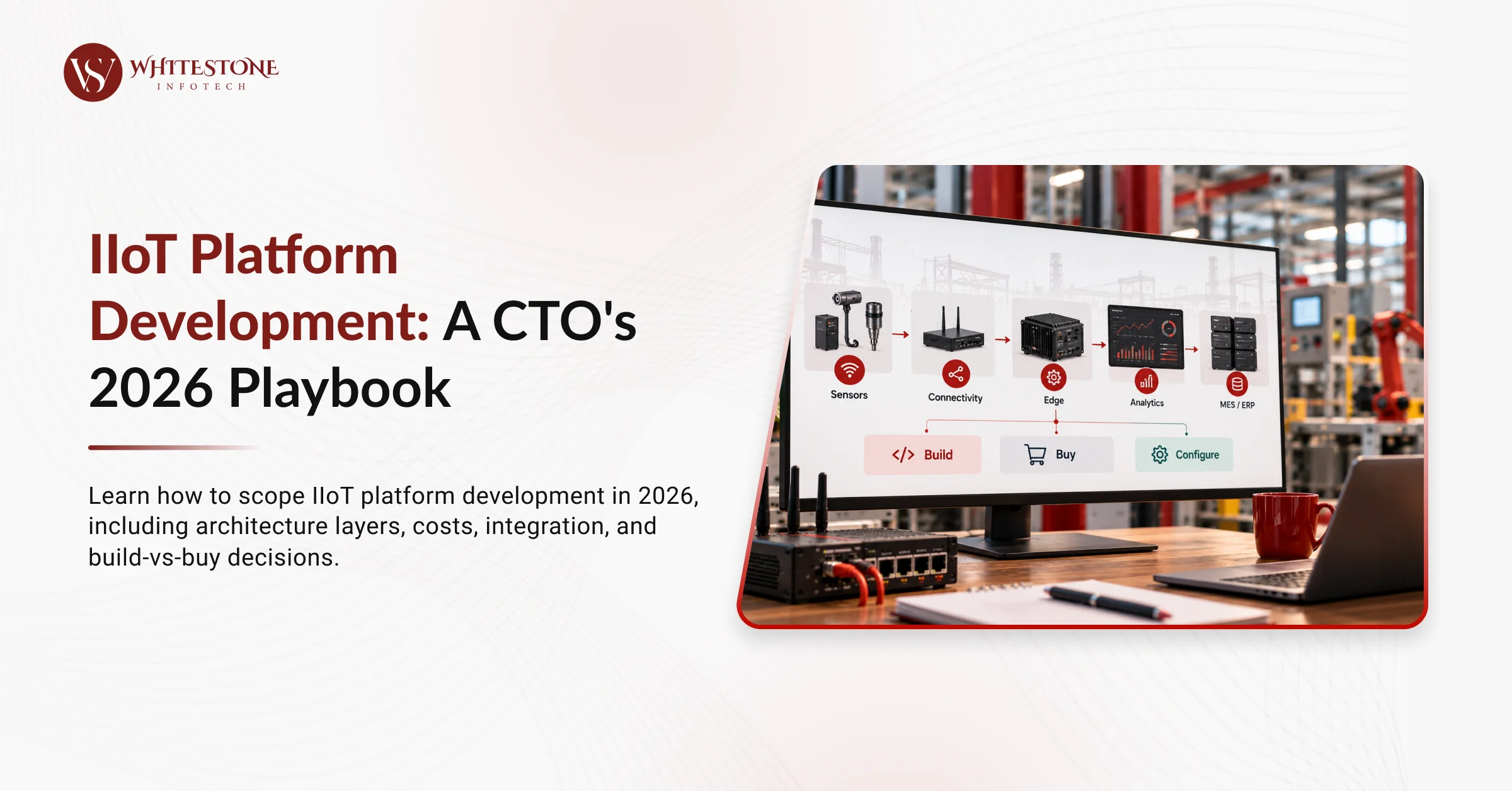
The Six Architectural Layers of an IIoT Platform in 2026
Layer 1: Devices and sensors. PLCs, RTUs, edge gateways, wireless sensors (temperature, vibration, pressure, current, position). Always bought from industrial hardware vendors (Siemens, Rockwell, Schneider, ABB, Advantech, and sensor specialists).
Layer 2: Connectivity. Protocols and networks: MQTT and MQTT-SN for wireless, OPC UA for industrial systems, LoRaWAN for wide-area low-power, cellular (LTE-M, NB-IoT, 5G) for remote assets, ethernet and industrial Wi-Fi for on-site. Standards-based, rarely built custom.
Layer 3: Edge computing. Protocol translation, local data filtering, edge machine learning, local operator dashboards, buffering during connectivity loss. Configured from vendor stacks (AWS IoT Greengrass, Azure IoT Edge, Siemens Industrial Edge, Balena, EdgeX Foundry).
Layer 4: Ingestion and storage. Time-series database (InfluxDB, TimescaleDB, QuestDB, AWS Timestream), event streaming (Kafka, AWS Kinesis, Redpanda), data lake for analytical workloads. Commonly configured from established stacks.
Layer 5: Processing and analytics. Rules engine, ML models for predictive maintenance and quality, dashboards, alerting. Where custom development delivers competitive advantage (proprietary process models, industry-specific algorithms).
Layer 6: Integration. With MES, ERP, QMS, operator interfaces, customer or supplier systems. Where custom integration work matters most and where vendor platforms consistently under-deliver.
Per the Industrial Internet Consortium (now part of the Object Management Group) reference architecture, IIoT platforms in 2026 increasingly separate connectivity and edge (Layers 1-3) from analytics and integration (Layers 5-6), because vendor platforms handle the former well while the latter is inherently specific to the manufacturer's competitive requirements and existing systems.
The Build vs Buy vs Configure Decision Per Layer
Layer 1 (devices and sensors): always buy. No manufacturer builds industrial hardware. Buy from established vendors (Siemens, Rockwell, Schneider, ABB, Advantech, and sensor specialists).
Layer 2 (connectivity): always standards-based, rarely built. MQTT, OPC UA, LoRaWAN, cellular, ethernet are standards. Use standards; do not build proprietary connectivity.
Layer 3 (edge computing): configure from vendor stacks. AWS IoT Greengrass, Azure IoT Edge, Siemens Industrial Edge, Balena, and EdgeX Foundry are mature. Configure the stack; do not build edge computing framework from scratch.
Layer 4 (ingestion and storage): configure from established stacks. InfluxDB or TimescaleDB for time-series, Kafka or Kinesis for streaming, cloud object storage for data lake. Configuration and integration work; do not build database or streaming from scratch.
Layer 5 (processing and analytics): build where competitive advantage lives. Rules engine and dashboards can be configured from vendors. Proprietary process models, industry-specific quality algorithms, and custom optimisation are where custom development pays back. Build what makes you different.
Layer 6 (integration): custom is almost always required. Vendor integration modules for SAP, Oracle, standard MES exist but rarely match the specific work order flows, dispatch patterns, and operator interfaces that reflect the manufacturer's actual operations. Custom integration is typically 30-50 percent of total platform development effort.
When Vendor Platforms Genuinely Win
Choose a vendor platform (PTC ThingWorx, Siemens MindSphere, Rockwell FactoryTalk InnovationSuite, Microsoft Azure IoT Central, AWS IoT SiteWise) when at least three apply:
Standard IIoT use cases (asset performance monitoring, OEE, standard predictive maintenance, condition monitoring)
Team lacks software engineering capacity to build custom
Existing vendor relationship (Siemens shop with existing Siemens PLCs, Rockwell shop with existing Rockwell PLCs) provides natural integration
Annual licence cost £80k-£600k+ fits budget and is acceptable ongoing
Integration with specific ERP and MES workflows is standard (SAP with standard PP-MII, Oracle with standard MES connector)
Realistic expectation: annual licence £80k-£600k+ plus initial integration and customisation £200k-£800k+. Fast time-to-value on standard use cases. Limited customisation beyond vendor extension points.
When Custom Build Genuinely Wins
Choose custom build when at least three apply:
Business logic and analytics create competitive advantage (proprietary process models, industry-specific quality algorithms)
Integration requirements are specific to your MES, ERP, QMS, and operator workflows
Data ownership and sovereignty matter (regulatory, IP protection, competitive concerns)
Team has software engineering capacity or will fund external development capacity
Ongoing platform evolution matters (weekly or monthly changes to analytics and integration)
Realistic expectation: 6-18 month build timeline for a full custom platform. Higher ongoing engineering cost. Full control over platform direction. Competitive advantage from proprietary analytics and integration.
When Hybrid (Configure Vendor Base plus Custom) Wins
Most manufacturers land in hybrid. Choose hybrid when at least three apply:
Standard IIoT layers (connectivity, edge, ingestion, storage) are commodity for you
Competitive advantage lives in analytics and integration
Team has some software engineering capacity but not enough for full custom build
Willing to manage multiple vendor relationships plus custom development team
Budget accommodates vendor licence plus custom development cost
Realistic expectation: vendor platform for Layers 1-4 plus custom development for Layers 5-6. Total cost typically 20-40 percent higher than vendor-only but delivers integration and competitive-advantage analytics that vendor-only misses.
Real 2026 Cost Bands
Deployment scale | Custom platform initial | Custom platform annual | Vendor platform (licence + integration) |
Small (single site, 100-500 devices) | £150k-£400k | £40k-£100k | £80k-£280k annually all-in |
Mid-market (multi-line single site or small multi-site, 500-2000 devices) | £400k-£1.2m | £100k-£300k | £280k-£800k annually all-in |
Enterprise (multi-site, 2000+ devices) | £1.2m-£4m+ | £300k-£800k+ | £800k-£2.4m+ annually all-in |
Two rules that hold at every scale. Layer 6 (integration) is typically 30-50 percent of total platform effort; underestimating this is the most common IIoT platform budget failure. And ongoing operational cost (edge device management, cloud infrastructure, platform team, integration maintenance) typically 25-35 percent of initial platform cost annually; underestimating this creates the second-year budget shock most manufacturers experience.
Integration with MES, ERP, and QMS
Six integration patterns that determine whether the IIoT platform delivers operational value.
IIoT to MES for real-time production and quality signals. IIoT quality events drive MES quality holds. IIoT equipment status drives MES scheduling decisions. Integration must match MES-specific workflow.
IIoT to ERP for work order and dispatch generation. IIoT signals (equipment down, quality issue, production complete) drive ERP work order generation and dispatch list updates. Must match specific ERP work order flow.
IIoT to QMS for traceability and audit. Every IIoT sensor reading and quality event feeds QMS traceability records. Full genealogy for regulated manufacturing (food, pharma, aerospace, medical devices).
IIoT to operator interfaces for next-action prompts. Sensor events drive operator interface prompts (quality check due, tool change required, next material load, safety alert). Turns IIoT into productivity tool for operators, not just data collection.
IIoT to analytics for OEE and continuous improvement. Sensor and event data feed analytics for OEE calculation, downtime analysis, quality trending, and continuous improvement projects.
IIoT to customer or supplier systems for supply chain visibility. Some contracts (aerospace primes, automotive tier-1) require near-real-time production visibility to customer systems. IIoT data flows through integration layer to customer systems.
Common IIoT Platform Development Mistakes
Underestimating Layer 6 integration effort. Team scopes IIoT platform assuming 15 percent of effort on integration. Reality: 30-50 percent of effort on integration with specific MES, ERP, QMS, and operator workflows. Fix: budget 30-50 percent for integration from day one.
Buying vendor platform without integration proof-of-concept. Team buys £600k annual platform based on vendor demo. Integration with specific SAP workflow does not match vendor standard connector. Fix: integration proof-of-concept with specific ERP, MES, QMS workflows before vendor commitment.
Building custom platform without industrial protocol expertise. Team builds custom platform with software engineering expertise but limited industrial protocol (OPC UA, MQTT-SN, Modbus) experience. Protocol integration takes 3x expected time. Fix: industrial protocol expertise on team from day one, or partner with agency that has it.
Ignoring edge computing requirements. Team plans cloud-only IIoT platform. Discovers connectivity is unreliable at production sites (rural manufacturing, basement machinery, RF-noisy environments). Fix: edge computing with local buffering and processing from day one.
Building operator interfaces as afterthought. Team focuses on data collection and analytics. Operator interfaces are built last as static dashboards. Operators do not adopt them because they do not match workflow. Fix: operator interfaces designed with operators from day one, integrated into their existing workflow tools.
Underestimating ongoing operational cost. Team budgets for platform build only. Discovers ongoing edge device management, cloud infrastructure, platform team, and integration maintenance costs 25-35 percent of initial cost annually. Fix: budget ongoing operational cost from day one.
What We Learned Building Real-Time Event-Processing Platforms
WhiteStone has shipped TrackVid (real-time video quality tracking for ecommerce fulfilment across 4000+ Indian merchants processing millions of events daily with edge capture and cloud analytics) and SiteFlow (construction site field-ops tracking with edge device management for UK property developer). Both share the technical DNA IIoT platforms require. Three lessons transfer to any UK or US manufacturer scoping IIoT platform development.
Reliable data capture at the edge determines platform value. TrackVid works because capture at the packing station is reliable and continues when connectivity drops. Same for IIoT platforms: edge computing must handle connectivity loss, filter meaningful events from noise, and reliably transmit when connectivity resumes. Cloud-only IIoT platforms fail in typical industrial connectivity conditions.
Integration into decision systems is where platforms become value. TrackVid integrates with ecommerce platforms, marketplaces, and courier APIs where merchants make decisions. Same for IIoT platforms: sensor data must flow into MES, ERP, QMS, and operator interfaces where operations decisions actually get made. Standalone platform dashboards that no one uses are technology theatre.
Hybrid architecture (vendor base plus custom analytics and integration) beats platform-only or custom-only for most manufacturers. SiteFlow uses commodity edge stack (Balena) for device management and custom field-ops analytics and integration. Same pattern works for IIoT platforms: vendor for connectivity and edge, custom for competitive-advantage analytics and specific ERP, MES, QMS integration.
See our portfolio of shipped work for real-time event-processing case studies. For a scoped IIoT platform conversation, book a manufacturing software architecture call with WhiteStone.
Frequently Asked Questions
What is an IIoT platform and what does it do in 2026?
An IIoT (Industrial Internet of Things) platform captures data from industrial devices and sensors, processes it at the edge and in the cloud, and delivers real-time visibility, predictive analytics, and integration with existing operations systems. In 2026 IIoT platforms have six architectural layers: devices and sensors, connectivity, edge computing, ingestion and storage, processing and analytics, and integration with MES, ERP, QMS, and operator interfaces.
What are the main layers of an IIoT platform architecture?
Six layers. Layer 1: devices and sensors (PLCs, RTUs, edge gateways, wireless sensors). Layer 2: connectivity (MQTT, OPC UA, LoRaWAN, cellular, ethernet). Layer 3: edge computing (protocol translation, local filtering, edge ML). Layer 4: ingestion and storage (time-series DB, event streaming, data lake). Layer 5: processing and analytics (rules engine, ML models, dashboards). Layer 6: integration with MES, ERP, QMS, operator interfaces.
Should a manufacturer build, buy, or configure an IIoT platform in 2026?
Most manufacturers land in hybrid: vendor platform for Layers 1-4 (connectivity, edge, ingestion, storage) plus custom development for Layers 5-6 (competitive-advantage analytics and specific integration). Pure buy fits standard IIoT use cases without integration friction. Pure custom fits when competitive advantage lives in analytics and integration, team has engineering capacity, and data sovereignty matters. Hybrid balances vendor strengths with custom advantage.
How much does IIoT platform development cost in 2026?
Custom platform: £150k-£400k small (single site, 100-500 devices), £400k-£1.2m mid-market (multi-line single site), £1.2m-£4m+ enterprise (multi-site, 2000+ devices). Ongoing 25-35 percent of initial annually. Vendor platform: £80k-£280k annually all-in small, £280k-£800k mid-market, £800k-£2.4m+ enterprise. Layer 6 integration is 30-50 percent of total platform effort; underestimating this is the most common budget failure.
How does an IIoT platform integrate with MES, ERP, and QMS?
Six integration patterns. IIoT to MES for real-time production and quality signals. IIoT to ERP for work order and dispatch generation. IIoT to QMS for traceability and audit. IIoT to operator interfaces for next-action prompts. IIoT to analytics for OEE and continuous improvement. IIoT to customer or supplier systems for supply chain visibility. Integration must match specific MES, ERP, QMS workflows; vendor standard connectors rarely match specific manufacturer processes.
What are the common IIoT platform development mistakes to avoid?
Six recurring mistakes. Underestimating Layer 6 integration effort. Buying vendor platform without integration proof-of-concept. Building custom platform without industrial protocol expertise. Ignoring edge computing requirements (cloud-only fails in typical industrial connectivity). Building operator interfaces as afterthought (operators do not adopt). Underestimating ongoing operational cost (25-35 percent of initial annually).
Why choose WhiteStone Infotech for IIoT platform development?
We build real-time event-processing platforms that share IIoT platform DNA. TrackVid processes millions of events daily for 4000+ Indian ecommerce merchants with reliable edge capture and cloud analytics. SiteFlow tracks construction site field operations with edge device management for a UK property developer. Both required the discipline IIoT platforms require: reliable edge data capture, resilient event processing at scale, and integration into existing decision systems. Contact WhiteStone Infotech at whitestoneinfotech.com/contact.
The One Thing to Remember
IIoT platform development in 2026 has six architectural layers, each with its own build vs buy vs configure decision. Layers 1-4 (devices, connectivity, edge, ingestion and storage) are typically bought or configured from established vendors. Layer 5 (processing and analytics) is where custom development creates competitive advantage. Layer 6 (integration with MES, ERP, QMS, operator interfaces) is where vendor platforms consistently under-deliver and where custom integration effort matters most. Real cost: £150k-£400k small custom platform, £400k-£1.2m mid-market, £1.2m-£4m+ enterprise, plus 25-35 percent annually. Vendor platforms £80k-£600k+ annually all-in. Most manufacturers land in hybrid: vendor base plus custom analytics and integration. The single decision that determines IIoT platform ROI: does the platform data flow into MES, ERP, QMS, and operator interfaces where operations decisions get made, or does it sit in a platform dashboard that no one acts on? Integration into existing decision systems matters more than platform vendor choice.

.webp)