A UK SaaS CTO we spoke to last quarter had adopted GraphQL from day one for a standard CRUD SaaS with a single web client and no mobile app. Team of 4 engineers. Product doing well with 300 customers. He asked why his team was spending 20 percent of engineering time on GraphQL-related work (schema evolution, resolver optimisation, N+1 query issues, Apollo Client cache invalidation) that a REST equivalent would not have required.
The honest answer was that GraphQL for a single-client CRUD SaaS is significantly over-scoped. His use case (standard CRUD resources, single web client, no aggregation of multiple backends, no complex client-shaped data requirements) would have run cleanly on REST with roughly 5 percent of engineering time on API-related work. GraphQL was solving problems he did not have while creating problems he now had to solve.
The reason he had adopted GraphQL was 2022 dev blog posts said modern SaaS uses GraphQL. He had never assessed whether his workload actually benefited. The team had built the schema, resolvers, and Apollo Client setup because they were meant to, then spent ongoing time managing the complexity.
We rebuilt the API layer on REST with OpenAPI schema over 6 weeks. Kept GraphQL for admin-facing queries where flexible client-driven data shaping actually helped their operations team explore data. Engineering time on API-related work dropped from 20 percent to 5 percent. Same feature velocity, cleaner code, simpler debugging. He noticed the difference within a month.
That is the graphql vs rest for saas 2026 conversation across UK and US SaaS teams. GraphQL is genuinely powerful for the workloads it fits (mobile plus web with different data needs, aggregating multiple backends, complex relational data clients need to shape). It is expensive overhead for the workloads it does not fit (standard CRUD, single client, simple data). tRPC has emerged as a strong option for TypeScript monorepo teams that would have chosen GraphQL for type safety alone. SaaS teams get sold GraphQL by content that assumes their use case matches GitHub's, Shopify's, or Facebook's when it does not.
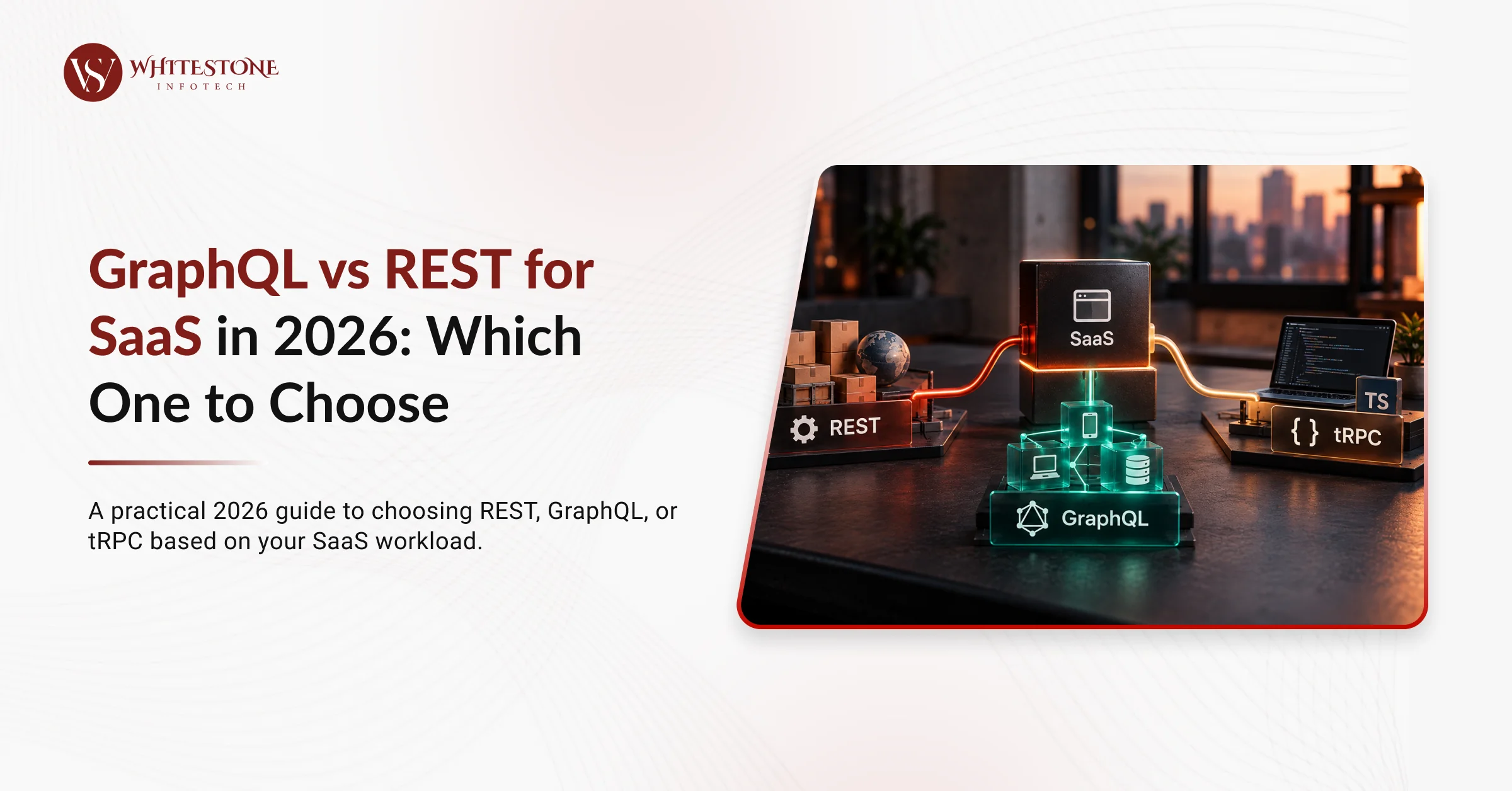
This article is a candid guide for CTOs, engineering leaders, and architects choosing an API paradigm for SaaS in 2026. When REST still wins. When GraphQL genuinely wins. What tRPC changes. How hybrid approaches actually work. Real cost and complexity comparison. What we learned shipping SaaS products across all three approaches.
The Three Paradigms in 2026
REST (Representational State Transfer). Resource-based HTTP APIs with standard verbs (GET, POST, PUT, PATCH, DELETE). Cacheable at HTTP level (CDN, browser, reverse proxy). Wide tooling (OpenAPI/Swagger, Postman, curl, everything). Mature since early 2000s. Still the majority of production SaaS APIs in 2026.
GraphQL. Single endpoint accepting queries where clients specify exactly what data they want. Schema-first. Enables client-driven queries, avoids over-fetching and under-fetching, supports aggregation of multiple backends. Managed by Apollo, Hasura, and others; open-source implementations widespread. Best for workloads that genuinely benefit from flexible client-driven queries.
tRPC. Typed RPC for TypeScript. No schema definition language; TypeScript types define the API contract end-to-end. No code generation required. Best for internal TypeScript monorepo teams valuing type safety without GraphQL complexity.
Per GraphQL Foundation adoption reports and IETF REST architectural principles, each paradigm has clear workload fits; the "GraphQL vs REST" question is workload-dependent rather than universal.
When REST Still Wins in 2026
Choose REST when at least three apply:
Standard CRUD SaaS with similar data needs across clients (single web app, or clients that all need the same resource shape)
Cache-heavy workloads where HTTP-level caching (CDN, browser cache, reverse proxy) delivers material performance benefit
Public APIs for third-party consumption where wide tooling and predictable behaviour matter
Team lacks GraphQL experience and workload does not clearly require GraphQL
Simple domain where GraphQL schema overhead exceeds the benefit
Rate limiting, versioning, and access control align with standard HTTP patterns
Realistic expectation: baseline development cost, minimal team ramp-up, wide tooling, mature patterns. Best for the majority of standard CRUD SaaS.
When GraphQL Genuinely Wins in 2026
Choose GraphQL when at least three apply:
Mobile plus web clients with materially different data needs (mobile needs subset per view, web needs relations)
Aggregating multiple backends (microservices, third-party APIs) behind one API surface
Complex relational data that clients genuinely need to shape (fewer round trips, less over-fetching)
Team has GraphQL experience or is willing to invest 3-6 months of ramp-up
Federation across services where GraphQL Federation (Apollo Federation or equivalent) genuinely helps
Frontend teams work independently and value client-driven query flexibility
Realistic expectation: £8k-£40k additional initial development effort. Ongoing schema evolution and resolver optimisation cost. Managed GraphQL services (Apollo GraphOS, Hasura Cloud) £100-£3000+ monthly if used. Best for workloads that genuinely benefit from client-driven queries.
When tRPC Wins in 2026
Choose tRPC when at least three apply:
Internal TypeScript monorepo (frontend and backend in same repository or coordinated repos)
Small-to-mid teams (3-15 engineers) valuing end-to-end type safety
No requirement for public API or third-party consumption
Tight coupling between frontend and backend is acceptable and desirable
GraphQL schema complexity feels like overkill for the team size
Team is TypeScript-first without polyglot backend requirements
Realistic expectation: minimal team ramp, no managed services required, near-zero API contract friction. Best for TypeScript monorepo teams that would have chosen GraphQL for type safety alone.
Real 2026 Cost and Complexity Comparison
Dimension | REST | GraphQL | tRPC |
Additional initial development | Baseline | £8k-£40k | Minimal |
Ongoing API-related engineering time | 3-7% typical | 10-20% typical | 3-5% typical |
Managed service cost | None required | £100-£3000+ monthly (optional Apollo GraphOS, Hasura Cloud) | None required |
Team ramp-up | Minimal | 3-6 months | 1-2 weeks for TypeScript teams |
Tooling maturity | Very high | High but concentrated (Apollo, Hasura, GraphQL Yoga) | Growing, TypeScript-specific |
Caching complexity | Low (HTTP-level) | High (Apollo Client cache, DataLoader, custom) | Moderate (React Query integration) |
Public API suitability | Excellent | Good but complex | Poor (TypeScript-only) |
Two rules that hold at every scale. GraphQL adds material complexity (schema management, resolvers, N+1 handling, caching strategy, versioning without HTTP semantics) that only pays back for workloads that genuinely need it. And tRPC eliminates most GraphQL complexity for TypeScript teams while providing similar type-safety benefits, at the cost of losing public API flexibility.
Hybrid Approaches: When Both Genuinely Fit
Most SaaS at scale end up hybrid. Three practical hybrid patterns.
Pattern 1: REST for public API, GraphQL for internal. Public API remains REST for third-party consumption, tooling, and predictable behaviour. Internal frontend uses GraphQL for flexible client-driven queries. Common for platform SaaS with third-party developers.
Pattern 2: REST for standard CRUD, GraphQL for admin and analytics. Customer-facing SaaS uses REST for standard operations. Admin and analytics interfaces use GraphQL because operations teams need to explore data flexibly. Common for B2B SaaS.
Pattern 3: REST plus BFF (Backend for Frontend). REST for backend services, BFF layer aggregates and shapes data for specific clients. BFF may be GraphQL or REST depending on team preference. Common for multi-client SaaS with polyglot backend.
Common Failure Modes
Adopting GraphQL for single-client CRUD SaaS. Team defaults to GraphQL because 2022 blog posts said modern SaaS uses GraphQL. Standard CRUD workload does not benefit. Engineering time on schema evolution, N+1 handling, and cache invalidation exceeds the benefit. Fix: assess workload fit before choosing GraphQL; REST is fine for standard CRUD.
Adopting REST for genuine multi-client polyglot workload. Team defaults to REST for mobile plus web plus third-party clients with materially different data needs. Endpoints proliferate (mobile-specific, web-specific, third-party-specific). Backend for Frontend (BFF) complexity emerges. Fix: assess whether GraphQL or BFF pattern would materially simplify the multi-client reality.
Adopting GraphQL without addressing N+1 problem. Team ships GraphQL API without DataLoader or equivalent batch-loading strategy. Query performance degrades under load. Fix: DataLoader or equivalent batch-loading strategy is not optional for GraphQL production deployment.
Adopting tRPC then needing public API. Team ships tRPC for internal TypeScript monorepo. Business need emerges for public API (third-party integrations, partner API). tRPC is not suitable; team must build REST layer alongside. Fix: assess public API roadmap before choosing tRPC.
Managing versioning without HTTP semantics on GraphQL. REST has mature URL-versioning and content negotiation patterns. GraphQL versioning is schema-evolution-based and requires deprecation discipline. Teams new to GraphQL frequently mismanage versioning. Fix: schema deprecation discipline and consumer coordination from day one.
What We Learned Shipping SaaS Across All Three Approaches
WhiteStone has shipped TrackVid (REST-only for standard CRUD SaaS serving 4000+ Indian ecommerce merchants), IELTSArena (REST for customer-facing operations plus GraphQL for admin data exploration), and various client work using tRPC for TypeScript monorepo internal APIs. Three lessons transfer to any UK or US SaaS team choosing API paradigm.
TrackVid runs on REST and it works. TrackVid is standard CRUD SaaS (users, merchants, orders, packing events, disputes) with single web client. REST plus OpenAPI schema plus standard HTTP caching delivers everything the workload needs. GraphQL would have been complexity without benefit for this workload. Choosing REST was engineering discipline, not legacy thinking.
IELTSArena uses REST for customer flows and GraphQL for admin data exploration. Customer-facing assessment and dashboard flows are REST because clients (students) need consistent shapes and HTTP caching helps performance. Admin interface for operations team is GraphQL because operations teams need to explore assessment data flexibly across many dimensions (student cohort analysis, question-level analytics, custom reporting). Hybrid pattern matches actual workload.
Client rebuild from GraphQL-only to REST plus targeted GraphQL delivered 4x engineering time back. UK SaaS CTO mentioned above. GraphQL-only for standard CRUD SaaS. Rebuild: REST for standard CRUD (customer-facing) plus GraphQL for admin queries (data exploration). Engineering time on API-related work dropped from 20 percent to 5 percent. Same feature velocity. Choosing paradigm to match workload matters more than choosing "modern" paradigm.
See our portfolio of shipped work for API architecture case studies. For a scoped API paradigm assessment, book a technical architecture call with WhiteStone.
Frequently Asked Questions
What is the difference between GraphQL and REST for SaaS in 2026?
REST is resource-based HTTP APIs with standard verbs (GET, POST, PUT, PATCH, DELETE), cacheable at HTTP level, wide tooling, mature patterns. GraphQL is single-endpoint schema-first APIs where clients specify exactly what data they want, enabling client-driven queries, avoiding over-fetching, and supporting aggregation of multiple backends. REST is simpler and mature; GraphQL is more flexible but adds complexity.
When should a SaaS use GraphQL vs REST?
Use REST for standard CRUD SaaS with similar data needs across clients, cache-heavy workloads, public APIs for third-party consumption, and teams without GraphQL experience. Use GraphQL for mobile plus web clients with materially different data needs, aggregating multiple backends, complex relational data clients need to shape, and teams willing to invest in GraphQL complexity for the benefits.
Is GraphQL still worth adopting in 2026?
GraphQL is worth adopting when workload characteristics genuinely benefit: mobile plus web clients with different data needs, aggregation of multiple backends behind one API, complex client-shaped queries. It is over-scoped for standard CRUD SaaS with single client and simple data needs. Assess workload fit rather than adopting because GraphQL is "modern"; for TypeScript monorepo teams valuing type safety alone, tRPC often beats GraphQL.
What is tRPC and how does it compare to GraphQL and REST?
tRPC is typed RPC for TypeScript. TypeScript types define the API contract end-to-end without schema definition language or code generation. Best for internal TypeScript monorepo teams (frontend and backend in same or coordinated repos) valuing type safety without GraphQL complexity or REST verbosity. Not suitable for public APIs or non-TypeScript clients. Best fit: small-to-mid TypeScript teams (3-15 engineers) with no public API requirement.
What are the cost and complexity differences between GraphQL and REST?
REST: baseline development cost, minimal team ramp, wide tooling, 3-7 percent typical ongoing API-related engineering time. GraphQL: £8k-£40k additional initial development, 3-6 months team ramp, 10-20 percent typical ongoing API-related engineering time, optional managed services £100-£3000+ monthly (Apollo GraphOS, Hasura Cloud). tRPC: minimal team ramp for TypeScript teams, no managed services required, 3-5 percent typical ongoing engineering time.
Can a SaaS use both GraphQL and REST?
Yes, most SaaS at scale end up hybrid. Common patterns: REST for public API plus GraphQL for internal frontend; REST for standard CRUD plus GraphQL for admin and analytics; REST plus GraphQL BFF (Backend for Frontend). Hybrid is often the right answer for SaaS with multiple client types (web, mobile, third-party) or internal operations teams needing flexible data exploration.
Why choose WhiteStone Infotech for API architecture decisions?
We ship SaaS products across REST, GraphQL, and tRPC in production. TrackVid runs REST-only for 4000+ Indian ecommerce merchants (standard CRUD with single web client). IELTSArena runs REST for customer flows plus GraphQL for admin data exploration (hybrid matches workload). We use tRPC for TypeScript monorepo internal APIs across client work. We migrated a UK SaaS from GraphQL-only to REST plus targeted GraphQL in 6 weeks, cutting API-related engineering time from 20 percent to 5 percent. Every API architecture engagement starts with workload-fit assessment. Contact WhiteStone Infotech at whitestoneinfotech.com/contact.
The One Thing to Remember
GraphQL vs REST for SaaS in 2026 is a workload-fit decision, not a modern-vs-legacy decision. REST remains the right choice for standard CRUD SaaS with similar data needs across clients, cache-heavy workloads, and public APIs for third-party consumption. GraphQL wins for mobile plus web clients with materially different data needs, aggregation of multiple backends, and complex relational data clients need to shape. tRPC has emerged as a strong third option for TypeScript monorepo teams valuing type safety without GraphQL complexity. Real cost: REST is baseline; GraphQL adds £8k-£40k initial plus 10-20 percent ongoing engineering time; tRPC minimal for TypeScript teams. Most SaaS at scale end up hybrid (REST for public API and standard CRUD, GraphQL for admin and complex client-shaped data). The single decision that determines API paradigm ROI: does the SaaS have workload characteristics where GraphQL delivers material benefit or tRPC delivers material benefit, or is it a standard CRUD workload where REST simplicity wins? Workload fit beats architectural fashion.


.webp)