
A UK COO we spoke to last month runs a 45-person industrial services firm turning over £8m. His CEO had come back from an industry event convinced they needed AI. His accounts team was on QuickBooks, sales was in three overlapping spreadsheets, HR was in a fourth, and jobs were tracked in a fifth. When a customer called to check status, three people had to be phoned. His question was where to actually start, and whether a £150k budget was realistic.
That is the digital transformation conversation across UK SMEs in 2026. Everyone hears about AI. Almost no SME has the data foundation to benefit from AI without first fixing more basic problems. Digital transformation done well starts with foundation, then integration, then automation, then intelligence. Skipping stages wastes six figures.
This article is a practical roadmap for UK SME leaders. What digital transformation actually means at your scale. The four-stage sequence. Realistic budgets. Where to start. What government support helps.
What Digital Transformation Actually Means for a UK SME
Enterprise transformation and SME transformation are different exercises.
Enterprise transformation deals with legacy mainframes, hundreds of applications, multiple business units, and regulatory complexity. Budgets run £5m-£100m plus over 3-5 years.
SME transformation deals with spreadsheet-heavy processes, 2-8 systems that do not talk to each other, and a small team wearing many hats. Budgets run £15k-£800k over 6-24 months. Owner or COO drives it personally.
The goal. Reduce operational friction, unlock data as a source of truth, then apply automation and AI where they earn payback. Not "digitise for its own sake." Not "AI first."
What separates SMEs that succeed: sequencing. Foundation before integration. Integration before automation. Automation before intelligence. The temptation to jump ahead ("let's start with AI") wastes the foundation investment because AI on scattered, inconsistent data delivers garbage output.
The GOV.UK SME Digital Adoption Taskforce 2026 update frames this well: SMEs need "central entry point" support because most owners face capability, cost, and awareness barriers before they can effectively evaluate technology.
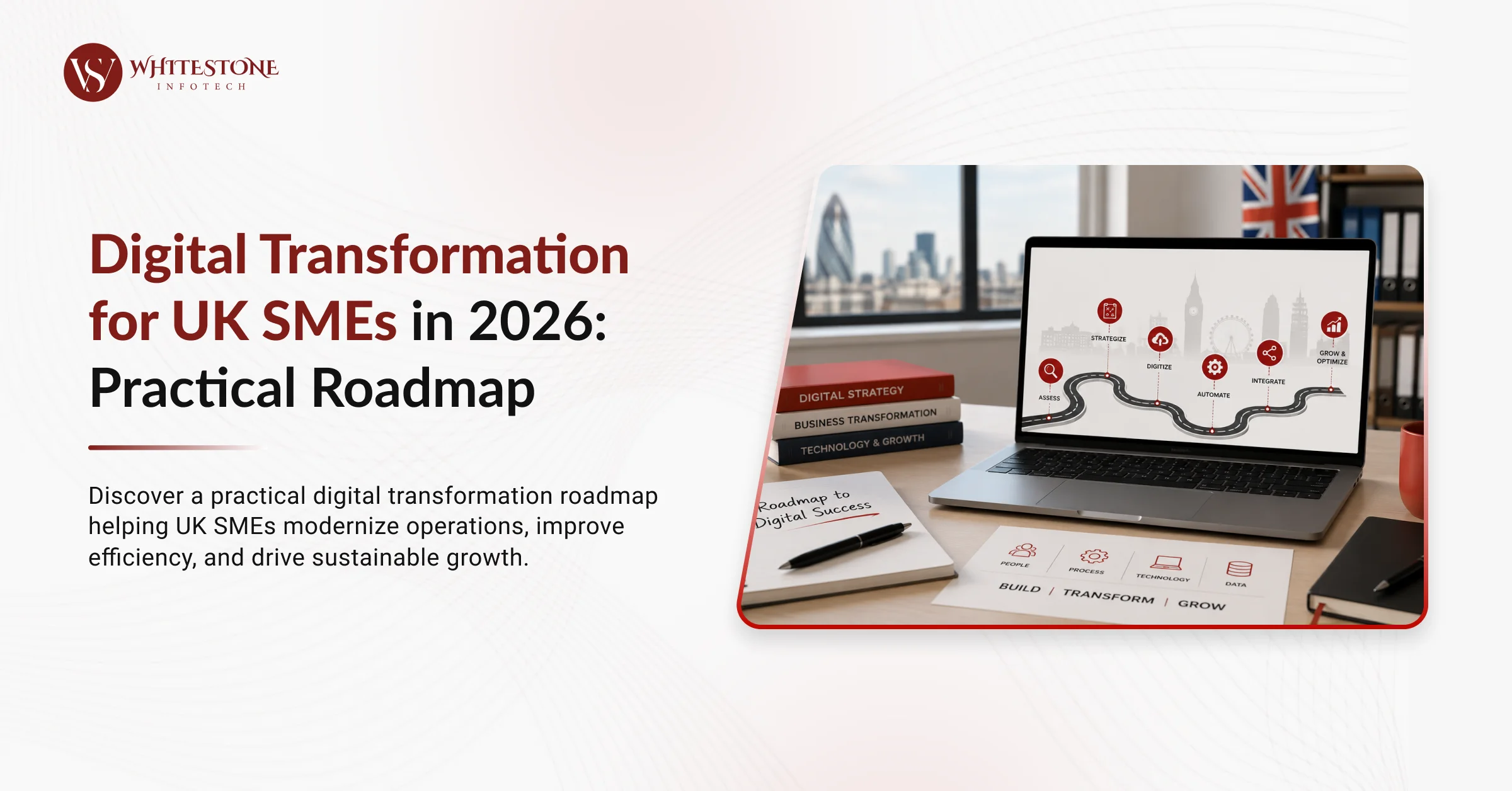
The 4-Stage Roadmap (Foundation, Integration, Automation, Intelligence)
Stage 1: Foundation (6-12 months, £15k-£100k). One system of record per function. CRM (HubSpot, Salesforce Starter, Pipedrive) for sales. Accounting (Xero, QuickBooks, Sage) for finance. HR system for people. Job management for delivery. Rule: each piece of information lives in exactly one system.
Stage 2: Integration (3-6 months, £10k-£80k). Systems connect so data flows automatically. Sales close in CRM triggers invoice in accounting. Job completion triggers time-and-materials capture. HR onboarding triggers system access. Zapier, Make, or n8n for simple integrations; custom middleware for complex cases.
Stage 3: Automation (6-12 months, £20k-£150k). Repetitive workflows removed. Automated invoice reminders. Automated report generation. Automated inventory reordering. Automated quote generation. Focus on tasks that consume most staff time and follow predictable rules.
Stage 4: Intelligence (ongoing, £15k-£150k annually). AI applied to well-instrumented workflows. Sales forecasting from clean CRM data. Automated document processing. Support ticket deflection. Predictive maintenance. Only viable if Stages 1-3 are complete.
Sequencing rule. Do not skip stages. AI on scattered data fails. Automation on unintegrated systems creates digital silos. Each stage depends on the previous being solid.
Realistic Budgets by SME Size and Stage
Small SME (5-25 employees, £1m-£5m ARR).
Total transformation programme: £15k-£60k
Ongoing annual tech spend: £20k-£100k (2-3 percent of revenue)
Typical duration: 12-18 months
Focus: foundation and simple integration; automation only for highest-friction tasks
Mid SME (25-100 employees, £5m-£20m ARR).
Total transformation programme: £60k-£250k
Ongoing annual tech spend: £150k-£600k (3-4 percent of revenue)
Typical duration: 18-24 months
Focus: full four stages, with intelligence limited to 1-2 high-value use cases
Larger SME (100-249 employees, £20m-£50m ARR).
Total transformation programme: £250k-£800k
Ongoing annual tech spend: £800k-£2m (3-4 percent of revenue)
Typical duration: 24-36 months
Focus: full four stages with genuine AI deployment on well-instrumented workflows
What blows budgets. Enterprise-scale tools with per-user licensing (Salesforce Enterprise, Workday, SAP) that need a full-time admin the SME cannot afford. Cost 2-3x realistic budget once you factor in implementation and ongoing management.
What comes in under budget. Cloud SME-native tools (HubSpot, Xero, monday.com) with modest customisation. Integration via low-code platforms (Zapier, Make, n8n). Custom development only where off-the-shelf does not fit.
Where to Start (Diagnostic Questions)
Five questions that identify the highest-impact starting point.
Which decision requires pulling data from multiple systems manually? Whatever answer you get is your integration priority. If your Head of Sales needs to check three systems to know the customer's full picture, integrate those three.
Which task consumes most staff time and looks repetitive? Automation priority. If AP is keying invoices, automate the invoice pipeline. If sales is chasing renewals manually, automate renewal workflow.
Where do you have duplicate data entry? Foundation priority. If contact details live in four systems and someone re-types them, consolidate to one system of record.
What data do you need but do not have? Instrumentation priority. If you cannot answer "what is our customer acquisition cost by channel," you need instrumentation before you can improve it.
What breaks when someone is on holiday? Documentation and automation priority. Every knowledge silo is a business continuity risk.
Fix the biggest one first, not the trendiest one. SME owners often chase the trendy (AI, blockchain, whatever) because it is aspirational. The biggest ROI usually comes from the boring answer (integrating three systems, automating one workflow).
What UK Government Support Actually Exists in 2026
Live programmes worth knowing about.
Business Growth Service (BGS). Launched July 2025. Central GOV.UK entry point for SME support including digital adoption. Signposts to Made Smarter, Growth Hubs, and regional support. Start here.
Made Smarter Adoption Programme. For manufacturing SMEs. Rolling out UK-wide across 2025-2027 with £99m committed. Provides one-to-one advice from digital specialists, funded intern programmes, and match-funded grants up to £20,000. Only for manufacturing; other sectors need different support.
Growth Hubs. Regional network across England providing free business advice including on digital transformation. Quality varies by region.
What is NOT available. Help to Grow: Digital was closed on 2 February 2023. Many SME owners still ask about it. Do not build a transformation plan around expected government subsidy; treat any grant as a bonus, not a foundation.
McKinsey research on SME transformation consistently shows SMEs that successfully transform focus on operational fundamentals (data foundation, process improvement) before advanced technology; those chasing advanced technology first typically stall or waste investment.
What We See Across UK SME Engagements
Two patterns recur.
SMEs win with sequencing discipline. Owners who accept "foundation first, AI last" get 3-5x ROI. Owners who try to jump to AI first typically re-do the foundation work later at higher cost.
Off-the-shelf beats custom for 80 percent of SME needs. Cloud SME-native tools (HubSpot, Xero, monday.com, ClickUp) cover most requirements at 20 percent of custom cost. Custom development justified only where operations are genuinely unusual.
We built a barcode and QR-based site management platform for a UK property developer where off-the-shelf did not fit their operational model. That is the correct threshold for custom: real operational uniqueness, not preference for control.
You can see our shipped work at our portfolio. If you want a candid conversation about where to start your transformation, book a transformation audit with WhiteStone.
Common Failure Modes
Chasing trendiest technology first. Owner reads about AI, jumps to AI implementation, discovers data foundation is not there. Six-figure spend wasted; foundation still needs doing.
Buying enterprise-scale tools. SME buys Salesforce Enterprise for 40 users; needs full-time admin they cannot afford; usage drops; tool abandoned within 18 months. Choose SME-native tools.
Trying to transform everything at once. Owner declares transformation year; parallel projects in every function; team overwhelmed; adoption fails. Sequence one function at a time.
Frequently Asked Questions
What is a realistic digital transformation budget for a UK SME?
Small SME (5-25 employees, £1m-£5m ARR): £15k-£60k programme, £20k-£100k annual ongoing. Mid SME (25-100 employees, £5m-£20m ARR): £60k-£250k programme, £150k-£600k ongoing. Larger SME (100-249 employees, £20m-£50m ARR): £250k-£800k programme, £800k-£2m ongoing. Ongoing tech spend runs 2-4 percent of revenue for SMEs.
Where should a UK SME start with digital transformation?
With the diagnostic questions: which decision requires manual multi-system data pulls, which task consumes most staff time and is repetitive, where is duplicate data entry, what data do you need but do not have, what breaks when someone is on holiday. Fix the biggest one first, not the trendiest.
How long does SME digital transformation take?
Small SME 12-18 months, mid SME 18-24 months, larger SME 24-36 months. The 4-stage sequence (foundation, integration, automation, intelligence) cannot be compressed meaningfully without skipping stages, and skipping stages destroys value.
What UK government support is available for SME digital transformation in 2026?
Business Growth Service (July 2025) is the central entry point. Made Smarter (rolling out UK-wide) for manufacturing SMEs with grants up to £20,000. Growth Hubs for regional advice. Help to Grow: Digital was closed February 2023; do not plan around it.
Should an SME hire a consultant, agency, or in-house team?
For programme design (roadmap, sequencing): consultant or agency. For implementation: mix of vendor implementation services (for off-the-shelf tools), agency (for custom development and integration), and one in-house owner (technical or operational lead). Full in-house team only for larger SMEs above £20m ARR.
The One Thing to Remember
Digital transformation for a UK SME is a four-stage sequence: foundation (one system of record per function), integration (systems connected so data flows), automation (repetitive workflows removed), intelligence (AI on well-instrumented processes). The sequence exists because each stage depends on the previous being solid. Skipping stages, particularly jumping to AI, wastes six figures. Start with the diagnostic questions to find highest-impact starting point. Use off-the-shelf tools where they fit; custom only where operations are genuinely unusual. Government support helps at the margin but is not a foundation.
If you want a candid conversation about your transformation strategy, browse our digital transformation services or come to the call.