A UK D2C fashion brand we spoke to last month sells across Shopify (their own site), Amazon UK, Amazon Germany, eBay UK, and their own D2C app. Six channels, 3,400 SKUs, £8m annual revenue. They ran inventory on a shared Google Sheet updated twice a day by a warehouse admin. In the last quarter they oversold 190 orders, hit Amazon's "high defect rate" threshold, and got an account suspension warning. Their FD had budgeted £150k for the fix and was weighing NetSuite (£70k first year) against a custom build (£220k).
That is the custom inventory software for D2C brands conversation across UK, US, and Indian brands in 2026. Multi-channel commerce is the default; per Statista multi-channel ecommerce data, more than 70 percent of UK D2C brands above £5m now sell on 3 or more channels. Every additional channel multiplies the sync complexity, and spreadsheets stop working somewhere between 500 and 5,000 SKUs across 3+ channels. But most D2C brands do not need custom; they need a good mid-market SaaS with the right sync patterns.
This article is a candid guide for Ops Directors, CFOs, and Founders scoping D2C inventory software. Why brands oversell. What good custom software does. Vendor comparison. Multi-channel sync patterns. Real cost bands and where custom actually pays back. What we learned about reconciliation.
Why D2C Brands Oversell on Amazon Every Week
Every sales channel updates stock at its own cadence.
Amazon updates inventory via API in 15 to 30 minute intervals for most sellers. Shopify pushes stock changes in real time via webhook. Meesho and Flipkart have their own cadences, often longer. eBay updates on a mixed schedule. Without a central source of truth, race conditions are inevitable: Shopify sells the last unit at 14:32, Amazon sees the stock as available until the next sync at 14:45, sells the same unit, and now you have an oversell.
Manual reconciliation does not scale. A single ops person can track perhaps 200 SKUs across 3 channels via spreadsheet. Above that, drift compounds daily. Inventory accuracy is consistently named as the top operational pain in UK D2C ops surveys.
The fix is a central inventory system that owns the truth and pushes updates to every channel. Every channel becomes a display layer; the master stock number lives in one place. Every serious SaaS and every custom build is architected around this principle.
What Custom Inventory Software Actually Does for D2C
Seven capabilities sit inside every credible platform (SaaS or custom).
Central source of truth for stock. One database that owns stock levels across all channels and warehouses. Every other system reads from it and syncs against it.
Real-time or near-real-time sync. Webhooks push updates to Shopify, BigCommerce, Amazon, eBay, Meesho, Flipkart, and D2C storefronts. Latency 5 to 60 seconds depending on channel.
Purchase order management. POs to suppliers, receiving workflows, cost tracking, landed cost calculation.
Reorder point and safety stock calculation. Automatic reorder alerts based on velocity, lead time, and target service level. Prevents stockout and overstock.
Warehouse management basics. Bin locations, pick lists, receiving flows, cycle counts. Not full WMS; that is a separate tier.
Multi-warehouse and 3PL integration. Stock split across multiple locations, allocation logic, 3PL API integration (ShipBob, ShipHero, WareIQ).
Reporting. Stock aging, dead stock, sell-through rate, carrying cost, GMROI. This is where CFOs get their answers.
Custom builds add value where the above are inadequate for the specific catalogue or channel mix. Below the break-even threshold, they simply add cost without value.
Cin7 vs Linnworks vs NetSuite vs Katana vs Custom
Option | Best for | Rough cost |
Zoho Inventory, TradeGecko | SMB, under 5k SKUs, 1-3 channels | £30-£200 monthly |
Cin7 Core / Omni | Mid-market, 5k-50k SKUs, multi-channel | £250-£1,500 monthly |
Linnworks | UK-strong multi-channel, 5k-100k SKUs | £150-£1,200 monthly |
Katana | Manufacturing-flavoured mid-market | £200-£1,000 monthly |
Brightpearl | UK mid-market retail, integrated with retail ops | £600-£3,500 monthly |
NetSuite | Enterprise, 50k+ SKUs, comprehensive | £3k-£20k+ monthly |
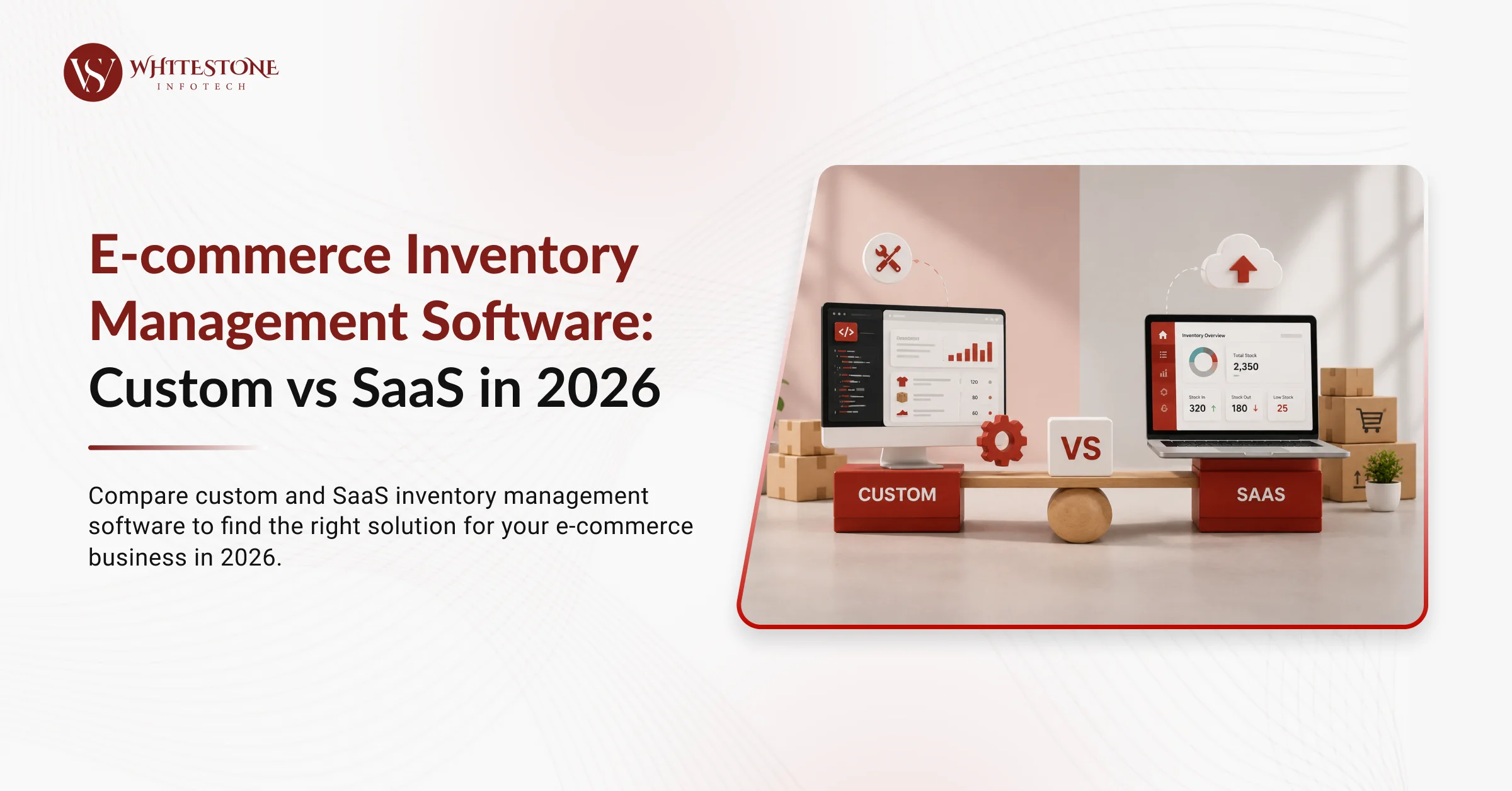
Custom builds | Above 100k SKUs, unusual channels, data residency | £80k-£800k build, £40k-£300k annual run |
Choice heuristic. Under 5k SKUs and 3 channels: Zoho or TradeGecko. 5k-50k SKUs on 3-6 channels: Cin7 or Linnworks (Linnworks stronger for UK-heavy multi-channel; Cin7 stronger globally). Above 50k SKUs or complex 3PL: NetSuite tier. Custom only above 100k SKUs, or when specific requirements (marketplace-specific dispute flows, India-heavy channel mix, data residency) rule SaaS out.
Per Gartner inventory software research, the mid-market SaaS tier delivers 80 to 90 percent of the functionality of custom builds at 10 to 20 percent of total cost of ownership. Custom only wins clearly above the break-even threshold.
How Multi-Channel Inventory Sync Actually Works
Five patterns that make sync reliable at scale.
1. Central inventory system as canonical source. Stock lives in one place. Every channel reads from it, never writes back as truth.
2. Event-driven updates. Central system fires a webhook to each channel when stock changes. Channels apply the update. Cadence matches channel capability (real-time for Shopify, 15-30 min for Amazon).
3. Buffer stock reserved per channel. Instead of exposing 100 percent of stock everywhere, expose 90 percent to Amazon, 100 percent to Shopify (real-time), 80 percent to Meesho. Buffer absorbs race-condition risk.
4. Idempotency keys on every stock update. Each update carries a UUID; channel dedupes to prevent double-application if a webhook fires twice.
5. Reconciliation job every 30 to 60 minutes. Central system pulls actual stock from each channel and compares against expected. Any drift triggers an alert and auto-corrects the channel.
Skip pattern 3 and you will oversell on Amazon within a month regardless of the platform.
Real 2026 Cost Bands and Build vs Buy Break-Even
Cost anchor for a UK D2C brand with 15,000 SKUs and 5 channels.
Cin7 or Linnworks (SaaS): £8k-£25k annual all-in
NetSuite (SaaS enterprise): £40k-£120k annual
Custom platform: £150k-£400k build, £60k-£180k annual run
Where custom actually pays back. Above 100k SKUs where per-SKU SaaS pricing eats margins. Unusual channel mix (heavy Meesho + Flipkart + AJIO in India where SaaS is weaker). Strict data residency (UK gov, EU financial). In-house engineering capability wanting long-term roadmap control. Below the break-even, custom is a common £200k mistake driven by the wrong reasons.
Hidden costs. Data migration from spreadsheets (£10k-£80k). Channel connector maintenance for bespoke channels (£20k-£100k annual). Reconciliation job engineering if going custom (£40k-£150k). Budget these explicitly.
What We Learned Reconciling Data Across Three Systems
WhiteStone built TrackVid, our own B2B SaaS video proof platform for ecommerce, used by 1,100+ merchants and a Snapdeal partner. The technical lesson is directly relevant.
TrackVid had to reconcile three data streams on three clocks: WMS Order ID, barcode scan SKU, and courier AWB. Each arrived on a different cadence from a different system. Get one wrong and the platform hands the wrong evidence clip to a marketplace dispute portal, which is worse than no platform at all.
Inventory sync faces the same shape at wider scale. Central stock number, per-channel sold count, per-warehouse received count. Three streams, three clocks, one truth to maintain. The solution is the same architecture: message-oriented, idempotent, with a reconciliation service that verifies drift before it becomes a customer-facing problem. Any inventory platform (SaaS or custom) that cannot describe this reconciliation will fail at multi-channel scale.
See our portfolio of shipped work. For a scoped conversation about your channel mix, book an inventory software call with WhiteStone.
Common Failure Modes
Letting a sales channel be the source of truth. Team uses Shopify inventory as the master, syncs out to Amazon and Meesho from there. Amazon updates back, Shopify overwrites its own truth with Amazon's stale data. Chaos. Central system, always.
Skipping the buffer stock reservation. Team exposes 100 percent of stock to every channel. Oversells the last unit twice within the first month. Set buffer per channel based on that channel's sync cadence.
Building custom below the break-even. SME with 8k SKUs and 3 channels commits to a £250k custom build because their team wanted control. Cin7 at £15k annual would have shipped the same value. Match tier to SKU count and channel count.
Frequently Asked Questions
When does custom inventory software beat Cin7 or NetSuite for D2C brands?
Above 100k SKUs where per-SKU SaaS pricing becomes uneconomic. Unusual channel mix (heavy India marketplaces like Meesho + Flipkart + AJIO where SaaS connector quality is weaker). Strict data residency requirements ruling out US-hosted SaaS. In-house engineering capability with capacity to own the platform long-term. Below any of these thresholds, SaaS wins on total cost of ownership.
How does multi-channel inventory sync actually work?
Central inventory system as canonical source; event-driven webhooks push updates to each channel; buffer stock reserved per channel to prevent race conditions; idempotency keys on every update; reconciliation job every 30 to 60 minutes to catch drift. Skip the buffer and you will oversell within a month regardless of the platform.
How much does custom inventory software cost in 2026?
Custom builds: £80,000-£800,000 build depending on complexity, plus £40,000-£300,000 annual run. SaaS alternatives: SMB tier (Zoho, TradeGecko) £30-£200 monthly, mid-market (Cin7, Linnworks) £200-£2,000 monthly, enterprise (NetSuite, Brightpearl) £2,000-£20,000 monthly. Custom pays back only above the break-even threshold.
How do you prevent overselling on Amazon and Meesho?
Central inventory system as source of truth. Buffer stock reserved per channel (typically 5 to 15 percent held back from higher-latency channels like Amazon and Meesho). Idempotency keys on every stock update. Reconciliation every 30 to 60 minutes with auto-correction. Without a buffer, race conditions cause oversells regardless of the platform.
What data does custom inventory software need to reconcile?
Three real-time streams. Central stock levels (source of truth). Per-channel sold count (from marketplace order feeds). Per-warehouse received count (from WMS and PO systems). All three must be reconciled continuously; any drift between them is a future oversell. Message-oriented architecture with idempotency keys is the standard 2026 pattern.
Cin7 vs Linnworks vs NetSuite vs custom for D2C?
Cin7 for global mid-market (5k-50k SKUs). Linnworks for UK-heavy multi-channel (5k-100k SKUs). NetSuite for enterprise (50k+ SKUs). Custom only above 100k SKUs, unusual channel mix, or data residency. For most D2C brands under £30m annual GMV, SaaS wins on total cost of ownership.
Why choose WhiteStone Infotech for custom inventory software?
We built TrackVid, our own ecommerce SaaS used by 1,100+ merchants and a Snapdeal partner, where three-way reconciliation is the core discipline. We have shipped 50+ custom software and AI products across the UK, US, and India. Every inventory engagement starts with the channel audit and build-vs-buy call before any code. We recommend Cin7 or Linnworks more often than we recommend custom, because the maths usually says so. Contact WhiteStone Infotech at whitestoneinfotech.com/contact.
The One Thing to Remember
Custom inventory software for D2C brands works when the central source of truth is protected, buffer stock is reserved per channel, and reconciliation runs every 30 to 60 minutes. For most D2C brands under 100k SKUs, SaaS wins on total cost of ownership; Cin7 or Linnworks cover the mid-market well. Custom is defensible only above 100k SKUs, unusual channel mix, or data residency. Ask any vendor (SaaS or custom builder) to walk you through the buffer stock and reconciliation architecture. Without both, you will oversell.