A UK SaaS founder we spoke to last quarter had built his B2B analytics product on AWS from day one because "everyone uses AWS". Team of 4 engineers, £14,000 monthly infrastructure bill, product doing well. He asked us to review his stack and tell him whether he should migrate to GCP because his data analytics workload (roughly 60 percent of his infrastructure spend) looked like a natural GCP fit.
We reviewed the workload. His BigQuery-equivalent workload on AWS Redshift was costing roughly £8500 monthly for 40 TB of queried data. The same workload on GCP BigQuery with equivalent query volume would cost roughly £5200 monthly. Rest of the stack (API, auth, static assets) was cheaper on AWS due to reserved capacity he had already committed to. Migration would save roughly £3300 monthly on the data pipeline, cost roughly £120k in engineering time to execute, and create ongoing multi-cloud operational overhead (dual monitoring, dual billing, dual compliance evidence).
Recommendation: keep the API on AWS, move new data analytics workloads to GCP over 12 months, do not migrate existing pipelines. Payback on the GCP migration for new data workloads: 6-8 months. Cost of migrating existing pipelines: never paid back due to engineering cost plus ongoing dual-cloud overhead.
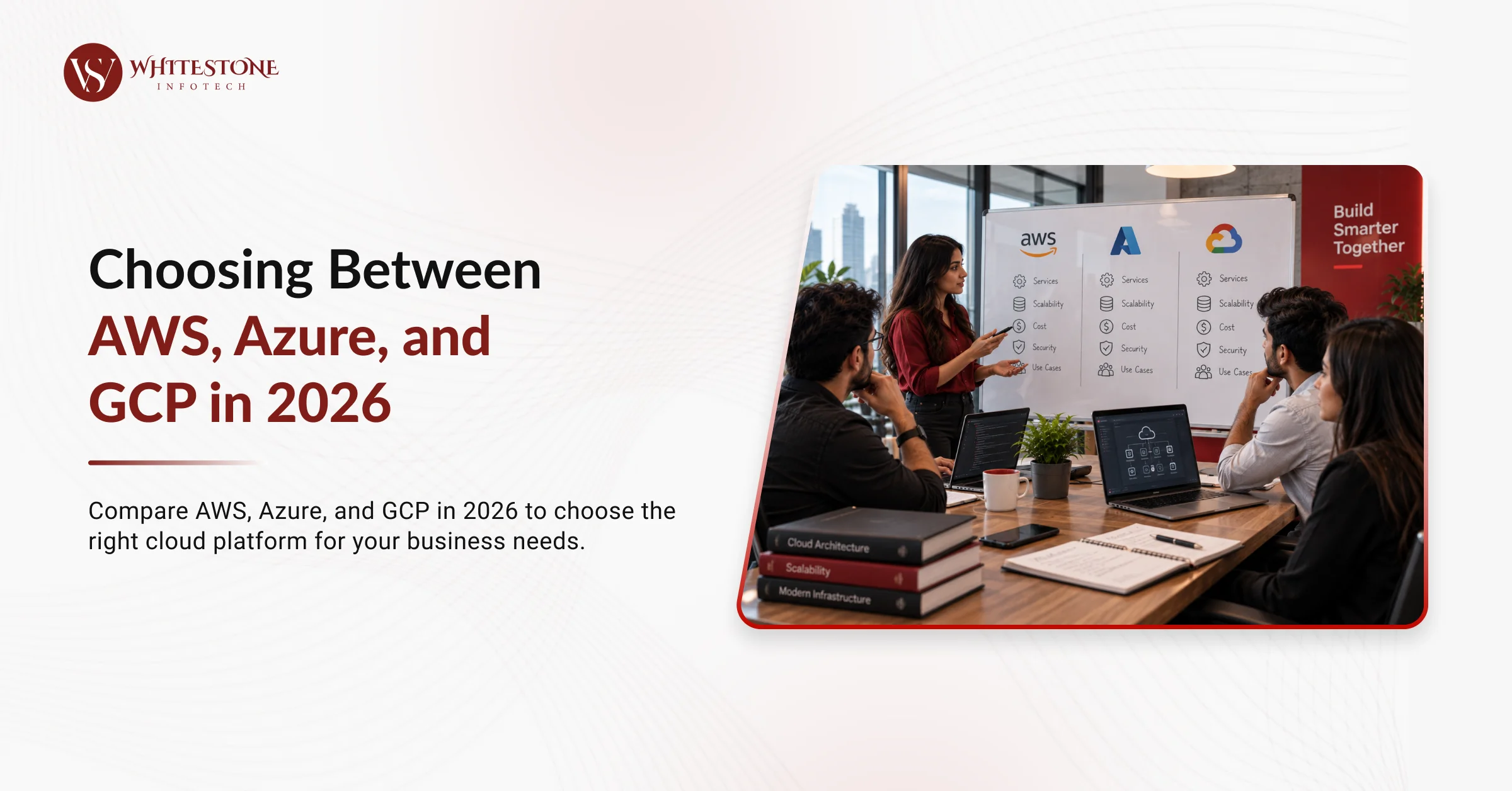
That is the aws vs azure vs gcp 2026 conversation across UK and US SaaS teams. All three clouds have converged on core capabilities but retain meaningful differences in ecosystem, pricing patterns, and specialised services. Cost differences at the same scale are typically 15-30 percent, which matters at scale but rarely decides the choice for a startup or mid-market team. What decides the choice is strategic fit with existing skills, existing enterprise IT stack, and workload-specific requirements.
This article is a candid guide for CTOs, engineering leaders, and technical founders choosing a cloud in 2026. Where each cloud actually wins. Real cost patterns at different scales. Ecosystem lock-in trade-offs. When multi-cloud makes sense and when it does not. What we learned running production workloads across all three plus bare-metal.
Where Each Cloud Wins in 2026
AWS wins on service breadth and enterprise workload portfolio. Widest service catalogue (over 240 services). Deepest managed database options (RDS across engines, DynamoDB, Aurora, DocumentDB). Most mature enterprise governance tooling (AWS Organizations, Control Tower, IAM Identity Center). Largest talent pool by a significant margin. Broadest partner ecosystem. Best default for workloads that could use anything and where team wants maximum optionality.
Azure wins on Microsoft-stack integration. Native integration with Windows Server, SQL Server, .NET, Active Directory, Entra ID (formerly Azure AD), Office 365, and Microsoft 365. Enterprise licensing agreements often extend to Azure at favourable terms. Azure OpenAI Service for GPT-family models in an enterprise contract. Government cloud offerings (Azure Government) with deep compliance certifications. Best default for companies with substantial existing Microsoft investment.
GCP wins on data analytics and Kubernetes-native architecture. BigQuery is the strongest data warehouse in the market by most benchmarks. Dataflow, Pub/Sub, and Composer for data pipelines are mature. Vertex AI with TPU access for ML workloads. Google invented Kubernetes and GKE (Google Kubernetes Engine) shows it. Cleaner pricing model (sustained-use discounts apply automatically, per-second billing on compute). Best default for data-heavy workloads and Kubernetes-native teams.
Per Gartner's 2026 Magic Quadrant for Strategic Cloud Platform Services, AWS remains the leader by market share and service breadth, Azure holds strong enterprise position via Microsoft stack integration, and GCP has narrowed the gap significantly on managed services while retaining strong data and ML positioning.
When to Choose AWS
Choose AWS when at least three apply:
Workload requires the widest service catalogue (uncommon databases, specialised managed services)
Team has existing AWS expertise (retraining costs matter)
Enterprise customers expect AWS (some enterprise procurement teams prefer AWS)
Complex compliance requirements benefit from AWS's mature governance tooling (SOC 2, HIPAA, FedRAMP, PCI DSS)
Company plans to hire aggressively (largest talent pool)
Multi-region requirements need AWS's mature global infrastructure
Predictable talent hiring is important (AWS certifications are the most common)
Realistic expectation: broadest service breadth, highest talent availability, sticker prices typically 10-25 percent higher than GCP but reserved capacity closes the gap significantly. Best default when unsure and team wants maximum optionality.
When to Choose Azure
Choose Azure when at least three apply:
Company runs Microsoft stack (Windows Server, SQL Server, .NET, Active Directory, Office 365)
Enterprise IT team has existing Microsoft licensing agreements with favourable Azure extension
AI workloads need OpenAI integration under enterprise contract (Azure OpenAI Service)
Government or regulated industry with strong Azure compliance certifications required
Company acquires other businesses that run on Microsoft stack (integration is simpler)
Team has substantial existing Microsoft expertise
Realistic expectation: strongest integration with existing Microsoft stack, enterprise licensing benefits, Azure OpenAI Service as primary AI advantage. Best default for enterprise IT teams and Microsoft-heavy companies.
When to Choose GCP
Choose GCP when at least three apply:
Workload is data-heavy (BigQuery is genuinely the strongest data warehouse)
Team is Kubernetes-native and wants best-in-class GKE
ML/AI workloads benefit from Vertex AI and TPU access
Team prefers Google's opinionated managed services over AWS's configurability
Cost efficiency at scale matters (sustained-use discounts and per-second billing help)
Team is small and wants cleaner pricing model with fewer surprises
Company already uses Google Workspace (integration exists)
Realistic expectation: strongest data analytics platform, cleanest pricing model, best Kubernetes experience. Best default for data-heavy startups, ML/AI teams, and Kubernetes-native architectures.
Real 2026 Cost Patterns
Scale | Monthly infrastructure | AWS | Azure | GCP |
Small SaaS | Under £5000 | Baseline | Within 10-15% | Within 10-15% |
Mid SaaS | £5000-£30000 | 10-25% higher sticker | 5-15% higher | Baseline (data-heavy) or 5-10% higher (general) |
Large SaaS data-heavy | Over £30000 | Baseline | 10-20% higher | 25-40% cheaper (BigQuery efficiency) |
Large SaaS Windows-heavy | Over £30000 | Baseline | 20-35% cheaper (Windows licensing) | 10-20% higher (Windows less native) |
Large SaaS Kubernetes-native | Over £30000 | Baseline | 5-15% higher | 10-25% cheaper (GKE efficiency) |
Two rules that hold at every tier. Reserved capacity, committed use, or enterprise agreements typically reduce sticker prices 30-50 percent; comparing sticker prices alone overstates cost differences. And workload composition matters more than cloud choice; a data-heavy workload on the wrong cloud costs significantly more than a general workload on any cloud.
When Multi-Cloud Makes Sense (And When It Does Not)
Multi-cloud makes sense when. Specific workload has strong strategic fit for a different cloud than main stack (data warehouse on BigQuery while API on AWS). Regulatory requirement demands multi-region across multiple providers. Business continuity requirement genuinely needs cross-cloud failover. Enterprise customer contractually requires specific cloud (customer runs on Azure, contract requires Azure hosting). Cost savings on a specific workload exceed operational overhead of running multi-cloud.
Multi-cloud does NOT make sense when. Team is under 15 engineers (operational overhead is disproportionate). Justification is "avoiding lock-in" without a specific business reason (lock-in avoidance is a philosophy, not a strategy). Justification is cost savings under 20 percent (operational overhead typically eats the savings). Compliance can be satisfied within one cloud (multi-region within one cloud is much simpler than multi-cloud).
The operational overhead of multi-cloud: dual monitoring stacks, dual billing reconciliation, dual compliance evidence, dual security tooling, dual identity management, engineering time on cross-cloud networking and data movement. Realistic estimate: 15-25 percent additional engineering time on infrastructure work.
Ecosystem Lock-In Reality
AWS lock-in. Deepest via proprietary services (DynamoDB, S3-specific tools, Lambda-specific event patterns). Migration off AWS is expensive but manageable if the team scoped for portability from day one (Kubernetes for compute, standard SQL databases, S3-compatible object storage abstractions).
Azure lock-in. Deepest via Microsoft-stack integration (Active Directory, Entra ID, Office 365 tie-ins). Migration off Azure means unwinding Microsoft stack integrations, which is often the harder problem than the cloud services themselves.
GCP lock-in. Shallowest via cloud services (Kubernetes is portable, most managed services have equivalents). Deepest via BigQuery (nothing else quite like it at scale). Migration off GCP is technically simpler but often means giving up specific capabilities.
Per AWS's own portability guidance, lock-in decisions should be evaluated per-service rather than per-cloud; standard interfaces (Kubernetes, PostgreSQL, S3-compatible APIs) preserve portability while cloud-specific services (DynamoDB, Aurora Serverless, Cloud Spanner, Cosmos DB) trade portability for capability.
What We Learned Running Production Workloads Across All Three Clouds
WhiteStone runs production workloads across all three major clouds plus bare-metal (Hetzner). Three lessons transfer to any team choosing a cloud in 2026.
AWS is the default for client work because the client's team usually knows AWS. Most of our client SaaS builds land on AWS not because AWS is technically superior but because the client's engineering team has AWS expertise and their enterprise customers expect AWS. Choosing AWS reduces future hiring risk and future customer procurement friction. This is a legitimate reason to choose AWS even when GCP or Azure would be technically better on merit.
IELTSArena runs a hybrid across Hetzner (bare-metal for hot path), AWS (S3-compatible for uploads), and GCP (BigQuery for analytics). Each workload lives where it costs least and performs best for that specific job. Hot-path API on Hetzner at fraction of cloud cost. Blob storage on AWS S3 for global CDN reach. Analytics warehouse on GCP BigQuery for query speed and cost efficiency. Multi-cloud is intentional and per-workload, not a philosophy.
TrackVid runs entirely on Hetzner with PostgreSQL because the workload does not need cloud services. 4000+ Indian ecommerce merchants, steady traffic, video processing pipeline. Total infrastructure cost roughly £700 monthly for what would cost £4500-£6000 on equivalent cloud infrastructure. Cloud is not the right answer for every workload. Bare-metal remains a legitimate choice for steady-traffic SaaS that does not need cloud-specific managed services.
See our portfolio of shipped work for architecture case studies. For a scoped cloud choice conversation, book a technical architecture call with WhiteStone.
Common Failure Modes
Choosing AWS by default without evaluating alternatives. Team defaults to AWS because "everyone uses AWS". Data-heavy workload lands on Redshift when BigQuery would cost 30-40 percent less at scale. Fix: evaluate workload composition before defaulting to any cloud; data-heavy, Kubernetes-heavy, and Microsoft-heavy workloads each have a genuinely better home.
Choosing multi-cloud for lock-in avoidance without business case. Team of 8 engineers decides to run multi-cloud "to avoid AWS lock-in". Operational overhead consumes 20-25 percent of engineering time. No business benefit realised. Fix: multi-cloud must have a specific business or workload justification that exceeds operational overhead; lock-in avoidance alone is not enough.
Comparing sticker prices without reserved capacity. Team compares AWS sticker prices to GCP sustained-use discounts and concludes GCP is cheaper. Reality: AWS reserved capacity and Savings Plans reduce prices 30-50 percent, closing most of the sticker gap. Fix: compare with actual purchasing pattern (on-demand vs reserved vs committed) applied to both.
Locking into cloud-specific services without portability plan. Team builds on DynamoDB, Lambda, and AWS-specific event patterns. Later needs to migrate for cost or strategic reasons. Migration is a rebuild. Fix: evaluate portability per-service; use standard interfaces (Kubernetes, PostgreSQL, S3-compatible APIs) where portability matters more than capability.
Frequently Asked Questions
What are the biggest differences between AWS, Azure, and GCP in 2026?
AWS wins on service breadth (over 240 services), talent pool size, and mature enterprise governance. Azure wins on Microsoft-stack integration (Windows Server, SQL Server, .NET, Active Directory, Office 365, Azure OpenAI Service) and enterprise licensing benefits. GCP wins on data analytics (BigQuery), ML/AI (Vertex AI, TPU access), and Kubernetes-native architecture (GKE). Core capabilities have converged; differences are in ecosystem, pricing patterns, and specialised services.
Which cloud is cheapest for startups in 2026?
At small scale (under £5000 monthly), all three are within 10-15 percent of each other and pricing is not the deciding factor. GCP has cleanest pricing model with automatic sustained-use discounts. Azure often has cheapest startup credits programme for Microsoft-partnered startups. AWS has broadest free tier. Choose based on team expertise and workload fit, not price at startup scale.
When should you choose Azure over AWS?
Choose Azure when company runs Microsoft stack (Windows Server, SQL Server, .NET, Active Directory, Office 365), enterprise IT team has existing Microsoft licensing agreements with favourable Azure extension, AI workloads need OpenAI integration (Azure OpenAI Service), government or regulated industry needs strong Azure compliance certifications, or team has substantial existing Microsoft expertise. Windows-heavy workloads typically 20-35 percent cheaper on Azure than AWS.
When does GCP make more sense than AWS or Azure?
Choose GCP when workload is data-heavy (BigQuery is the strongest data warehouse), team is Kubernetes-native (GCP invented Kubernetes and GKE reflects it), ML/AI workloads benefit from Vertex AI and TPU access, or team prefers Google's opinionated managed services over AWS's configurability. Data-heavy workloads often 25-40 percent cheaper on GCP than AWS at scale.
Should a SaaS startup use multi-cloud or single-cloud in 2026?
Single-cloud for most startups under 15 engineers. Multi-cloud operational overhead (dual monitoring, dual billing, dual compliance, cross-cloud networking) typically consumes 15-25 percent additional engineering time, which is disproportionate at startup scale. Multi-cloud makes sense when specific workload has strong strategic fit for different cloud, regulatory requirements demand it, or enterprise customer contractually requires specific cloud.
How much does it cost to run a mid-size SaaS on AWS versus Azure versus GCP?
At £5000-£30000 monthly range, AWS sticker prices typically 10-25 percent higher than GCP but reserved capacity closes most of the gap. Azure prices 5-15 percent higher than GCP on general workloads but 20-35 percent cheaper on Windows-heavy workloads. GCP typically cheapest on data-heavy workloads (BigQuery efficiency) but 5-10 percent higher on general workloads. Workload composition matters more than cloud choice.
Why choose WhiteStone Infotech for cloud architecture assessment?
We run production workloads across all three major clouds plus bare-metal Hetzner. IELTSArena runs a deliberate hybrid: hot path on Hetzner, blob storage on AWS S3, analytics warehouse on GCP BigQuery. TrackVid runs entirely on Hetzner for 4000+ merchants at fraction of cloud cost. Client work lands on whichever cloud fits the client's team, customers, and workload. Every architecture engagement starts with workload composition analysis before recommending any cloud. Contact WhiteStone Infotech at whitestoneinfotech.com/contact.
The One Thing to Remember
Choosing between AWS, Azure, and GCP in 2026 is a strategic fit decision, not a price comparison. Core capabilities have converged. AWS wins on service breadth, talent, and mature enterprise governance. Azure wins on Microsoft-stack integration and enterprise licensing. GCP wins on data analytics, ML/AI, and Kubernetes-native architecture. Cost differences at the same scale are typically 15-30 percent, which matters at scale but rarely decides the choice for startups or mid-market. Multi-cloud makes sense when specific workloads have strategic fit for different clouds; multi-cloud for lock-in avoidance alone typically costs more in operational overhead than it saves. The single decision that determines cloud choice: which cloud has the strongest fit with existing team skills, existing enterprise IT stack, and workload-specific requirements.