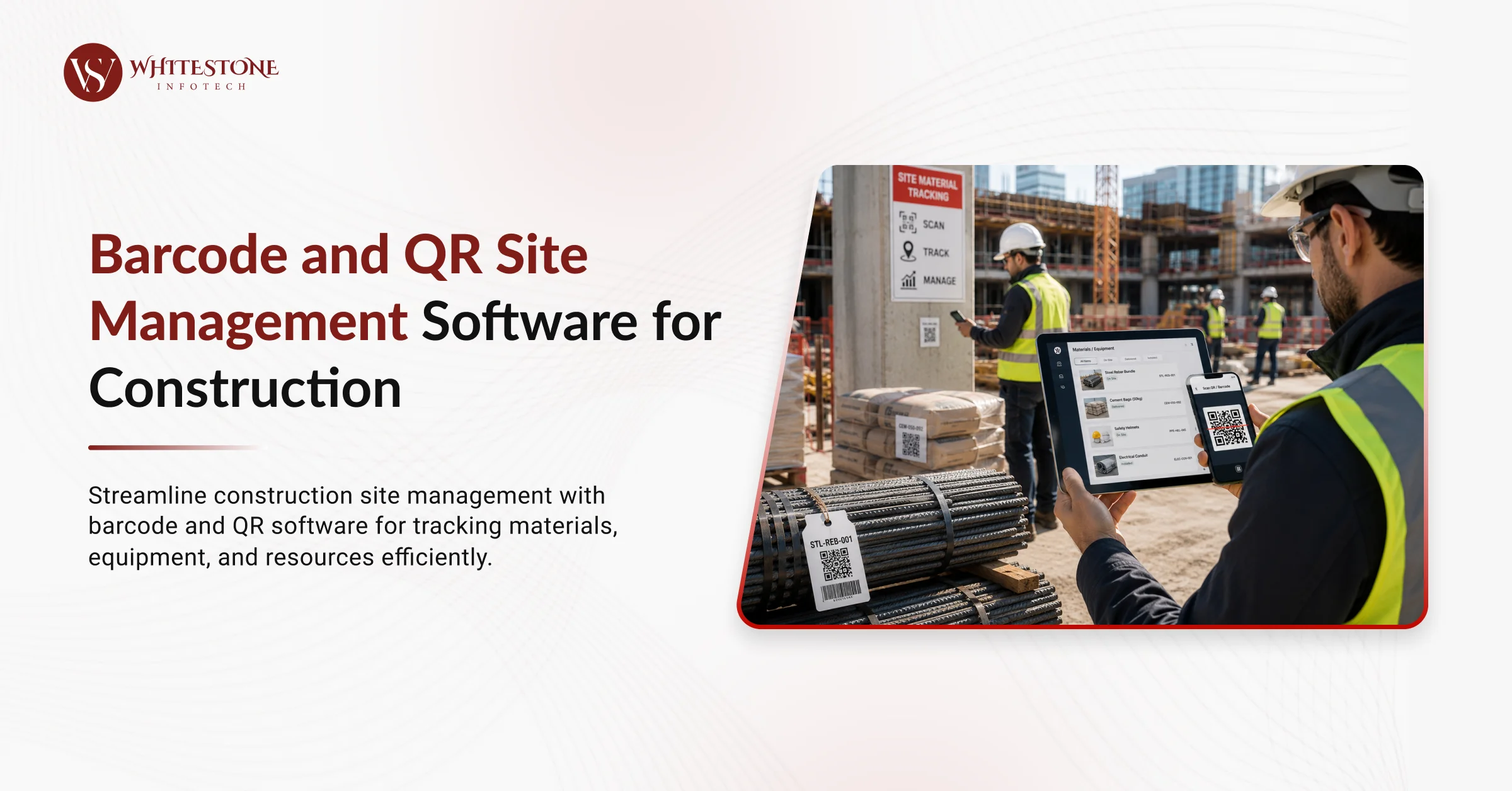
A UK site manager we spoke to last month had labelled 400 rooms with paper stickers in week one of second fix. By week four, 60 percent were gone or illegible. His snagging team was back to describing rooms by paint colour and window position. His QS could not verify which materials were where.
That is the QR site management conversation across UK construction in 2026. The concept is not new. The physical reality of UK sites (rain, mud, hi-vis solvents, forklift knocks) has punished platforms that treated QR as a nice-to-have. Vendors and custom builds that got the weatherproofing and workflow right ship value.
This article is a candid buyer's guide for project directors, HSE managers, and operations directors. Which processes actually benefit from QR. The weatherproofing reality nobody at the vendor demo mentions. The 2026 UK vendor landscape. Real cost bands. And where custom pays back over off-the-shelf.
What Barcode and QR Site Management Actually Enables
Six use cases where QR earns its place on UK sites.
Room-level snagging and history. Every room, plant space, or defined location gets a QR tag on a permanent surface. Scan the tag to see all snags open and closed for that room, subcontractor responsibilities, sign-off history. Ends the "which room was that?" problem.
Plant and asset tracking. Excavators, generators, hoists, MEWPs, welfare units. QR or barcode tag with location, service due date, current operator. Scan to check status, log usage, flag issues.
Tool tracking. Especially for larger contractors with tool stores. Loan out, track location, chase returns. Reduces tool loss 30 to 60 percent in typical operations.
Materials on site for interim valuation. Materials delivered to site are billable if properly evidenced. QR-tagged pallets with photo and location evidence make the QS's application defensible.
Permit and RAMS access at the workface. Scan the location tag, see relevant RAMS, active permits, and hazards. Reduces the "I did not know that permit was in force" incidents that show up in HSE audits.
O&M documentation and handover. Every plant room, service, and asset with a QR tag. At handover, FM team inherits the trail. Ten years later, someone scans a boiler tag and gets the install date, servicing history, warranty status, manual. This is where the QR programme pays back for decades.
The CIOB research and policy hub publishes data on digital site adoption; programmes designed for handover-to-O&M continuity deliver longer-term ROI than programmes focused only on construction phase.
Which Processes Fit QR (and Which Do Not)
QR works when the physical location is stable and the information needed at that location is not. Room-level snagging fits because rooms do not move but snag lists change constantly. Plant tracking fits because assets move but their identity does not.
QR does not fit for fast-moving temporary work (temporary formwork, scaffolding movement, day-to-day materials in transit). Attempts to QR-tag these usually fail because the label falls off or becomes stale within days.
Four questions to test whether a process fits QR:
Is the physical location stable for at least a month? If yes, QR fits.
Does the information tied to that location change over time? If yes, QR delivers value by giving current data on scan.
Can the QR tag survive the environment? Determines the material choice, not whether to use QR.
Does the workforce have phones on site with scanning capability? In 2026 almost always yes, but confirm rather than assume.
Processes that pass all four are QR candidates. Processes that fail one or more do not benefit from QR regardless of vendor pitch.
The 2026 UK Vendor Landscape
Sitemate. UK-focused site H&S platform with QR features for asset tagging and location-based workflow. £20 to £45 per user per month. Best for smaller UK contractors wanting native UK site conventions with QR built in.
Assignar. Australian platform with UK footprint. Strong on equipment and subcontractor tracking with QR-driven workflow. £25 to £60 per user per month. Best when subcontractor and plant management is the primary need.
Fieldwire (Hilti-owned). US mid-market with location-based task management. QR support for site locations and asset tagging. £30 to £75 per user per month. Best for medium contractors wanting site-focused platform with QR.
PlanRadar. European SaaS strong on defects and inspections. QR-linked locations for snagging and RAMS access. £30 to £90 per user per month. Best when defects are the primary QR use case.
Custom builds. Often the right answer for portfolio developers wanting construction-to-O&M continuity, main contractors above £100m turnover with unusual workflow, or where QR integrates with broader bespoke construction and asset platforms.
The GOV.UK BIM guidance sets out how BIM asset data should support handover; QR tags are increasingly the physical link between BIM-based digital asset registers and real-world facilities management.
Site Reality: Weather, Dirt, and Physical Damage
The single most important design decision in a QR site programme is the tag material. Wrong material means the whole programme fails within weeks.
Paper labels. Fail within days to weeks in UK weather. Only appropriate for temporary indoor use.
Vinyl weatherproof labels. Last 1 to 3 years outdoor, 3 to 5 years indoor. Reasonable cost (£0.50 to £2 per label). Suitable for medium-term construction phase use.
Aluminium tags. Last 10-plus years in most environments. Higher cost (£2 to £5 per tag). Best for permanent installations that persist into O&M.
Etched metal. For heavy plant, machinery, structural elements. Decades of readability. Cost £3 to £8 per tag depending on size.
Screen-printed on painted surface. Direct print of QR onto wall or door frame during finishing. Lasts as long as the paint. Ideal for room-level tags where longevity matters.
Vendors that sell QR platforms without discussing tag material are selling a system that will fail. Physical tag budget should typically be 5 to 15 percent of total platform cost.
Real 2026 Cost Bands
Off-the-shelf annual cost (fully-loaded for typical mid-market UK contractor):
Sitemate: £8k to £30k
Assignar: £15k to £45k
Fieldwire: £15k to £45k
PlanRadar: £15k to £60k
Custom build:
Proof of concept: £30k to £70k over 8 weeks
Pilot: £70k to £150k over 3 to 4 months
Production: £180k to £400k over 6 to 10 months
Physical tag cost. £0.20 to £5 per tag depending on material. For a large residential development with 200 rooms plus plant spaces plus assets, expect 800 to 1,500 tags totalling £1,500 to £6k in physical material.
Add £15k to £60k per year in ongoing platform run cost. Add £30k to £100k per year if you keep in-house engineering.
Break-even for custom against off-the-shelf typically lands at year two for portfolio developers wanting construction-to-O&M continuity, or contractors above £100m turnover with unusual workflow.
What We Learned Building a UK Property Platform
We built a QR-driven site management platform for a UK property developer with 30-plus concurrent sites. Two lessons transfer directly.
Tag material choice is a first-class design decision. Our first pilot used vinyl labels. Six months in, 20 percent of outdoor tags were unreadable. Second pilot used aluminium for permanent locations and vinyl for temporary. Retention improved to 90-plus percent. This determines whether the programme succeeds.
Construction-to-O&M continuity is where the compounding value lives. Programmes that treated QR as a construction-phase tool captured construction value. Programmes that designed for handover continuity delivered value for years post-handover. FM teams inheriting a QR-tagged building can manage it more efficiently for its full operational life. See our earlier post on construction project management software UK for the broader platform pattern.
You can see our shipped work at our portfolio. If you want a candid conversation about your QR programme, book a QR site software call with WhiteStone.
Common Failure Modes
Three failure modes we see repeatedly.
Choosing tag material wrong. Paper labels in an outdoor UK site. Vinyl on machinery vibrations. Tags failing within weeks. Programme abandoned.
Skipping O&M design during construction rollout. QR tags on temporary construction tags only. At handover, FM team gets nothing. Long-term value never materialises.
Buying platform without physical tag budget. Software delivered. Physical tag budget forgotten. Programme stalls at pilot because tags never got ordered or installed properly.
Frequently Asked Questions
How do QR codes work on a real construction site?
Worker scans QR tag with phone camera or in-app scanner. Software returns location-linked data: current snags, permits, RAMS, drawings, asset history. Tag lives on room door, plant, tool, or material. Weatherproof material choice determines whether tags survive site conditions.
Which processes are best suited to QR scanning?
Room-level snagging and history, plant and asset tracking, tool loans and returns, materials on site for valuation, permit and RAMS access at workface, and O&M handover documentation. Fast-moving temporary items (formwork, scaffolding movement) generally do not fit.
Can QR codes survive site conditions?
Only with the right tag material. Paper fails in days. Vinyl weatherproof lasts 1-3 years outdoor. Aluminium lasts 10-plus years. Etched metal lasts decades. Screen-printed onto painted surfaces lasts as long as the paint. Programmes that skip tag material selection fail regardless of vendor.
How does QR integrate with BIM and O&M?
BIM asset register holds digital identity of every plant item and space. QR tag on the physical asset links to the digital identity. On scan, worker sees BIM-registered data (specs, warranties, service records). At handover, FM inherits the trail. This is where QR pays back for the life of the building.
Should we buy or build QR site management software?
For most UK contractors under £75m turnover, off-the-shelf covers essential construction-phase needs. Custom becomes defensible for portfolio developers wanting construction-to-O&M continuity, contractors above £100m turnover, or where QR integrates with a broader custom platform.
The One Thing to Remember
Barcode and QR site management succeeds or fails on two things: whether the tag material survives real UK site conditions, and whether the programme is designed for handover continuity rather than construction-only. Vendors that sell software without discussing material choice are selling half a solution. Programmes that treat QR as a construction phase tool capture a fraction of the value that programmes designed for the full construction-to-O&M lifecycle deliver.
If you want a candid conversation about your specific programme, browse our custom software development services or come to the call.