A UK enterprise CTO we spoke to last month runs an operations team of 45 across three regions. His managers were receiving 150-250 emails per day each; his ops directors were closer to 400. Time-motion data his COO ran showed 5 to 8 hours weekly per manager spent on email triage before real work started. He had Microsoft Copilot in the M365 tenant already, was piloting Superhuman AI on the sales team, and had a Front AI proposal on the desk. His compliance officer had flagged all three for a DPIA review under UK GDPR, and he wanted to know which was safe to deploy at scale.
That is the AI email triage enterprise conversation across UK and US enterprises in 2026. Email volume has grown 15-25 percent annually across knowledge-work roles, per Gartner productivity research, and enterprise teams cannot hire out of the problem. AI triage is the productivity lever, but the deployment risk is real: auto-archiving a legitimate customer email is worse than the productivity gain, and GDPR non-compliance is worse than both.
This article is a candid guide for CTOs, Heads of Operations, and DPOs. What it does. Six vendors that ship. UK ICO privacy rules. Real cost bands. What we learned about confidence-band routing. When it is the wrong answer.
How AI Email Triage Actually Works for Enterprise Inboxes
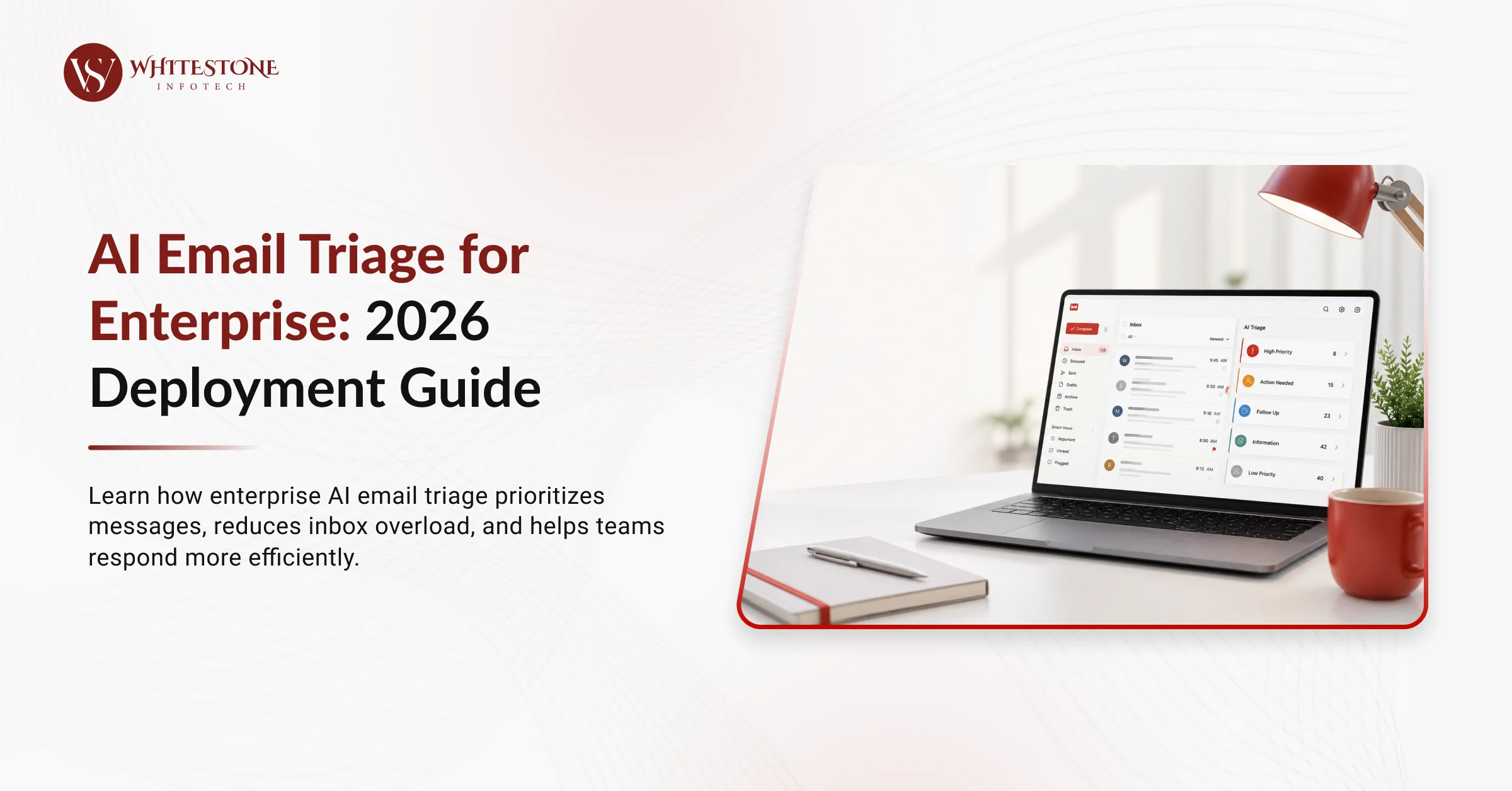
Modern AI email triage sits on the mail server or on top of the client. Every incoming email goes through five steps.
Classification. An LLM reads the message against a policy taxonomy: urgent customer, internal update, newsletter, personal, spam, sales enquiry, complaint, invoice, meeting request. Categories are configurable per team.
Confidence scoring. Every classification returns with a confidence value (typically 0-100). This is the layer that separates safe deployments from incidents.
Priority scoring. A second layer scores messages against the user's actual work: current projects, escalation history from the sender, calendar context (meeting participants get priority), thread continuity (an active thread stays hot).
Routing. High-confidence low-priority is auto-handled (archived, auto-replied, or delegated). Medium-confidence is flagged for human review before any action. Anything high-priority or low-confidence surfaces to the user immediately.
Learning. User actions feed back: emails the user opens quickly vs archives immediately, whom they respond to fast vs slow, what they mark as urgent. The model retunes weekly or continuously.
The 2024-to-2026 shift is not any single step. It is the maturity of confidence scoring across all five. Modern engines return a score for every action; older ones auto-actioned everything or nothing and burnt user trust within a fortnight.
UK ICO Privacy Rules for AI Email Triage in 2026
The UK Information Commissioner's Office ICO explicitly named AI email triage in its 2025-2026 guidance as "high-risk data processing" under UK GDPR. That triggers four requirements before any enterprise deployment.
DPIA. Document what the AI processes, why, and what the risks are. Not optional; this is what the ICO will request on any incident review.
Purpose limitation. State exactly what the AI is doing (triage, categorisation, routing) and what it is not doing (no external LLM training on employee email, no cross-account data mixing). Written down; auditable.
Data minimisation. Only the email content and metadata needed for triage; nothing else. No third-party enrichment on sender personal data without a lawful basis.
Human oversight. Every auto-action must be reversible; a human review path for medium-confidence classifications is non-negotiable; users must be able to see and override any AI decision.
Compliance cost is real (2-6 weeks of DPO time), but skipping it is worse. UK enforcement action on AI-driven data processing intensified through 2025-2026; the ICO now treats "we deployed a productivity feature without a DPIA" as evidence of negligence.
Superhuman AI vs Microsoft Copilot vs Front AI vs Missive vs Custom
Vendor | Best for | Rough cost | Data residency |
Microsoft Copilot for Outlook | Enterprises on Microsoft 365, familiar admin surface | £24.70/user/month on top of licence | EU/UK regions available |
Superhuman AI | Sales, exec, and comms-heavy teams; fast keyboard-first UX | £30-£50/user/month | US only for most tenants |
Google Duet AI for Gmail | Workspace-first enterprises | ~£26/user/month on top of Workspace | EU/UK regions available |
Front AI | Shared inboxes, customer support teams | £75-£100/user/month all-in | EU/UK regions available |
Missive AI | Small-to-mid teams needing shared inbox + chat | £15-£30/user/month | US and EU |
Salesforce Einstein for Service | Support teams on Service Cloud | Bundle-dependent, usually £75-£200/user/month | Multi-region |
Custom builds | Above 200 users, unusual policy, strict data residency | £80k-£400k build, £40k-£150k annual run | As designed |
Choice heuristic by environment. Microsoft 365 enterprises: Copilot as default. Workspace enterprises: Duet AI. Support-heavy teams with shared inboxes: Front AI or Missive. Sales-heavy teams: Superhuman. Custom builds only above 200 users or where data residency rules out every vendor above (rare in 2026; most now offer UK-region hosting).## Real 2026 Cost Bands and Where the ROI Comes From
Cost anchor for a UK enterprise with 60 users.
Microsoft Copilot (existing M365): £17,800 annually
Superhuman AI: £22,000-£36,000 annually
Front AI: £54,000-£72,000 annually
Custom equivalent: £120,000+ year one, £60,000+ ongoing
Where the ROI actually shows up. Reclaimed time per user: 5-8 hours weekly if triage is tuned. For a 60-user team, that is 300-480 hours weekly of restored productive time; at a £45/hour blended internal rate, £700,000-£1.1m annually. Payback is 4-8 weeks on any credible vendor. If payback is longer, the deployment is being fought by users (usually the auto-archive threshold is set too aggressive).
Hidden costs. DPIA and compliance sign-off (£8k-£40k one-off). User training (£3k-£15k). Custom policy taxonomy definition (£5k-£20k if the vendor default does not match your workflow). Budget these explicitly.
What We Learned Building Confidence-Band Routing on IELTSArena
WhiteStone built IELTSArena, our AI-powered IELTS platform used by students in 40+ countries. The parallel to AI email triage is direct.
The hard problem on IELTSArena was not scoring an essay. Any modern LLM returns a plausible IELTS band.
The hard problem was preventing bad AI outputs from overwriting good human judgement, and giving reviewers a documented reason when they disagreed with the AI. Solution was rubric-anchored prompting with three-band confidence: the model scores against explicit criteria, returns a confidence value per criterion, and any low-confidence score routes to a human reviewer before publication.
Email triage is the same architecture. Three bands. High-confidence auto-actions. Medium-confidence surfaces for user review with the AI's reasoning shown. Low-confidence never triggers an action. Any vendor that does not show you the confidence score behind an auto-action is fragile in production; the reversibility path the ICO requires becomes theoretical rather than usable.
See our portfolio of shipped work. For a scoped conversation for your stack, book an email triage consultation with WhiteStone.
Common Failure Modes
Deploying without a DPIA. Team turns on Copilot or Superhuman across the enterprise without documented purpose-limitation and data-minimisation review. First customer complaint triggers an ICO enquiry; deployment paused for 4-8 weeks; C-level trust erodes.
Setting the auto-archive threshold too aggressive. Confidence threshold at 70 percent; AI auto-archives legitimate customer emails weekly. Users lose trust within a fortnight. Fix: start at 90-92 percent; lower only after 30 days of clean human-review data.
Buying enterprise-tier when a native suffices. M365 enterprise already has Copilot bundled at £24.70/user/month; team buys Front AI at £90/user/month. Feature overlap 80 percent.
Frequently Asked Questions
How does AI email triage work for enterprise inboxes?
An LLM classifies each incoming email against a policy taxonomy, scores the classification with a confidence value, then routes it: high-confidence low-priority is auto-handled, medium-confidence flagged for human review, high-priority or low-confidence surfaces to the user. Modern engines learn from user actions and retune weekly or continuously.
Is AI email triage GDPR-compliant in the UK?
Yes, when deployed with a DPIA, purpose limitation, data minimisation, and documented human oversight. The UK ICO named AI email triage as high-risk data processing in its 2025-2026 guidance; DPIA is required before deployment. Vendors with UK-region hosting (Copilot, Duet AI, Front AI, Missive) reduce data-residency risk substantially.
Superhuman AI vs Microsoft Copilot vs Front AI: which for enterprise?
Microsoft 365 enterprises: Copilot as default (£24.70/user/month, bundled admin, UK-region hosting). Workspace enterprises: Duet AI. Support-heavy teams with shared inboxes: Front AI (£75-£100/user/month). Sales-heavy comms-first teams: Superhuman AI (£30-£50/user/month). Custom builds only above 200 users or where data residency rules out every vendor above.
How much does AI email triage cost per user?
Microsoft Copilot: £24.70/user/month. Google Duet AI: ~£26/user/month. Superhuman AI: £30-£50/user/month. Missive AI: £15-£30/user/month. Front AI: £75-£100/user/month all-in. Salesforce Einstein: £75-£200/user/month bundle-dependent. Custom: £80k-£400k build plus £40k-£150k annual run.
What data does AI email triage actually process?
Email content (subject, body, attachments), metadata (sender, recipient, time, thread ID), user action history. Under UK GDPR data minimisation, nothing else without a documented lawful basis. Reputable vendors do not use enterprise email content to train external models; check the DPA before signing.
When is AI email triage the wrong answer?
When email volume is under 50 per user per day (productivity gain is marginal). When emails are mostly external customer messages requiring individual judgement (auto-actions create risk). When compliance environment (financial services, healthcare, legal) does not permit auto-action on client communication. In those cases, AI-assisted human triage beats full auto-triage.
Why choose WhiteStone Infotech for AI email triage?
We built IELTSArena where confidence-band routing on AI outputs is the core discipline, used by students in 40+ countries. We have shipped 50+ custom software and AI products across the UK, US, and Europe. Every email triage engagement starts with the DPIA scoping, the confidence-threshold design, and the vendor-vs-custom call before any code. Contact WhiteStone Infotech at whitestoneinfotech.com/contact.
The One Thing to Remember
AI email triage for enterprise works in 2026 when three things are true: the DPIA is documented, confidence thresholds are set high (90+ percent) for auto-actions, and users can see and override any AI decision. On any credible vendor, payback is 4-8 weeks. Native tools (Copilot, Duet AI) usually beat premium alternatives on total cost unless shared-inbox or support-desk features are needed. Skip the DPIA and the productivity gain is a compliance incident waiting to happen.